A Morning Skincare Routine That Actually Fits Real Mornings

A morning routine has one job the evening's does not. It has to hold up outside the bathroom for the rest of the day. That single difference decides what belongs in it, and most published morning routines ignore it entirely.
Key Takeaways
- The morning protects and the evening removes. They are not the same routine run twice, so a morning built from an evening list is both too long and missing the step that matters.
- Sunscreen is the one step nothing else covers. The American Academy of Dermatology asks for broad-spectrum protection, SPF 30 or higher, water resistance, and at least a teaspoon for the face.
- The morning cleanse is a genuine question, not a rule. The answer changes with skin type, and both answers come from dermatologists.
- Order only becomes non-negotiable at the end. Sunscreen goes on last, and it goes on dry skin.
- A water-free tallow cream does the moisturize step in one pass. It carries no SPF, and no fat does.
Morning and Evening Are Not the Same Routine Twice
By evening your face is carrying a day of sunscreen, sweat, city air and whatever your own oil glands added. There is something real to take off. Cleveland Clinic says it through dermatologist Kathryn Anderson: if you only wash once a day, do it in the evening, after you have been out and about.
The morning is the reverse. Nothing has accumulated except what your skin made while you slept, and the work ahead is not removal but coverage. You are putting a surface on your face that has to survive a commute, a window seat and a walk to lunch.
This is why the seven-step morning routine reads so strangely once you notice it. It is an evening routine with sunscreen bolted onto the end, and the wait times between layers were designed for someone who is not going anywhere. If your real question is how few products you can own, that is a different article and one product per job is the frame that answers it. This one is about a specific window of time, usually a short one.
Does the Morning Cleanse Earn Its Place?
For most people yes, and this is still the step with the most legitimate variation of any in the routine.
Cleveland Clinic's position is that most of us should wash twice a day, once in the morning and once at night. Dr. Anderson attaches two caveats, and both are useful. For oily or acne-prone skin she calls washing twice a day vital. For skin that leans dry or sensitive she offers the alternative directly: wash in the morning with water only, and use a cleanser at night. She also notes that overwashing can lead to drier skin, since every wash takes some natural oil along with the grime.
FATCO's own guidance leans the same way, toward rinsing with water in the morning rather than reaching for a cleanser. The gap between that and the dermatology advice is narrower than it looks. Both are arguing about how much you take off, not whether you stand at the sink.
So the honest version is that what you wash with matters more than whether you wash. The cleanser formats differ mostly in how aggressively they strip, and a morning wash that leaves your face tight has told you something about the product, not about morning washing.
Wash in the morning if you sweat overnight, if you run oily, or if you go to bed in something rich enough to still be there at seven. Rinse instead if your skin feels tight afterwards, every time.
The Order, and Where It Actually Changes Anything
Thinnest to thickest is the standard advice, and with two or three products it is close to self-executing. The lighter thing is usually the thing you want under the heavier thing, and you will do it without thinking.
The order stops being a preference at the end. Sunscreen goes on last, over everything else, and the AAD is specific that it goes on dry skin fifteen minutes before you go outdoors. Note where that number is attached. It sits between sunscreen and the front door, not between your own layers.
That has one practical consequence worth planning around. A rich, water-free cream needs a little time to settle, and sunscreen dragged over a face that is still slick either goes on unevenly or gets skipped. On a four-minute morning, the fix is a thinner layer of cream rather than a race, because a thin layer settles faster than a generous one.
Sunscreen Is the Step With No Substitute
Everything else in a morning routine has an alternative, a workaround or a version you can skip for a week without consequence. This one does not.
The AAD's guidance is that the best sunscreen is the one you will use again and again. It just has to offer broad-spectrum protection, an SPF of 30 or higher, and water resistance. For the face it asks for at least one teaspoon, described as about the amount needed to cover the length of your index and middle fingers. That is more than most people use, and underapplying is the quietest way to lose what the bottle promised.
Reapplication has a rule and a boundary. When outdoors, the AAD says to reapply approximately every two hours, or after swimming or sweating, following the directions on the bottle. If your day is a desk and a window, the morning application is doing the work.
The same page carries a warning for anyone whose plan is a moisturizer with SPF in it. Those products are convenient, and they still need reapplying approximately every two hours outdoors, which a moisturizer step is not going to get.
FATCO makes no sunscreen, and the reason is regulatory rather than philosophical. The FDA regulates sunscreens as drugs, so every SPF number sits on top of Drug Facts labeling, an approved manufacturer and standardized testing. Nothing rendered from an animal or pressed from a seed carries an SPF, and no FATCO product offers sun protection. Buy that step somewhere else.
What to Cut First When You Have Four Minutes
Ordered by what survives longest. Work down the list, not up it.
| Step | Keep it when | Cut it first when |
|---|---|---|
| Sunscreen | Always, including grey days and desk days | Never. This is the step the whole routine exists to deliver |
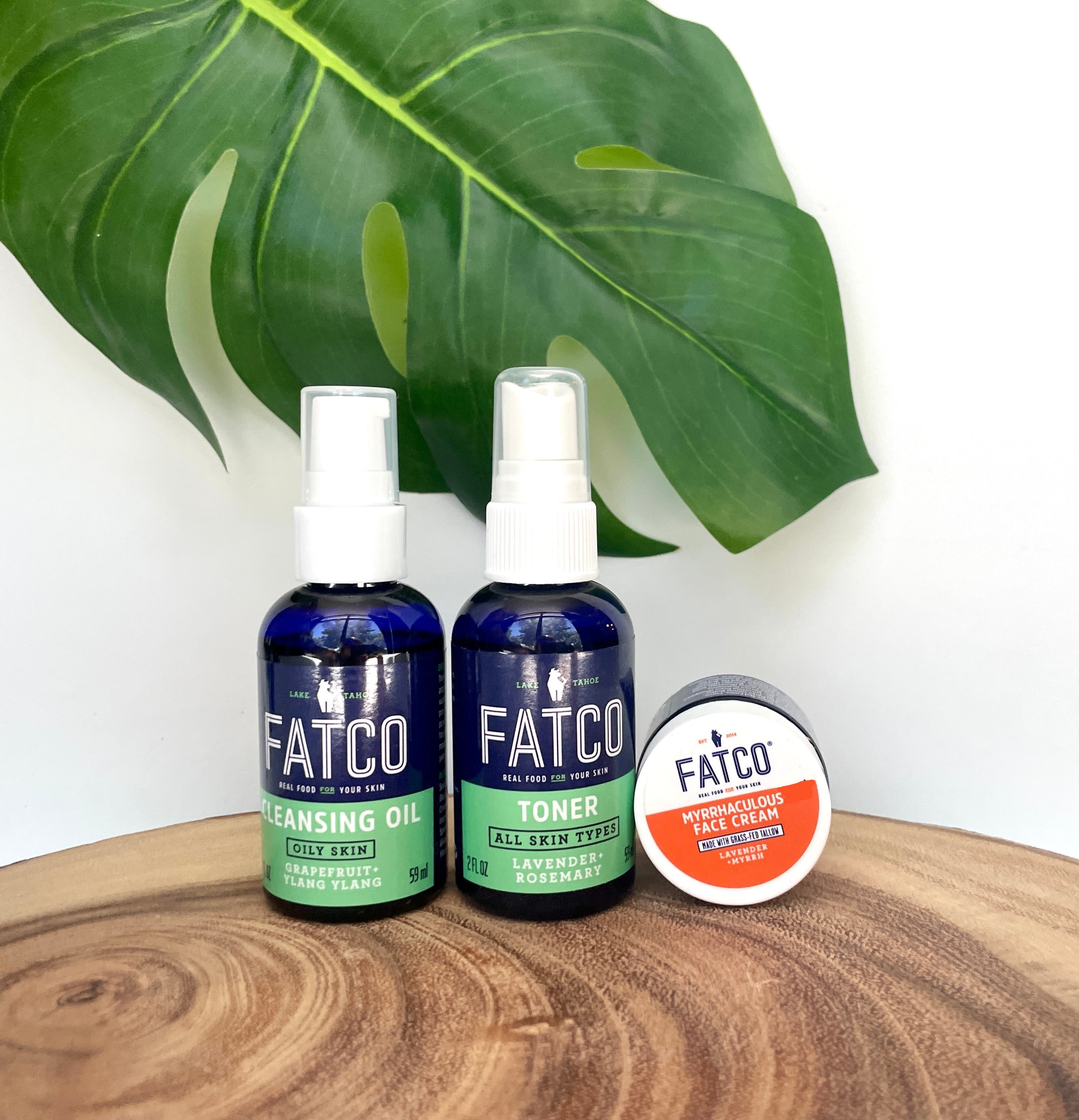
| Moisturizer | Your skin feels tight by mid-morning, or you need a smooth base under sunscreen. FATCO's Myrrhaculous Face Cream is the water-free version of this step | You are genuinely oily and sunscreen alone sits comfortably |
| Cleanse | You woke up oily, sweaty, or wearing last night's balm | Water does the job and your skin prefers it that way |
| Toner | You like what it does and you have the seconds | The morning is short. This is the first thing to go |
| Serum or essence | It is treating something specific you can name | You cannot say what it is for |
| Eye cream | You have one you like and it earns the step | Always, before anything above it goes |
The thing this list is really saying is that a two-step morning of moisturizer and sunscreen is a complete routine, not a compromised one. A six-step morning that quietly drops the sunscreen is the compromised one, and it takes four times as long.
The Honest Minimum, and Who Needs More
Two steps. Moisturize, then protect. Add a cleanse if your skin asked for one.
That is not a lowered bar. It is the routine that actually gets done every day, and consistency beats an elaborate one performed three mornings a week. A water-free cream is dosed by the pea rather than the pump. That is why dosing a tallow face cream goes further than the tube it replaced, in a single pass.
Two situations need more. If you are treating something specific under a dermatologist's direction, that treatment keeps its slot however short the morning is. And if you use anything that makes your skin more sun sensitive, the morning sunscreen stops being important and becomes the thing holding the rest together.
Got Questions?
Frequently Asked Questions
Q Does not washing your face in the morning cause acne?
Not on its own, though skin type changes the answer. Cleveland Clinic's dermatologist calls washing twice a day vital for oily and acne-prone skin. For skin that leans dry or sensitive, the same guidance offers water only in the morning and a cleanser at night as a reasonable alternative.
Q How often do dermatologists recommend washing your face?
Twice a day for most people, once in the morning and once at night. Cleveland Clinic adds that a third wash after vigorous activity can help if you are acne-prone, and warns that overwashing can lead to drier skin. Once a day is not really bad, and the evening is the wash to keep.
Q In what order should my morning skincare go?
Lightest textures first, heaviest last, with sunscreen always at the end. The AAD is specific that sunscreen goes on dry skin fifteen minutes before you head outdoors, so let a rich cream settle first. With two or three products, the order mostly sorts itself out.
Q What are the 7 steps of skincare?
The usual list runs cleanser, toner, essence, serum, eye cream, moisturizer and sunscreen. Only the last two are doing work that nothing else covers in the morning, and the cleanse is conditional. The remaining four are optional extras, which is why a short morning routine is not a deficient one.
Q Should I wash my face in the morning if I have oily skin?
Yes. Cleveland Clinic's guidance calls a twice-daily wash vital for oily and acne-prone skin, and a clean surface gives sunscreen something even to sit on. Use a gentle formula rather than the harshest one you own, since a wash that leaves your face tight has taken more than it needed to.
Q What is the best skincare to use in the morning?
Whatever you will genuinely apply every day, which for most people is a moisturizer and a sunscreen. A water-free tallow cream suits dry and reactive skin because it shares fatty acids with the skin's surface lipids and needs no preservative system. Buy the sunscreen separately, since no fat carries one.
The FATCO Alternative
FATCO's catalogue fits a short morning almost by accident, because it was never built for a long one. There is nothing here for the morning cleanse on purpose, since water suits most people at that hour. For the moisturize step, Myrrhaculous Face Cream is tallow from grass-fed cows with coconut oil, shea butter and a stack of seed oils. No water, no preservative system, dosed a pea at a time. Read the panel first, because it carries lavender and myrrh essential oils. The Unmyrrhaculous version drops the myrrh and keeps the lavender, so neither is the pick if you are avoiding fragrance. For the third step, buy a real sunscreen elsewhere. We do not make one and we will not pretend a fat is one.
FATCO Tallow Skincare
Grass-Fed. Suet-Sourced. Dry-Rendered.