Building a Minimalist Skincare Routine Around Tallow

A minimalist skin care routine is not three products instead of ten. It is one product per job, with each product chosen to do more than one thing. Built on fats, that comes to two or three items for most people. It also has real limits, and the useful version of this article is the one that names them.
Key Takeaways
- One product per job beats a smaller product count. The jobs are cleaning, replacing lipids and blocking ultraviolet light. Everything else on the shelf is optional.
- A fat base collapses two jobs into one. Oil cleans without detergent, and a water-free balm fills and seals in a single pass.
- Fewer products means fewer variables. When your skin reacts, you can name the culprit in days rather than guessing across nine bottles.
- Tallow's case is compositional overlap, not a copy. Tallow and sebum both carry high proportions of palmitic and oleic acid, and the overlap is partial.
- Minimalism does not cover everything. Sun protection, retinoids and prescription treatment are not jobs a fat can take over.
A Minimalist Routine Is One Product Per Job
Count jobs, not bottles. A face routine has three: take off what the day left behind, put back the lipids that washing removed, and keep ultraviolet light off your skin. Toners, essences, eye creams and weekly masks are extras rather than missing steps.
The ten-step routine is not wrong so much as expensive. Every layer in it is thin and single-purpose by design, which is exactly why there are ten. That costs time each morning, and it costs something less obvious. Each product you add is one more variable you cannot isolate when your skin turns on you.
The common failure is cutting the wrong things. People drop from ten products to three, keep the foaming cleanser that started the tightness in the first place, and decide minimalism does not work for them.
The Three Jobs Any Face Routine Has to Cover
Cleaning. The usual mistake here is cleansing too harshly, not too rarely. Oil dissolves oil, so washing your face with oil lifts sebum, sunscreen and makeup without a detergent, and nothing has to be repaired afterwards. The American Academy of Dermatology arrives at the same place from the other direction, telling people to resist the urge to scrub and to cleanse gently instead.
One honest caveat belongs here. Oil cleansing suits shine better than it suits congestion, and FATCO's own guidance is to stick it out for at least two weeks and to oil cleanse once per day.
Replacing lipids. Washing removes some of the fat your skin uses to hold water in, and the moisturize step puts it back. A water-free balm is the efficient version, because nothing in the jar evaporates and no emulsifier or preservative system is needed to hold it together. A pea-sized dab covers a whole face, against the nickel-sized amount a lotion asks for.
Protecting. This is the job no fat can do. Nothing rendered from an animal or pressed from a seed carries an SPF, and no number can go on a product that has not been through standardized testing. The AAD's everyday advice is to apply sunscreen before you go outdoors, looking for broad-spectrum protection at SPF 30 or higher, plus water resistance. FATCO does not make a sunscreen, and the reason is regulatory rather than philosophical.
Why a Fat Base Collapses Two Steps Into One
Tallow is beef fat rendered down to a firm white block. USDA reference data puts it at 36 g oleic acid, 24.9 g palmitic and 18.9 g stearic per 100 g. Human sebum also carries palmitic and oleic acid in quantity, and that is the whole compositional argument for putting tallow on a face.
It is also worth stating where it ends. The overlap is partial. Your skin's leading monounsaturate is sapienic acid rather than oleic, and sebum carries squalene and wax esters that tallow has none of. Tallow is a fat your barrier can use, not a replica of what your barrier already makes. Grass-fed is FATCO's description of its sourcing rather than a federal standard, since the USDA withdrew its grass-fed marketing claim standard in 2016.
What that buys in practice is a short ingredient list and one product doing two jobs. The fats fill the gaps between surface cells and the layer on top slows water loss, in the same pass, with no water content to flash off ten minutes later. The tradeoff is real. It goes on as an oil and leaves a sheen for the first ten or fifteen minutes. That is why a tallow face cream suits dry and reactive skin far better than oily skin.
What a Short Routine Covers and What It Does Not
| What you want | A fat-based minimalist routine | What actually delivers it |
|---|---|---|
| Skin that is not tight by mid-afternoon | Yes | A water-free balm, morning and night |
| Makeup and sunscreen off at the end of the day | Yes | An oil or balm cleanser, wiped away with a warm cloth |
| Protection from ultraviolet light | No | A tested broad-spectrum sunscreen, SPF 30 or higher |
| Softer fine lines and more even tone | No | A retinoid, over the counter or prescribed |
| Moderate or severe acne brought under control | No | A board-certified dermatologist |
| A calmer barrier while a condition is treated | Partly | An emollient supports the skin; the condition needs its own treatment |
Where a Minimalist Routine Genuinely Falls Short
Three places, and none of them is solved by buying a nicer moisturizer.
Actives do things fats do not. Tretinoin was approved as a topical acne treatment in 1971, and dermatologists soon noticed it also boosts collagen and speeds the turnover of surface skin cells. No amount of fat does that. That same AAD guidance cuts both ways. Retinoids should not be used during pregnancy, and people with a lot of redness or inflammation are told to ask about rosacea therapies instead.
Sun protection is not negotiable at any product count. A two-step routine plus sunscreen is minimalist. A two-step routine that quietly drops the sunscreen is just a shorter routine with a hole in it.
A diagnosed condition still needs treating. A short routine is a good place to be while acne, eczema or rosacea is being treated, and a bad place to be instead of treating it. An emollient supports a barrier; it does not clear a condition. If you dislike something about your skin, the standing dermatology advice is to see a board-certified dermatologist, and simplifying your shelf is not a substitute for that.
How to Cut Down Without Wrecking Your Skin
- Subtract one product at a time and wait two weeks. Removing five things at once tells you nothing about which one was the problem.
- Cut the extras before the actives. The fourth serum is the cheap thing to lose. A retinoid or a prescription is not.
- Keep the sunscreen however short the routine gets. It is the one step whose outcome nothing else covers.
- Judge by late afternoon, not by minute one. A routine is working when your skin stops feeling tight at four in the afternoon.
Got Questions?
Frequently Asked Questions
Q How do you build a skincare routine from scratch?
Start with two products: a gentle cleanser and a moisturizer you will genuinely use twice a day. Add daily sunscreen as the third. Run that combination for two weeks before adding anything else, so you can tell what each new product is actually doing.
Q What is a PM routine?
A PM routine is the evening half of a skin care routine, done when the day's sunscreen, makeup and grime need removing. In a minimalist version it is two steps: cleanse, then moisturize. Nothing has to sit under sunscreen overnight, so richer textures work better after dark.
Q How often should you use a face mask in a weekly skincare routine?
A mask is an extra rather than a step you owe your face. Once or twice a week suits most skin, and gentle hydrating formulas can go higher. Frequency tracks the mask type and your barrier, which our guide to how often to do a face mask breaks down formula by formula.
Q Do I really need both shampoo and conditioner, or can I simplify my routine?
Most people want both, because they do opposite jobs. Shampoo goes on the scalp to lift oil and buildup, and conditioner moisturizes and detangles the hair afterwards. The place to simplify is wash frequency, which dermatology guidance ties to how oily your scalp actually gets.
Q What is a good summer skincare routine for dry skin?
The same short routine with the textures dialed back. Use a thinner layer of the same balm rather than switching to a watery lotion, and keep the sunscreen exactly as it was. Dry skin in summer is still dry, so stripping it harder is the wrong correction for shine.
Q How do you incorporate beef tallow into a skincare routine?
Swap it in at the moisturize step and change nothing else for two weeks. A pea-sized amount goes on slightly damp skin morning and night, in place of your lotion. Judge it on whether your face still feels tight late in the day, not on the sheen at minute one.
The FATCO Alternative
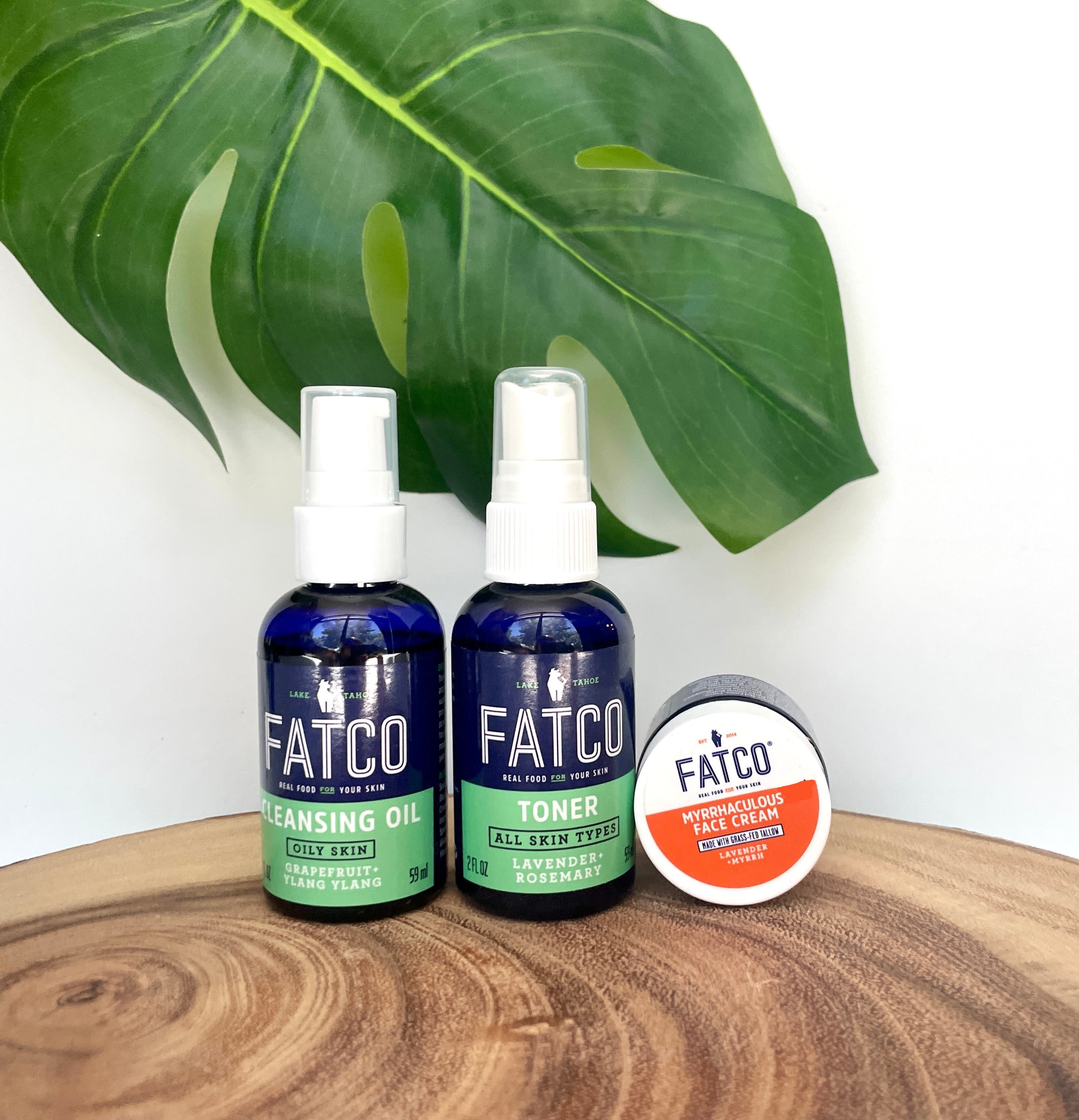
FATCO's catalogue is built for exactly this shape of routine. The cleansing oils are plant-oil blends that take a face off with a warm cloth and no detergent. The Myrrhaculous Face Cream is tallow from grass-fed cows blended with coconut oil, shea butter and a stack of seed oils, with no water and no preservative system. Two products, two of the three jobs. Buy the third elsewhere, because we do not make a sunscreen and will not pretend a fat is one. And read the panel before you commit: Myrrhaculous carries lavender and myrrh essential oils, so it is not the pick if fragrance is what you are avoiding.
FATCO Tallow Skincare
Grass-Fed. Suet-Sourced. Dry-Rendered.