Beef Tallow Moisturizer: How It Works on Skin and Who It Suits
A beef tallow moisturizer is a face cream built on rendered beef fat instead of water, so every gram you apply is lipid rather than something that evaporates off. It suits dry, normal, mature, and reactive skin best, and it is the wrong first pick for oily or congested skin.
Key Takeaways
- Tallow works by adding fats the skin barrier already uses. A 2024 Cureus review found four of the same fatty acids in tallow and in the epidermis, while noting thin human evidence.
- The texture is a balm, not a lotion. It arrives firm, melts at body heat, and leaves a sheen that most skin dulls down within fifteen minutes.
- A pea-sized amount is the whole dose. Applying more does not absorb faster. It just sits there.
- Dry, sensitive, and mature skin do best; oily skin often does not. The same review noted that plain tallow leaves an oily surface that may deter acne-prone users.
What a Beef Tallow Moisturizer Actually Is
Tallow is beef fat melted down, strained, and cooled into a firm white block. A tallow moisturizer is that same fat blended with plant oils and a little beeswax into something spreadable, with no water in the jar and so no preservative system. Quality varies with the source fat and the rendering method, but the mechanism below is the same either way.
How Tallow Works on the Skin's Surface
Your skin's outermost layer holds itself together with lipids. A 2024 scoping review in Cureus describes the stratum corneum as a bricklike arrangement of cells bound by a matrix of cholesterol, free fatty acids, and ceramides. The same review lists the main fatty acids in the epidermis as palmitic, stearic, palmitoleic, oleic, and linoleic acid. Tallow is rich in oleic, palmitic, stearic, and linoleic acid. That overlap is the entire compositional argument for putting it on your face.
Two honest limits belong here. The review's authors say plainly that no direct research exists on the exact mechanism by which tallow crosses the barrier. Most published work on tallow and skin also lacks human subjects, and the authors call for randomized controlled trials. The fair claim is compositional similarity, not proven superiority.
In practice that buys ordinary emollient behavior: fats settle into the gaps between surface cells, and a firm layer on top slows the rate at which water leaves.
A Tallow Moisturizer Versus a Water-Based Lotion
Open a conventional face lotion and water is usually the first ingredient. A StatPearls clinical review sorts moisturizer ingredients into three jobs: humectants that pull water in, occlusive agents that reduce transepidermal water loss, and emollients that fill the gaps between cells.
A lotion leans on all three, and the water is the part that leaves. Most of it evaporates within minutes, which is why a light lotion feels wonderful at minute one and unremarkable by hour three.
The same review flags a second wrinkle. Humectants can hydrate skin when humidity is above 70%, but the review says that more commonly they draw water from the deeper epidermis and dermis instead. It adds that some humectants increase water loss and worsen dryness when nothing occlusive goes over them.
A tallow cream skips that arrangement. Nothing evaporates, and every gram is emollient and occlusive at once. The tradeoff is real: no instant plumping, because no water is being deposited on the surface.
What the Texture and Absorption Are Really Like
Nobody warns you that it arrives solid. It is firm at room temperature and wants a few seconds of warming between your fingertips.
Once it melts, it goes on as an oil rather than a cream, and for the first ten to fifteen minutes your face will look shiny. That sheen is why first-time users assume they have used too much. Most skin takes it in and dulls down, but a matte finish this is not.
The 2024 review is direct about this. It noted that plain tallow fat left an oily surface, which may deter oily or acne-prone skin. If your face already runs shiny by lunchtime, that is a real objection.
Scent is the other surprise. Well-filtered tallow smells of very little; poorly filtered tallow smells like a roasting pan. FATCO describes its own tallow as dry-rendered and triple-filtered.
How to Apply a Tallow Face Cream
- Cleanse, then pat dry, leaving skin slightly damp rather than bone dry.
- Scoop a pea-sized amount. That is the whole face.
- Warm it between your fingertips until it turns to oil.
- Press and sweep it upward across your face and neck instead of rubbing it in.
- Wait ten minutes before deciding you need more.
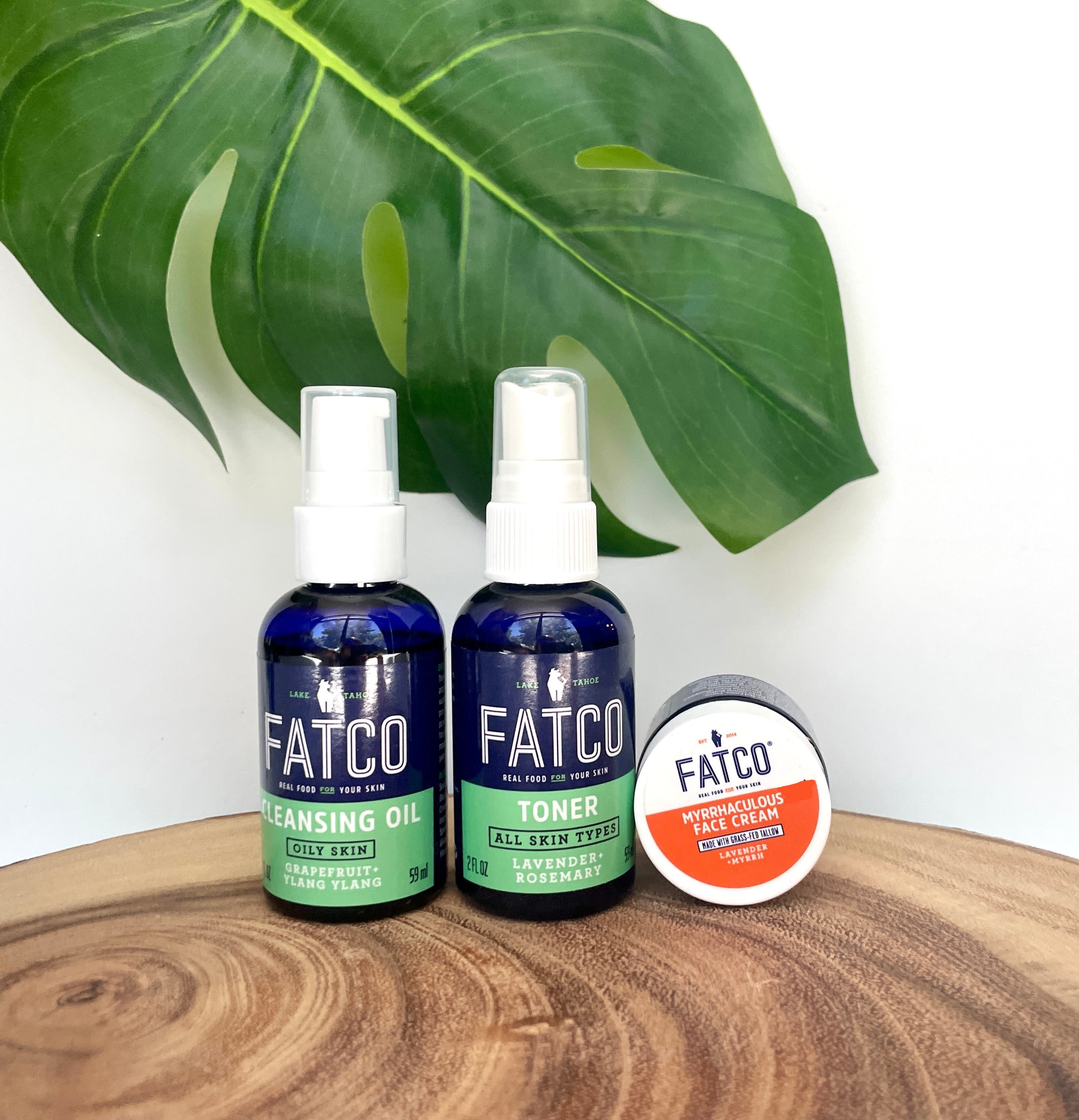
A pea covers more ground than it looks, since there is no water filler to spread. FATCO's Myrrhaculous Face Cream is dosed exactly that way, morning and evening. Below the neck, skin has fewer oil glands and tolerates a heavier layer, which is the job a tallow body butter is built for.
What to Expect in the First Two Weeks
Give it two weeks before you decide. That is the same adjustment window FATCO quotes for oil cleansing, and it is fair for any fat-based product replacing a water-based one.
Week one usually feels wrong. Skin trained on lotion reads the sheen as too much, so people halve the dose, and they are usually right to.
By the end of week two, watch for one thing: your skin no longer feeling tight in the late afternoon.
What is not normal is new breakouts where you do not usually break out. That is a reaction rather than an adjustment period, and not purging either, since tallow contains no exfoliating actives. Stop if it happens. Whether tallow suits acne-prone skin is genuinely unsettled.
Who a Tallow Face Cream Suits
- Dry skin. The clearest match.
- Sensitive or reactive skin. Short ingredient lists give fewer things to react to. People with eczema-prone skin often land here too, though tallow is an emollient and not a treatment for the condition.
- Mature skin. Oil production drops with age, so a lipid-replacing formula suits better than a light lotion.
- Normal skin in a dry season. Central heating and low humidity are exactly where humectant-led lotions underperform.
- Combination skin, selectively. Tallow on dry cheeks and nothing across an oily T-zone beats one product everywhere.
Who Should Skip It
- Oily, congested skin. The sheen is the problem, and the 2024 review named it. If you blot by noon, a lighter formula serves you better.
- Anyone with active inflammatory acne. A rich occlusive fat is not the right experiment during a flare. Work with a dermatologist first.
- Anyone who needs fragrance-free. Many tallow face creams are scented with essential oils. Myrrhaculous carries lavender and myrrh.
- Vegans. Tallow is an animal byproduct. Cruelty-free and vegan are not the same claim.
- Anyone whose results come from actives. A moisturizer will not do the work of a retinoid or an acid.
The Case Against Tallow
Dermatology's mainstream view is skeptical, and it deserves an answer rather than a detour. Cleveland Clinic argued in February 2026 that there is no evidence tallow does anything for skin beyond act as a natural moisturizer. The same piece said its thick consistency may trap oils and contribute to breakouts, and that unregulated tallow carries formulation and rancidity risks.
The first two land, and this article has already granted both. The evidence is thin, which is why the claim here is compositional overlap and ordinary emollient behavior, nothing more.
On pores, tallow has never been formally rated in the primary comedogenicity studies, and it stays off the commonly cited high-risk lists. Low risk is the fair position rather than a number. The rest of the formula matters as much. Some plant oils blended into tallow creams sit high on pore-clogging ingredient lists, coconut oil among them, and Myrrhaculous carries it second on the label. A finished formula behaves differently from an isolated ingredient, so treat those lists as a first screen and patch-test.
The regulation point argues for buying carefully, not for buying nothing. Ask for the source fat, the rendering method, and the full label. And accept the shelf life: with no water and no preservative, tallow eventually goes rancid.
Got Questions?
Tallow Moisturizer FAQ
Q Is beef tallow good as a moisturizer?
For dry, normal, and reactive skin, yes. Tallow is a water-free emollient whose main fatty acids also appear in the epidermis, so it fills and seals in one step. For oily or congested skin it is a poor first choice, because plain tallow leaves an oily surface.
Q Does beef tallow cream clog pores?
Not for most people, though it is not risk-free either. Tallow has no formal comedogenic rating and stays off the commonly cited high-risk lists, so low risk is the fair call. The bigger variables are the rest of the formula and how thickly you apply it. Patch-test on your jawline first.
Q Can I put beef tallow on my face every day?
Yes, and morning plus evening is the standard rhythm for a tallow face cream. Keep the dose to a pea each time, since amount matters more here than frequency. A water-free jar needs no preservative system, though the fat itself goes rancid eventually, so store it away from heat and light.
Q What are the disadvantages of tallow for skin?
Four honest ones: a sheen for the first ten minutes, no vegan version, thin human research, and a jar that can go rancid faster than a preserved lotion. A 2024 scoping review found most tallow studies lack human subjects and called for controlled trials. It is also the wrong texture for oily skin.
Q Can you use beef tallow cream on a baby?
Yes. FATCO's Baby Butta is the tallow moisturizer built for it, made with tallow, coconut oil, shea butter, and beeswax, and no essential oils. The face cream above is scented with lavender and myrrh, so it is not the pick for infant skin. Patch-test first, and check with your pediatrician.
The FATCO Alternative
Most face creams are mostly water. FATCO builds the other way around. Myrrhaculous Face Cream starts with tallow from the kidney fat of grass-fed, pasture-raised cows. Then coconut oil, shea butter, and a stack of seed oils including jojoba, rosehip, argan, and borage. No water, no parabens or sulfates, and a pea-sized amount morning and evening. If your skin is dry, reactive, or tired of formulas that fade by lunch, it is worth two weeks of your time.