Ancestral Tallow: The Skincare Heritage Worth Knowing

Ancestral tallow is simply rendered beef fat, the same ingredient that generations of people applied to their skin long before the first synthetic moisturizer existed. It is not a new discovery. It is a very old one, quietly coming back into view.
Key Takeaways
- Ancestral tallow refers to the traditional practice of using rendered animal fat in skincare, a habit documented across Egyptian, Roman, Indigenous, and European cultures for thousands of years.
- The nose-to-tail philosophy behind tallow treats every part of a raised animal as useful, making tallow both a practical and values-aligned ingredient for people who care about waste.
- Tallow contains fat-soluble vitamins, chiefly E with a trace of D, along with fatty acids like oleic and palmitic acid that it shares with the skin's surface lipids.
- The modern revival of ancestral tallow is driven by a broader shift toward simple, ingredient-transparent skincare and away from long synthetic formulas.
- FATCO is built on this exact heritage: real food-philosophy skincare that uses grass-fed beef tallow as its anchor ingredient.
What Is Ancestral Tallow?
Tallow is rendered fat from ruminant animals, most commonly beef or mutton. To make it, the raw fat (typically suet, the fat surrounding the kidneys and loins) is slowly melted down and filtered until it becomes a stable, shelf-steady fat with a mild, neutral character.
The word "ancestral" in ancestral tallow does two things. First, it signals origin: this is a historically used ingredient, not something invented in a lab. Second, it signals philosophy: the people using the word are placing tallow within a broader framework of traditional, whole-food approaches to health. That framework values foods and ingredients that worked for humans across generations, not just ones that are cheap to synthesize.
What ancestral tallow is not: it is not a certified category, not a regulated term, and not a clinical claim. It is a heritage and values argument. When a brand says "ancestral tallow," they are saying this ingredient has roots, not that it has been randomized in a clinical trial.
A Brief History of Tallow in Skincare
Animal fats appear in the cosmetic and medicinal records of almost every ancient culture that kept records at all.
Ancient Egyptian medical papyri describe a standard wound dressing of grease, honey, and lint, reapplied daily until the injury closed. The grease was the base that held everything else against the skin. This was not cosmetic vanity; it was practical skin maintenance in a dry, harsh climate.
One thing worth correcting, because it circulates widely in tallow writing: Galen's "cold cream" was not an animal-fat product. A 2023 review in Clinics in Dermatology traces the formula, ceratum Galeni, to a mixture of beeswax and oil of roses, an oil-and-water emulsion with no tallow in it. The Greco-Roman world used animal fats freely, but the most famous skin preparation to come out of it was plant and wax based. Where tallow does belong in that comparison is as a modern alternative to plant oils, which is a separate question from tallow versus olive oil on your face today.
Medieval European healers did lean on animal fats. A 2023 analysis in the Journal of Cosmetic Dermatology of De Ornatu Mulierum, the cosmetic text associated with Trotula and the Medical School of Salerno, identifies animal-derived ingredients running through the facial-care recipes alongside the plants and minerals. The ointments were deliberately greasy, which kept the active ingredients in contact with the skin.
In Australia, emu fat has a long documented history as a topical preparation in Aboriginal medicine, and the pharmacology literature still studies it under that description, including a 2010 paper in Inflammopharmacology.
None of these historical uses prove tallow is clinically superior to modern alternatives. They do show something real: across wildly different climates, cultures, and centuries, humans reached for rendered animal fat when they needed to protect and maintain their skin. That pattern is worth taking seriously, even if you want more than tradition before committing to a skincare ingredient.
The Nose-to-Tail Philosophy
Tallow sits at the heart of a broader idea: if you are going to raise an animal for food, use the whole animal.
Nose-to-tail eating is not a trend. It is how traditional cultures approached livestock by necessity and by ethos. Organ meats, bones, skin, marrow, and fat were all considered part of the yield. Wasting them was considered wasteful in both the practical and moral sense.
In modern food culture, that habit broke down. Supermarket cuts became boneless and bloodless. The parts of an animal that required knowledge to prepare, or that looked unfamiliar, quietly disappeared from most kitchens. The food system narrowed, and so did the definition of what "counts" as useful.
Tallow is the fat chapter of that story. When beef fat is rendered into tallow rather than discarded, it becomes a stable, long-lasting ingredient for cooking or skincare. It is genuinely a byproduct turned into a resource, not a euphemism. A well-raised animal that is fully used is, by most ethical frameworks, better than a well-raised animal that is partially wasted.
This is why tallow appeals to the same people who care about pasture-raised beef, regenerative farming, and ingredient transparency. FATCO's founding ethos is the nose-to-tail way of life, and tallow skincare is its most direct expression.
Why Tallow Works as a Skin Ingredient
The reason tallow has appeared in skincare across so many different cultures is not mysterious once you look at the chemistry.
Tallow shares fatty acids with the skin's surface lipids. USDA FoodData Central puts beef tallow at 36 grams of oleic acid, a monounsaturated fatty acid, and 24.9 grams of palmitic acid, a saturated one, per 100 grams, and both are also present in human sebum. That overlap is why tallow absorbs readily and settles into the skin's surface rather than sitting in a greasy layer on top of it.
Grass-fed tallow also carries fat-soluble vitamins, though less dramatically than the category's marketing suggests. The same USDA FoodData Central entry for beef tallow (fdcId 171400) lists 2.7 mg of vitamin E and 28 IU of vitamin D per 100 grams, with vitamin A and vitamin K both measured at zero. The Weston A. Price Foundation makes a narrower and more defensible point about sourcing: it reports that when animals are not grazing green grass, vitamins A and K go largely missing from their fat, and that vitamin D depends on the animals being raised in sunlight. That is a comparison between pasture and feedlot, not a claim that any tallow is loaded with vitamins.
The texture of tallow reinforces its usefulness. At room temperature it is semi-solid and creamy. On warm skin it melts into a light, nourishing layer rather than sitting on top like a barrier. Food-adjacent comparisons are apt here: applying tallow balm feels closer to rubbing a dab of very good butter into your skin than it does to applying a conventional lotion, and that is not a coincidence.
What tallow does not do: it does not treat or cure skin conditions. It is not a drug. It supports the skin's surface, soothes dryness, and may help maintain a healthy moisture barrier, which is exactly what well-formulated emollients are designed to do. The American Academy of Dermatology notes that emollients in moisturizers keep skin soft and smooth, and tallow functions in precisely this role.
Why the Modern Revival Is Happening
Tallow nearly disappeared from skincare in the 20th century. The cosmetics industry embraced petroleum-derived ingredients, synthetic emulsifiers, and plant-based oils partly because of cost, partly because of the cultural shift away from animal products in the mid-century, and partly because those synthetic alternatives were genuinely effective and much easier to standardize at scale.
That exit from animal fats was not driven by a finding that tallow was harmful. It was driven by economics and fashion.
The revival now is similarly cultural, but in the opposite direction. People reading ingredient labels are asking what is in their products and why. The clean beauty movement has created a market for shorter, more legible formulas. Consumers who care about regenerative agriculture are thinking about nose-to-tail principles. Social media has surfaced ancestral skincare routines that, a generation ago, would have stayed in family kitchens.
More people are having the conversation about why tallow belongs in a skin care routine openly, and the answers tend to be consistent: the ingredient is simple, the ingredients list is readable, and the results for dry and sensitive skin are typically good.
How to Choose Quality Ancestral-Style Tallow
Not all tallow is the same. How cattle are raised directly affects the quality of the fat.
Source matters most. Pasture finishing changes what ends up in the fat. The Weston A. Price Foundation's position is that vitamins A and K are largely absent from the fat of animals that have not been grazing green grass, and a 2010 review in Nutrition Journal found grass-finished cattle carry more beta-carotene and alpha-tocopherol, the precursors to vitamins A and E, in their meat than grain-fed cattle do. Look for explicit "grass-fed" or "grass-finished" sourcing, not just "natural."
Rendering process. High-quality tallow is rendered at low temperatures and filtered carefully to remove impurities. The result should be a clean fat with a mild, neutral smell. Color is not the test people assume it is: a yellow or ivory cast in grass-fed tallow comes from carotenoids picked up on pasture, which is FATCO's own published position, so pure snow-white is not automatically the premium signal. If tallow smells strongly of animal, it is likely poorly rendered or old.
Formulation. Some tallow skincare blends add beeswax for texture, essential oils for scent, or complementary plant oils like jojoba or rosehip. These additions can be good or neutral depending on your skin and preferences. Watch out for formulations that bury tallow behind a long list of synthetic ingredients, which largely defeats the purpose. With grass-fed tallow, how and where it is sourced is what separates quality from filler.
Format. Tallow skincare comes as plain rendered fat (versatile, no-frills), whipped balm (lighter texture, easier to apply), or blended balm (scented, often with complementary ingredients). For face and sensitive skin, whipped or lightly blended formulas tend to perform best.
Brand transparency. If a brand is not telling you where their cattle came from, it is worth asking why.
Got Questions?
Ancestral Tallow FAQ
Q What is ancestral tallow and why is it used in skincare?
Ancestral tallow is rendered beef or mutton fat, the same fat cultures worldwide applied to skin long before synthetic moisturizers existed. "Ancestral" points to that history and to a values framework favoring simple, traditional ingredients. People reach for it today as a moisturizer for that same reason: transparency and a short ingredient list.
Q Is ancestral tallow safe for skin?
Tallow has been applied to skin for centuries without widespread reported problems. Most people with dry or normal skin tolerate it well. Those with oily or acne-prone skin may prefer to patch-test first, since response varies. It is not a drug and does not treat or cure skin conditions.
Q What is the difference between ancestral tallow and regular tallow?
No formal difference exists. "Ancestral tallow" is a marketing and philosophical framing that places tallow within a traditional, whole-food approach to skincare. The actual ingredient is the same: rendered beef or mutton fat. Grass-fed sourcing and careful rendering are what distinguish quality tallow from poor-quality tallow.
Q Does grass-fed tallow have better nutrients than grain-fed?
Sourcing does change the fat, though less than most labels imply. The Weston A. Price Foundation reports that vitamins A and K are largely missing from the fat of animals not grazing green grass, and research in Nutrition Journal found grass-finished cattle carry more vitamin A and E precursors. USDA reference data still lists plain beef tallow at zero vitamin A and zero vitamin K.
Q What does tallow feel like on skin?
Tallow is semi-solid at room temperature and melts on contact with warm skin. A small amount spreads easily and absorbs without a heavy or greasy residue when applied lightly. The texture is often described as creamy and nourishing, closer to a rich balm than a conventional lotion.
Q Where can I find tallow skincare that actually uses grass-fed sourcing?
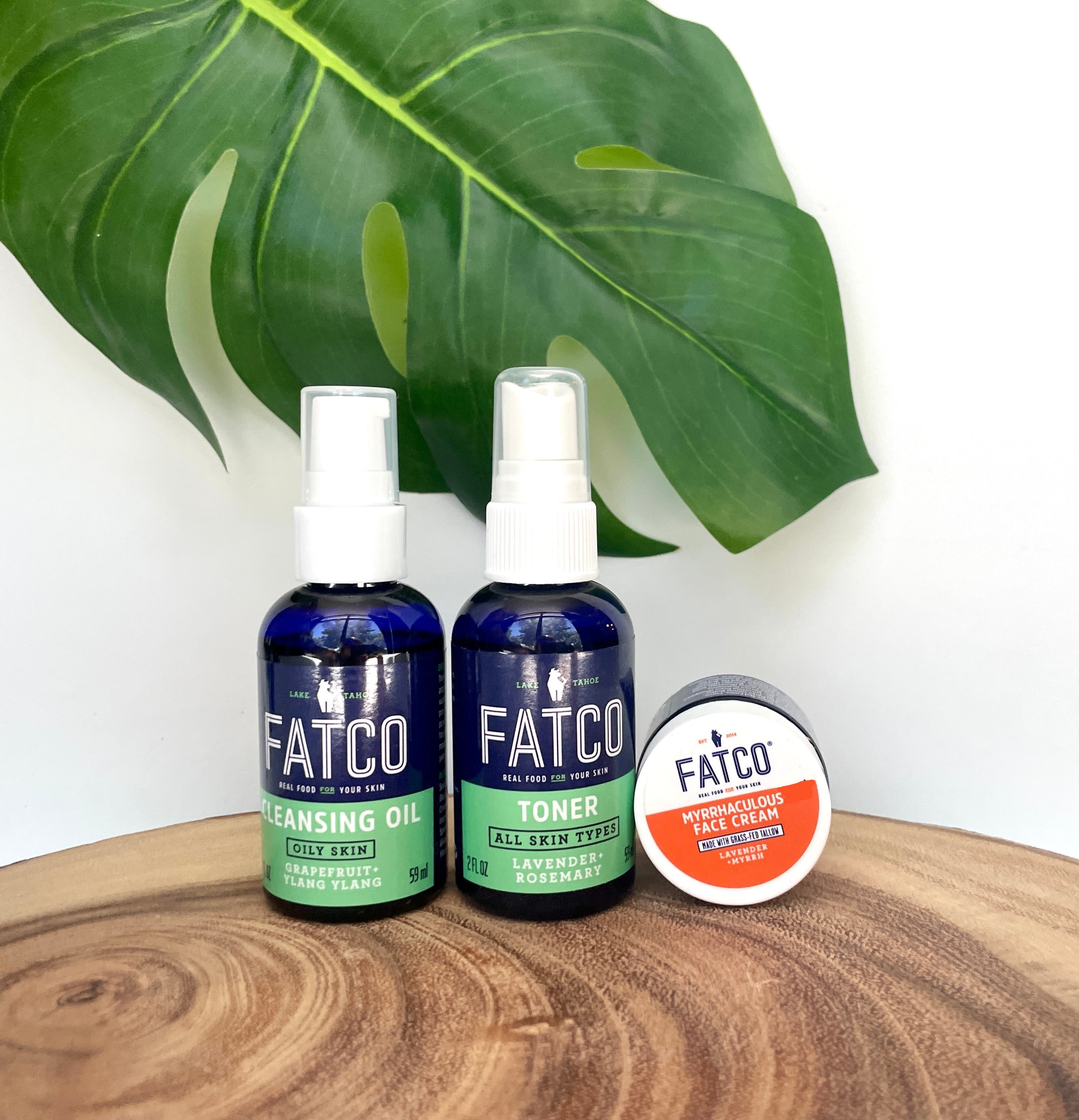
FATCO builds its entire product line on grass-fed beef tallow, sourced deliberately and rendered to a clean, consistent standard. Their face creams, body butters, and skin sticks keep the ingredient list short and legible instead of burying tallow behind filler, which is the point of choosing an ancestral-style brand in the first place.
The FATCO Alternative
FATCO exists because tallow should not be a niche ingredient that takes an internet search to find. Their face creams, body butters, and skin sticks use grass-fed tallow as the primary ingredient, kept as close to the ancestral formulation as a well-made modern product can get. No petroleum. No synthetic emulsifiers. No ingredient list that reads like a chemistry exam. Just rendered fat from well-raised cattle, the same thing generations of people trusted on their skin, made to a standard that holds up.