Beef Tallow vs Olive Oil for Skin: An Honest Comparison

Beef tallow and olive oil both moisturize skin, but they work differently. Tallow is roughly half saturated fat and shares its two most common fatty acids, palmitic and oleic, with human sebum. Olive oil is a plant oil dominated by oleic acid, which barrier research flags as a problem on inflammation-affected skin specifically. Neither is a universal winner. The better pick depends on your skin type and your goal.
Key Takeaways
- Tallow shares more fatty acids with skin surface lipids than olive oil does, but the overlap is partial. Skin's leading monounsaturate is sapienic acid, sebum carries squalene and wax esters tallow lacks, and stearic acid, tallow's third-largest fatty acid, is not a sebum fatty acid.
- Olive oil is overwhelmingly oleic acid. In a randomized study, twice-daily olive oil damaged the skin barrier on adult forearms, with the significant erythema effect showing up in volunteers who had a history of atopic dermatitis.
- Neither oil is "bad." They're different tools: tallow leans occlusive and saturated, olive oil is lighter, vegan, and easier to find on any grocery shelf.
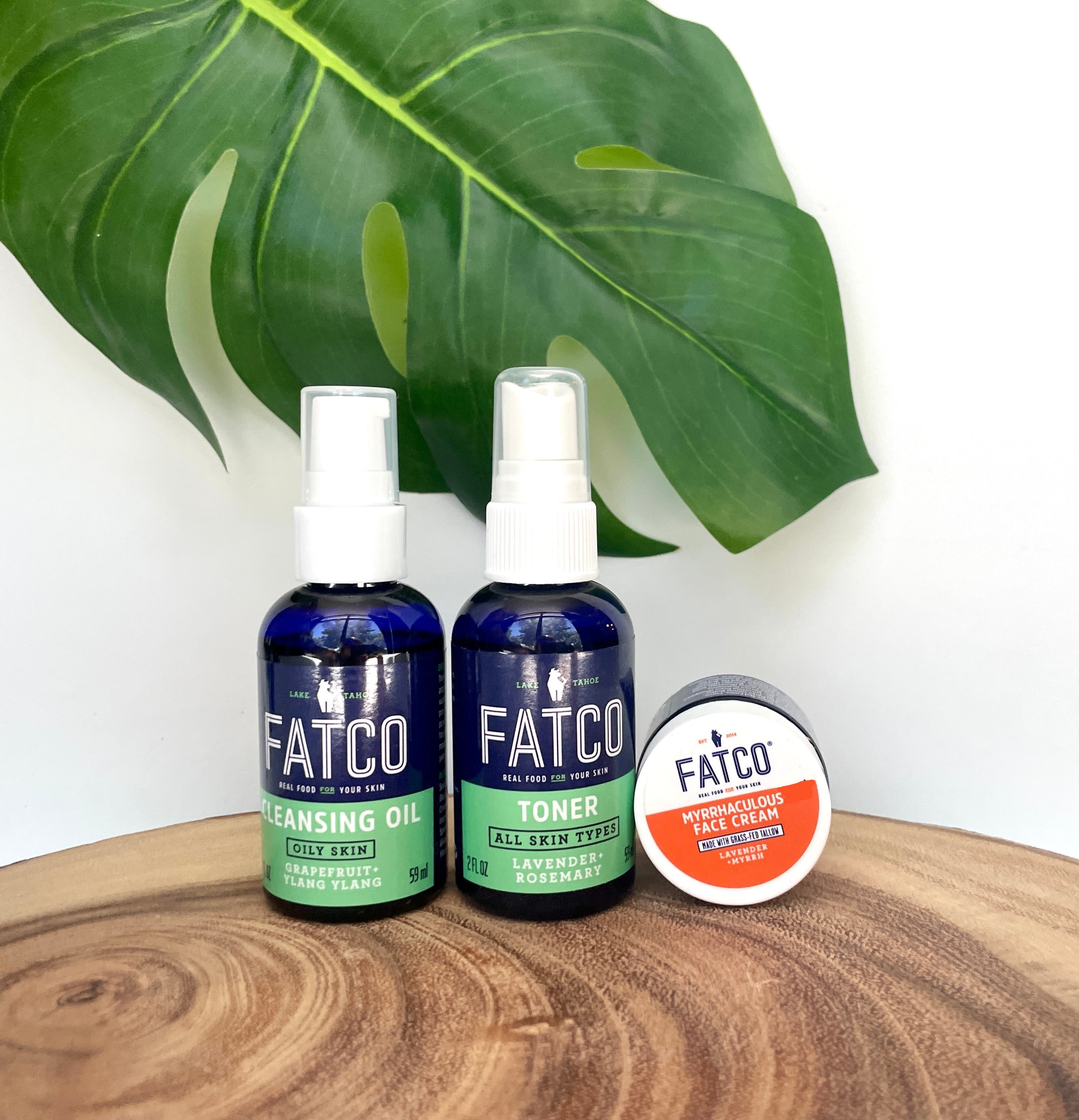
- FATCO's Myrrhaculous Face Cream uses grass-fed tallow as its base and includes extra virgin olive oil in the blend, proof the brand doesn't treat this as an either-or fight.
- Neither oil comes with a comedogenic rating you can act on. Tallow is absent from the classic ingredient charts entirely, and a 2025 review concluded that tallow's popular "non-comedogenic" billing warrants further study rather than repetition.
How Oils and Fats Actually Work on Skin
Oils and fats moisturize skin through two mechanisms: occlusion, forming a surface layer that slows water loss, and emolliency, filling the microscopic gaps between skin cells to smooth texture. Most fats do some of both.
Which effect dominates comes down to fatty-acid composition: the ratio of saturated fatty acids (solid at room temperature) to unsaturated ones (liquid, less stable). Human sebum, the oil skin produces on its own, is roughly 57.5% triglycerides and free fatty acids, 26% wax esters and 12% squalene, with cholesterol and its esters making up the rest, according to a review of sebaceous gland lipids in Dermato-Endocrinology. Palmitic acid is its most abundant saturated fatty acid. Its leading monounsaturated one is sapienic acid, about 25% of its total fatty acids, and sapienic acid is unique to human sebum: neither tallow nor olive oil contains it. The same review notes that squalene and wax esters are found nowhere else in the body either. A topical fat carrying some of the same fatty acids can integrate into that lipid matrix, which is part of why tallow's skincare benefits get compared to sebum more often than plant oils do. Sharing fatty acids is not the same as being a copy of sebum, and no study has shown tallow behaves like one.
Beef Tallow vs Olive Oil: The Fatty-Acid Breakdown
Both figures below come from USDA FoodData Central, read on the same basis so they are actually comparable: grams per 100 g of fat, converted to a percentage of the fatty acids the entry reports. Beef tallow (fdcId 171400) lists 36.0 g oleic acid, 24.9 g palmitic and 18.9 g stearic, which works out to about 38 percent oleic, 26 percent palmitic and 20 percent stearic of its total fatty acids. Extra virgin olive oil (fdcId 748608) lists 67.8 g oleic, 12.1 g palmitic, 8.4 g linoleic and 2.59 g stearic, or roughly 72 percent oleic and 13 percent palmitic. Individual batches shift with breed, diet, cultivar and harvest, so treat these as the center of a range.
| Fatty acid | Beef tallow | Extra virgin olive oil |
|---|---|---|
| Total saturated | About 52% | About 16% |
| Palmitic + stearic | About 46% combined | About 16% combined |
| Oleic acid (monounsaturated) | About 38% | About 72% |
| Linoleic acid (polyunsaturated) | About 3% | About 9% |
Tallow's saturated-fat content gives it a firmer, more occlusive texture. Olive oil's oleic-acid dominance makes it lighter and more fluid, which is also why it behaves differently on skin. Note that oleic acid is still tallow's single largest fatty acid; the difference between the two is one of degree, not of kind.
The Oleic-Acid Question: What the Barrier Research Actually Shows
This is where the comparison gets genuinely nuanced: oleic acid, the fatty acid that makes up most of olive oil, is not universally gentle on skin.
Danby and colleagues ran a small randomized, observer-blind study on adult forearms, published in Pediatric Dermatology in 2013 under a title that flags its implications for neonatal skin care. Nineteen adults took part across two cohorts. Seven applied six drops of olive oil to one forearm twice daily for five weeks. Twelve more applied olive oil to one forearm and sunflower seed oil to the other, twice daily for four weeks. As summarized in a 2022 Frontiers in Pharmacology review of clinical studies, the olive oil (76.3% oleic acid, 4.6% linoleic) damaged the lipid barrier integrity, while sunflower oil (27.3% oleic, 60.9% linoleic) did not disturb the stratum corneum, caused no erythema, and improved hydration. Two details matter and are usually dropped: the sample was tiny, and the significant increase in erythema for olive oil showed up in the volunteers who had a history of atopic dermatitis.
The mechanism is well described. Oleic acid is a recognized skin penetration enhancer, and ultrastructural work shows it disrupts the ordered lipid packing of the stratum corneum and can increase permeability. That is a real caveat, not a reason to write off olive oil, and the same Frontiers review is explicit about the limit of it: on inflammation-affected skin, high-oleic oils with little linoleic acid may cause additional structural damage, while non-affected skin "may not react negatively to oils high in oleic acid." Frequency and duration matter too. Occasional use on healthy skin for hair or a DIY mask is a different exposure from twice daily for a month.
Tallow does not escape this caveat by virtue of being an animal fat, and articles that claim it does are wrong: oleic acid is tallow's largest single fatty acid. Its saturated fraction is much larger than olive oil's, and its linoleic-to-oleic ratio is lower, so it is a different exposure, but not an oleic-free one.
Head-to-Head: Tallow vs Olive Oil for Skin
Barrier match and occlusion
Tallow shares more of its fatty acids with skin surface lipids than olive oil does, and its much higher saturated-fat content makes it more occlusive, forming a stronger surface layer that slows water loss. Olive oil is lighter and absorbs faster, but that same lightness gives it less staying power as a barrier.
Comedogenicity
This is where the honest answer is "no useful number exists." Beef tallow does not appear on the classic ingredient comedogenicity charts at all, so any 0-to-5 rating you find attached to it was extrapolated from its fatty acids rather than tested. Olive oil does appear on those charts, at the low end, but the assay behind them is a 1970s rabbit-ear model with a documented false-positive problem. A 2025 cross-sectional analysis in the Journal of Cosmetic Dermatology looked at how tallow is marketed and concluded that, given its lipid composition, the popular "non-comedogenic" billing warrants further study. In practice, either oil can clog pores for some people and not others, and a patch test tells you more than any chart.
Feel and texture
Tallow is a solid at room temperature and needs warming between the fingers before it spreads. The payoff is a richer, balm-like finish. Olive oil is liquid, spreads instantly, and feels lighter, good for everyday use but often too light for very dry patches.
Availability and cost
Olive oil wins on convenience: it's in every grocery store, already in most kitchens, and inexpensive. Quality tallow, especially grass-fed and properly rendered, is a more specialized purchase, usually from a butcher or a skincare brand.
Ethics and dietary fit
Olive oil is plant-based and vegan by default. Tallow is rendered animal fat and is not vegan under any circumstance.
Which Should You Choose
| Your skin or goal | Better fit | Why |
|---|---|---|
| Very dry or flaky skin | Tallow | Much higher saturated-fat content supports occlusion where the barrier needs the most help |
| Normal to slightly dry skin, want a light daily oil | Olive oil | Lower cost, more available, absorbs quickly, and the review found non-affected skin may not react badly to high-oleic oils |
| Vegan or plant-based routine | Olive oil | Tallow is animal-derived and off the table by definition |
| Inflammation-affected skin, or a history of eczema | Neither oil unsupervised; ask a dermatologist | This is the population where high-oleic oils showed the erythema and barrier effects, and where the review warns of additional structural damage |
| Infant or newborn skin | Ask a pediatrician | The 2013 study was run on adults and titled for its neonatal implications; it is not itself an infant result |
| Want a tallow-based routine that still includes plant oils | FATCO Myrrhaculous Face Cream | Blends grass-fed tallow with extra virgin olive oil and several other plant oils rather than picking one over the other |
| Acne-prone or easily congested skin | Patch test either; go lighter first | Neither oil has a comedogenic rating worth acting on, and individual response varies more than any chart |
Can You Use Both? Layering and Quality Notes
Nothing about the chemistry rules out using both in the same routine. A common approach is a tallow-based moisturizer for daily use, with olive oil kept for occasional jobs like a hair treatment or a DIY mask. Its lighter feel and lower cost make more sense for those occasional uses.
Quality matters more than the ingredient name for both. FATCO's own published position is that suet-sourced, grass-fed, dry-rendered and triple-filtered tallow keeps a cleaner scent and more of its fat-soluble content than tallow rendered from scrap trimmings. On the plant side, the Frontiers review notes that oils of the highest quality are obtained by cold pressing without subsequent refining, precisely because refining exposes them to heat and oxidation, which is the case for extra virgin over "light" olive oil.
If you're switching from a lighter oil to a heavier, tallow-based routine, it helps to know what changes to expect over the first month. Judging results after a few days isn't a fair test.
Got Questions?
Tallow vs Olive Oil FAQ
Q Is beef tallow better than olive oil for skin?
Neither is universally better. Tallow is about half saturated fat and more occlusive, which favors very dry skin. Olive oil is lighter, plant-based, and easier to find, which favors people who want a simple daily oil and don't need heavy occlusion.
Q Is beef tallow healthier than olive oil?
For skin, "healthier" depends on the goal, not a fixed ranking. Tallow's saturated fraction suits dry skin needing occlusion, a strength olive oil doesn't match. Olive oil's high oleic-acid content, by contrast, has been linked to reduced barrier integrity in research on inflammation-affected skin.
Q Which is better for dry skin, tallow or olive oil?
Tallow generally performs better for very dry or flaky skin because its higher saturated-fat content makes it more occlusive, holding moisture in longer. Olive oil moisturizes too, but its lighter, faster-absorbing texture gives it less staying power for severe dryness.
Q Which is better for acne-prone skin?
Neither, on current evidence. Tallow carries no formal comedogenic rating at all, and the ratings that exist for oils come from an assay with known false positives. A patch test on a small area is a more reliable guide than any chart. Individual pore response varies more than a single number can capture.
Q Is olive oil comedogenic?
Olive oil sits at the low end of the classic comedogenicity charts, meaning it can clog pores for some people but not others. Its oleic-acid content is a separate concern: research has linked regular use to reduced barrier integrity, most clearly on inflammation-affected skin rather than healthy skin.
Q Can you mix tallow and olive oil?
Yes. There's no chemical conflict between them, and FATCO's own Myrrhaculous Face Cream blends grass-fed tallow with extra virgin olive oil and other plant oils in one formula. Many people use a tallow moisturizer daily and reserve olive oil for occasional use, like hair or DIY treatments.
The FATCO Alternative
If tallow's barrier-matching profile appeals to you but you don't want to give up plant oils entirely, FATCO's Myrrhaculous Face Cream is built on exactly that middle ground. Grass-fed tallow forms the base, blended with extra virgin olive oil, shea butter, jojoba oil, and several other plant oils, plus myrrh for scent and skin support. It's not tallow instead of olive oil. It's both, formulated together rather than pitted against each other.