What Makes our Shampoo Bar Better than the Competition?
THE SHORT ANSWER
FATCO's tallow shampoo and conditioner bars work because beef tallow's fatty acid profile mirrors your scalp's natural oils — so instead of stripping and re-coating (the sulfate + silicone cycle), they clean and condition without disrupting the scalp's baseline. Grass-fed tallow, no sulfates, no silicones. That's it.
What Makes a Tallow Shampoo and Conditioner Bar Different?
Most shampoo bars fail for one of two reasons: they use the same sulfate-heavy formula as liquid shampoo (just in bar form), or they swap sulfates for a gentler surfactant but add nothing to compensate for the stripped moisture. Either way, the scalp is left off-balance.
A tallow shampoo bar does something fundamentally different. Beef tallow — specifically from grass-fed, pasture-raised cattle — has a fatty acid composition (oleic, stearic, palmitic, linoleic) that's closely compatible with the oils your scalp already produces. It doesn't just coat the hair shaft; it works with your scalp's own biology to cleanse without over-stripping.
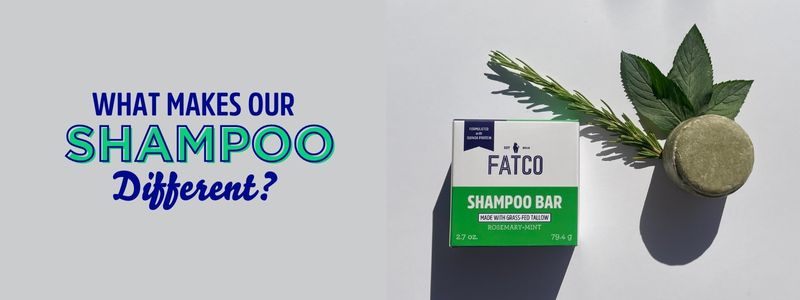
FATCO's tallow shampoo and conditioner bars are built on this principle. The shampoo bar cleans without sulfates. The conditioner bar softens without silicones. Together they replace a two-product routine that most conventional lines can't actually deliver — a clean scalp and conditioned hair without the buildup cycle.
Soap is great for washing your body, but it's not great for washing your hair — and here's why.
The pH Difference
Most shampoo bars are soap-based, with a pH of 9-10 — far too alkaline for your scalp, which sits at pH 4-5. FATCO's Shampoo Bar is formulated at pH 4.4-5 and built on grass-fed tallow, whose fatty acid profile mirrors your scalp's natural oils. The result is a bar that genuinely cleans without stripping.
When we were developing our shampoo bar, I heavily researched the competition, inspecting the ingredient panels on the other bars I could find at my local health-food store. What I found were a lot of "shampoo bars" that were formulated just like a soap: a combination of fats and oils, mixed with lye, and formed into a hard bar. I've got bad news — this isn't going to be great for your hair!
Soap-based shampoo bars sit at pH 9-10, which is completely wrong for your scalp. FATCO's Shampoo Bar is formulated at pH 4.4-5, matching your scalp's natural chemistry for a gentler, healthier cleanse.
How Do I Know If a Bar Is Formulated Like a Soap?
When checking to see if a shampoo bar is formulated like a soap, look for Sodium Hydroxide or lye in the ingredient list. If you find it, or if the entire ingredient list is composed strictly of oils and fats, it's likely soap-based and not safe for your hair.
But Why Tallow in a Shampoo Bar?
Tallow has been used for centuries as an all-natural moisturizer and skin conditioner. It's rich in vitamins A and D and contains essential fatty acids that help protect against environmental damage. You'll find the same grass-fed tallow in our Body Butta and Fat Stick: tallow that's biocompatible, nutrient-dense, and nothing like the synthetic ingredients found in conventional products.
But did you know that tallow is also great for hair? Vitamins A and D help strengthen hair follicles and prevent breakage; essential fatty acids keep your scalp healthy; and its natural moisturizing properties keep your scalp hydrated so it doesn't dry out or become too oily. It's exactly why our tallow shampoo and conditioner bars work so well for people who've struggled to find a natural bar that actually performs.
Who Tallow Shampoo and Conditioner Bars Work Best For
- Dry scalp and scalp sensitivity: The tallow base conditions the scalp while it cleans — no irritation from aggressive detergents.
- Color-treated hair: Sulfate-free cleaning means less color fade. The conditioner bar moisturizes without heavy silicone coating.
- Low-porosity hair: Tallow's oleic acid penetrates the hair shaft rather than sitting on top — works better than water-based conditioners for hair that repels moisture.
- Anti-plastic people: One shampoo bar replaces 2-3 bottles of conventional shampoo. Zero liquid restrictions for travel.
- No-poo and water-only washers: Tallow shampoo is the gentlest bridge back to a real cleanser without re-triggering scalp oil overproduction.
The one group that needs patience: anyone coming off heavy silicone products. The scalp needs 3-4 weeks to rebalance after silicone buildup clears. Stick with it.
Is Tallow Actually Good for Your Hair?
Yes. Tallow from grass-fed cattle has a fatty acid profile that closely mirrors your scalp's natural sebum, so it absorbs without buildup and doesn't disrupt oil balance the way synthetic detergents do. Stearic acid conditions and softens hair; oleic acid moisturizes without clogging follicles; vitamins A, D, and E support scalp cell turnover and follicle health. People with dry scalp, brittle hair, or sensitivity to conventional shampoo ingredients see the biggest difference.
For the full science on how beef tallow performs on hair and scalp — fatty acid breakdown, how to use it, and what to expect — see: Beef Tallow for Hair: Benefits, Uses, and What to Expect.
How Do You Use a Tallow Shampoo Bar?
Wet your hair thoroughly, then rub the bar between your palms to build a lather or work it directly into your scalp. Focus on the scalp first, not the ends. Rinse completely — residue is the most common reason hair feels heavy after a bar shampoo. Follow with the Conditioner Bar on mid-lengths and ends if needed.
What About the Transition Period?
Most people experience two to four weeks of adjustment when switching to any shampoo bar. Your scalp has spent years being stripped by sulfate shampoos and has been overproducing oil to compensate. As it recalibrates, hair can feel heavier or waxy at first. This is normal and temporary. An apple cider vinegar rinse (1 tablespoon in a cup of water, applied after shampooing and rinsed out) helps reset scalp pH and speeds up the process.
Beef Tallow for Hair: Your Questions Answered
Can beef tallow actually help with hair growth?
Does beef tallow make hair look greasy or weigh it down?
Is beef tallow good for natural or curly hair?
How does tallow differ from silicone-based conditioners?
Can I apply beef tallow directly to my hair and scalp?
Is grass-fed tallow better for hair than conventional tallow?
Is tallow-based haircare a long-term solution or just a trend?


Video Tutorial
New to shampoo bars?
We walk you through exactly how to use our Shampoo and Conditioner Bars: from lathering to rinsing, so you get the best results every wash.
Watch the Tutorial