Rosacea Skincare Routine: A Calm-First Approach for Flare-Prone Skin

A calm rosacea skin care routine comes down to four things done consistently: a gentle cleanse twice a day, a barrier-supporting moisturizer, daily SPF, and avoiding the specific triggers that set your skin off. None of it cures rosacea. What it does is reduce the number and severity of flares day to day, which is why dermatologists recommend it alongside, not instead of, prescription treatment. If you haven't been formally diagnosed, see a dermatologist first. A dermatologist diagnoses rosacea by examining your skin and eyes, and will describe what you have by its features rather than sorting you into a numbered subtype.
Key Takeaways
- A rosacea routine is calm-first, not aggressive. Gentle cleanse, barrier moisturizer, daily SPF, and consistent trigger avoidance, in that order of importance.
- This is not a cure. Rosacea is a chronic condition with no cure; a routine reduces flare frequency and severity but does not treat the underlying vascular and inflammatory drivers. See a dermatologist for diagnosis and prescription options.
- Sun is the most reported trigger. In a National Rosacea Society survey of 1,066 patients it topped the list at 81%, ahead of emotional stress at 79% and hot weather at 75%, which is why daily SPF matters as much as anything you put on at night.
- Introduce one product at a time and patch-test everything, including anything marketed as "gentle" or "for sensitive skin."
- Tallow is a plain occlusive moisturizer, not a rosacea treatment. It shares some fatty acids with the skin's surface lipids, which is a compositional overlap rather than proof of anything, and FATCO's face creams contain essential oils, so patch-test with the same caution you would give any product.
What Rosacea Actually Is (and Why "Less Is More" Works)
Rosacea is a long-term facial skin condition marked by redness, visible blood vessels, and in some cases bumps or pustules. MedlinePlus is blunt about the cause: no one knows what causes rosacea, and there is no cure, though treatments help. A review of rosacea skin care in the Journal of Clinical and Aesthetic Dermatology lists what may be involved as genetic disposition, dysfunction of the innate immune system, vascular changes and hyper-reactivity, skin barrier dysfunction, and microbial imbalance. Note the hedging in that sentence. It is a list of contributors, not a settled mechanism.
One thing to know before a dermatology appointment: the old four-subtype system is out of date. The National Rosacea Society's expert committee replaced it with a phenotype-based classification in 2017, published in the Journal of the American Academy of Dermatology, so expect to hear your skin described by its features rather than by a subtype number. Some clinical sources, Cleveland Clinic among them, still use the four types, so you may hear both.
The barrier half of that list is worth stating precisely, because it is often overstated. The same review summarizes a study of 75 papulopustular rosacea patients that found raised water loss through the skin in clinically involved areas, the perinasal cheek and the side of the nose, while clinically healthy areas such as the lateral cheek showed no such rise. So the barrier problem is real and it is local, not a blanket property of every inch of a rosacea face. Where it is impaired, irritants that would bounce off healthy skin can get through, which is why a calm, minimal routine tends to outperform an aggressive one. Every ingredient you add is a potential trigger. Strong actives, frequent exfoliation, and multi-step routines with a dozen products all raise the odds of hitting something your skin can't tolerate that day. The goal of a rosacea routine is narrower than a typical skincare routine: support the barrier, protect from triggers, and change as little as possible at once so you can actually tell what's working.
The Daily Routine, Step by Step
Morning
- Cleanse gently. The American Academy of Dermatology's instruction is to cleanse twice a day, morning and night, with a mild rosacea-friendly cleanser rather than soap, because that removes the oil and dirt that can worsen irritation. A fragrance-free, non-foaming cleanser is the format to look for. If a full morning cleanse stings no matter what you use, a plain water rinse is a reasonable fallback while you find something gentler, but treat it as a compromise rather than the recommendation.
- Apply a barrier-supporting moisturizer. Look for ceramides, glycerin, or occlusive fats that reinforce the barrier rather than just sitting on top of it. If you use a prescription rosacea medication, their order is medication first, moisturizer after.
- Finish with sunscreen every day. The specification is broad-spectrum, SPF 30 or higher, and water resistant. If sunscreen stings your skin, the same guidance says to look for one containing zinc oxide, titanium dioxide, or both (a mineral formula), silicone, and no fragrance. Sun exposure topped that patient trigger survey, so this step matters on cloudy days too.
Evening
- Cleanse with your fingertips, using a circular motion. No washcloths, sponges or brushes. The rinsing instruction that goes with it is warm water, using only your fingertips; hot is the temperature to avoid, so lukewarm to warm is the safe zone.
- Rinse thoroughly. The guidance makes this an explicit step: cleanser left on the skin can cause irritation.
- Let your face dry, then moisturize. This is the one that surprises people. The advice for rosacea is to wait until your face is dry before applying moisturizer, because moisturizer applied to dry skin is less likely to burn or sting. Use the same barrier-focused product from your morning routine, since consistency matters more than variety here.
That's the whole routine. Anything beyond cleanse, moisturize, and SPF (an exfoliating acid, a retinoid, a new serum) should be introduced one at a time, weeks apart, and only after your baseline routine is stable.
Worth knowing that the moisturizing step is not just comfort. In a small study described in the same guidance, patients applied metronidazole gel to their whole face twice a day and a gentle moisturizing cream to one side only. After 15 days the moisturized side showed less dryness, peeling and roughness.
Triggers Worth Knowing
Every person with rosacea has a somewhat different trigger profile, but a few categories show up consistently across patient surveys. In that same survey of 1,066 patients, the leading factors were sun exposure (81%), emotional stress (79%), hot weather (75%), wind (57%), heavy exercise (56%), alcohol consumption (52%) and hot baths (51%). The society's broader list of flare-up factors, compiled from patient histories, groups them into a few buckets:
- Heat and weather: sun, strong wind, cold, humidity, saunas, and hot baths
- Skin care ingredients: alcohol, witch hazel, and fragrance in cosmetics and hair products, along with anything that causes stinging or redness on contact
- Beverages and foods: alcohol (especially red wine), hot drinks, and spicy or histamine-rich foods
- Emotional and physical strain: stress, anxiety, and strenuous exercise
- Certain medications: vasodilators and topical steroids used on the face
Not every trigger applies to every person. The most useful approach is keeping a short diary of flares and what preceded them, then adjusting based on your own pattern rather than avoiding everything on the list preemptively.
Patch-Test Everything, Introduce One Thing at a Time
Because a rosacea-prone barrier reacts more readily than average, the way you introduce a new product matters almost as much as the product itself.
- Test on your inner arm or behind the ear first. These spots have thinner skin and are easy to monitor without risking your face.
- Wait 48 hours. Redness, stinging, or itching at any point in that window means skip it.
- If it passes, do a small facial test. Apply to one area, like the jaw, for three to five days before using it across your whole face.
- Add only one new product every two weeks. If your skin reacts after you've introduced three things at once, you have no way to know which one caused it.
This applies to every new product, including ones labeled "gentle," "for sensitive skin," or "dermatologist recommended." Marketing claims aren't a substitute for your own patch test.
What to Look For vs. Avoid
| Category | Look for | Avoid |
|---|---|---|
| Cleanser type | Mild, non-foaming, fragrance-free, and not soap. Syndet bars and liquid cleansers usually sit in the neutral-to-acidic pH 5.5 to 7 band, near the skin's own 4.1 to 5.8 | True soap bars, which run pH 9 to 10 by chemistry; foaming sulfate cleansers |
| Moisturizer | Ceramides, glycerin, barrier-supporting fats (tallow, shea, squalane). A cream rather than a lotion or gel | Added fragrance, high alcohol content |
| SPF | Broad-spectrum, SPF 30 or higher, water resistant. If it stings, look for zinc oxide, titanium dioxide, silicone, and no fragrance | Anything that stings on application; "unscented" rather than "fragrance-free" |
| Actives | Azelaic acid, only if a dermatologist prescribes it | The dermatologist avoid list: alcohol, camphor, fragrance, glycolic acid, lactic acid, menthol, sodium lauryl sulfate, urea. Patients also flag witch hazel and eucalyptus oil. Astringents and toners, never. Unsupervised retinoids |
| Texture | Simple, short ingredient lists | Multi-step routines layering several actives at once |
When to See a Dermatologist
Rosacea is a medical condition, and nothing in this guide diagnoses or treats it. A routine is a foundation, not a replacement for medical care. See a board-certified dermatologist if:
- You haven't been formally diagnosed and want to confirm rosacea versus a look-alike condition. Testing is sometimes needed to rule out conditions such as lupus
- Bumps, pustules, or persistent redness aren't improving with routine changes alone
- You want to discuss prescription options
Eye symptoms go to a doctor, not a skincare shelf. If your eyes feel dry, gritty, bloodshot or irritated, that may be ocular rosacea, and the AAD's position is that when rosacea affects the eyes, treatment is essential. Anyone whose ocular rosacea threatens their eyesight is referred immediately to an ophthalmologist.
Prescription treatments exist and work well alongside a calm daily routine. Among the medications the academy lists as FDA approved for the acne-like breakouts of rosacea are azelaic acid foam or gel, ivermectin cream, metronidazole cream, gel or lotion, minocycline foam, and low-dose oral doxycycline; brimonidine gel and oxymetazoline cream are approved for persistent facial color. Set your expectations accordingly: their guidance says you may see slight improvement in 3 or 4 weeks and that it usually takes 2 to 3 months to see a noticeable difference. Which of these fits you is a dermatologist's call, not a routine's.
Got Questions?
Rosacea Routine FAQ
Q What's the best skincare routine for rosacea?
The simplest one: a mild fragrance-free cleanser used twice a day, a barrier-supporting moisturizer applied once your face is dry, and daily broad-spectrum SPF 30 or higher. Add nothing else until that baseline is stable, and introduce any new product one at a time with a patch test first.
Q What skincare ingredients should rosacea avoid?
The American Academy of Dermatology names eight to avoid: alcohol, camphor, fragrance, glycolic acid, lactic acid, menthol, sodium lauryl sulfate, and urea. It also says never to use an astringent or toner. National Rosacea Society patients additionally report witch hazel and eucalyptus oil as irritants.
Q Is moisturizer good for rosacea?
Yes, and dermatology guidance calls it essential whether rosacea makes your skin dry or oily. In one small study it cites, patients using metronidazole gel who also moisturized one side of the face had less dryness, peeling and roughness on that side after 15 days. Apply it once your face is dry, since that stings less, and patch-test first.
Q Can a skincare routine get rid of rosacea?
No. Rosacea is a chronic condition with no cure, and a routine cannot resolve it on its own. A calm, consistent routine can reduce how often and how severely your skin flares, but managing rosacea long-term usually requires a dermatologist's diagnosis and, in many cases, prescription treatment.
Q Is sunscreen important for rosacea?
Very. Sun exposure topped the National Rosacea Society's trigger survey at 81% of 1,066 patients, so daily SPF belongs in every rosacea routine regardless of season. The dermatological spec is broad-spectrum, SPF 30 or higher, water resistant, applied even on cloudy days. If a sunscreen irritates your skin, the recommendation is to look for zinc oxide, titanium dioxide, silicone, and no fragrance.
Q Why does my skin still flare even with a gentle routine?
Because skincare is only one of the categories. In that same patient survey, skin-care products came 12th at 41%, well behind sun exposure, emotional stress, hot weather, wind, heavy exercise, alcohol and hot baths. A gentle routine handles one column of that table. The society suggests keeping a diary of daily events and matching them to flares to find your own pattern.
The FATCO Alternative
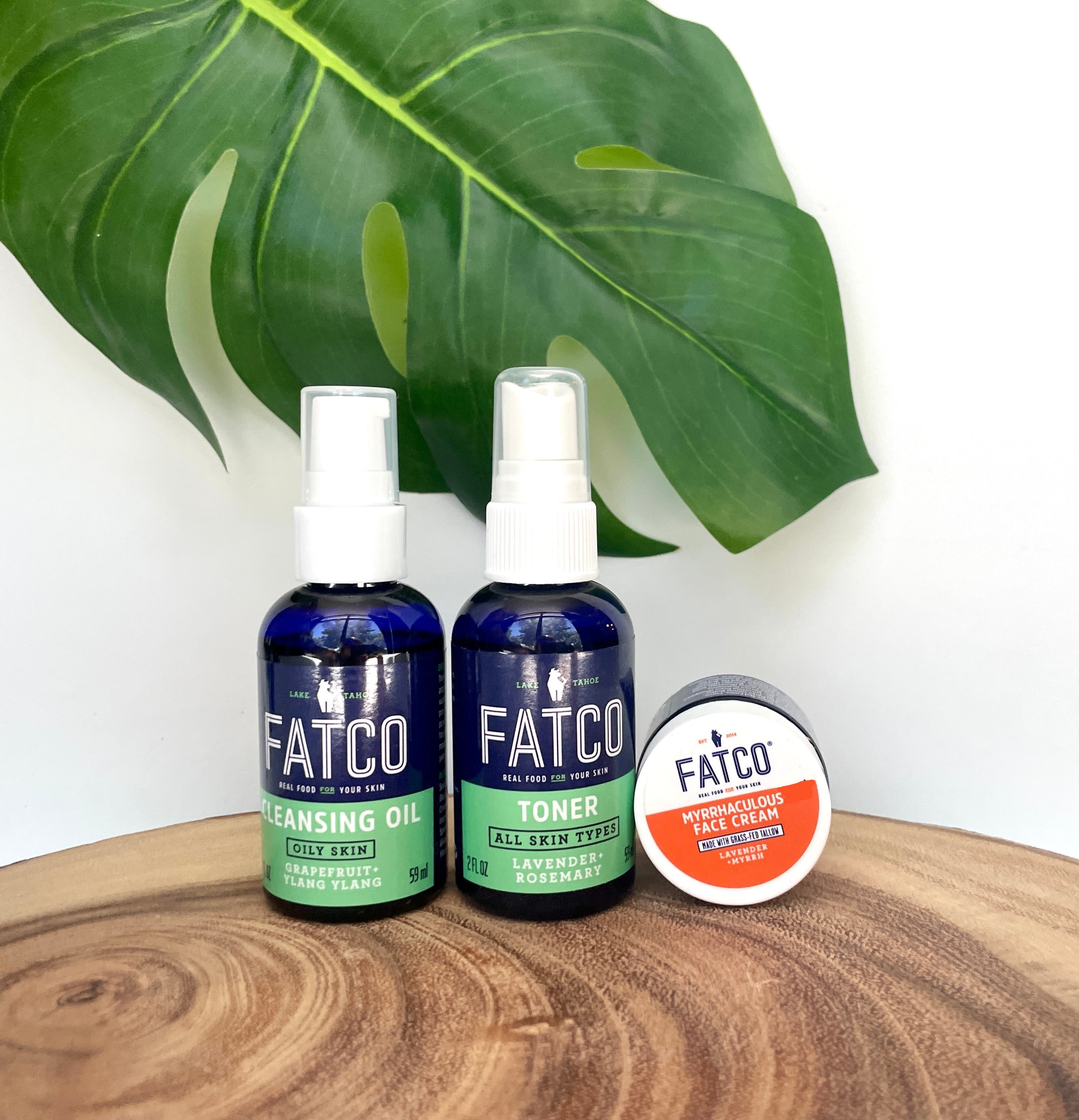
If you're looking for a plain moisturizer to patch-test as part of a calm rosacea routine, FATCO's Myrrhaculous Face Cream is built from grass-fed tallow and a short list of plant oils. Two honest caveats before you consider it. It is not a rosacea treatment and does not address the vascular and inflammatory side of the condition. And it contains lavender essential oil and myrrh essential oil, so it is not fragrance-free, which matters because fragrance sits on the dermatologist avoid list above. FATCO's Unmyrrhaculous version drops the myrrh but still carries lavender. If fragrance is one of your triggers, this is not your product. If it isn't, it's a simple, food-based option to test alongside the rest of your routine and whatever your dermatologist has you on.