Scented Body Care: Reading the Label When You Actually Want a Scent

Wanting to smell good is a perfectly ordinary reason to buy a body product, and almost nothing written about fragrance is addressed to you. The advice assumes you are trying to get away from scent. Here is the other half: what a scent declaration is required to say, what it leaves out, and what decides whether the smell survives past lunch.
Key Takeaways
- One word can stand for a whole blend. US rules let fragrance be declared simply as fragrance. That is a disclosure rule, not a verdict on quality.
- The European list of named fragrance allergens just got much longer. Regulation (EU) 2023/1545 added 56 substances, and the deadline for putting non-compliant products on the EU market was 31 July 2026.
- Natural does not mean hypoallergenic. Linalool and limonene are among the most commonly declared fragrance allergens, and both occur naturally in essential oils.
- Longevity is physics, not price. Light molecules leave first and heavy ones linger. How moisturized your skin is changes the rate.
- FATCO names every scent on every panel. Across 159 catalogue listings, 64 carry an ingredient panel, and none of them uses Fragrance, Parfum or Aroma.
What a Scent Declaration Has to Tell You
Less than you would hope, and the rule is short enough to read. Under 21 CFR 701.3(a) a cosmetic label must declare each ingredient in descending order of predominance, "except that fragrance or flavor may be listed as fragrance or flavor." That exception is the whole story. Dozens of aroma chemicals collapse into one word, and Parfum is the same word in international nomenclature.
Two details in that regulation are rarely quoted. One limits the exception: "No ingredient may be designated as fragrance or flavor unless it is within the meaning of such term as commonly understood by consumers." The other is a separate trade-secret route under 21 CFR 720.8(a), which lets accepted ingredients appear as "and other ingredients" at the end.
For a shopper who wants a scent rather than wants rid of one, that word tells you almost nothing. It does not say synthetic. It does not say cheap. It says the recipe is not yours to see. If you care whether the vanilla is really vanilla, only a panel that names its scent ingredients will settle it. What "fragrance-free" and "unscented" each promise is a different question, covered in our guide to reading a label when fragrance is the problem.
Why the Same Product Carries Two Different Ingredient Lists
Buy the same brand in Paris and in Portland and the back of the box can differ. The formula is usually identical. The disclosure rules are not.
The European Union starts from the same shortcut the US does. Perfume compositions are named as parfum or aroma, then complemented by any substance flagged in the Other column of Annex III. That column is where individually named fragrance allergens live.
Then it grew. The Scientific Committee on Consumer Safety "identified 56 additional fragrance allergens, which have clearly caused allergies in humans and which have currently no requirement of individual labelling." Regulation (EU) 2023/1545 requires each of them to be named individually on the ingredient list above 0.001 percent in a leave-on product, or 0.01 percent in a rinse-off one. Non-compliant products "may be placed on the Union market until 31 July 2026 and made available on the Union market until 31 July 2028". The first of those dates has now passed.
The US is heading the same way and has not arrived. The Modernization of Cosmetics Regulation Act of 2022 added a plain duty. "The responsible person shall identify on the label of a cosmetic product each fragrance allergen included in such cosmetic product." The catch is in the next sentence, which leaves those substances to be "determined by the Secretary by regulation", and the statute tells the agency to consider the European requirements. FDA's own MoCRA page still lists fragrance allergen labeling among the regulations it is required to establish. Until that lands, a long tail of allergen names on a label usually means EU-market packaging.
Essential Oil or Synthetic: What Really Changes
Both are fragrance. An essential oil added to make a jar smell of lavender is a scent ingredient in exactly the way a fragrance blend is, and plant origin buys no allergy exemption. Linalool and limonene, two of the most frequently declared allergens in cosmetic labeling surveys, are ordinary constituents of essential oils. Our guide to scent families in natural deodorant sets that out with the survey numbers.
What genuinely differs is what you can find out. A named botanical can be looked up, and its usual constituents are published. Behind Fragrance, they are not. A named oil also varies a little between harvests, which is why a botanical scent shifts through the day while an engineered blend holds its shape.
One more difference matters if you like citrus. The same European regulation treats substances that become allergens through air oxidation as equivalent to allergens themselves. In plain terms, terpene-rich oils change once the bottle has been open a while. Keep citrus-heavy products closed and out of sunlight, and replace the one that has lived in your shower for two years. FATCO's own rundown of where each of its oils comes from shows the level of detail a named scent makes possible.
What Makes a Scent Last on Skin
Volatility, mostly. A scent molecule leaves your skin at a rate set by its size and its vapor pressure, and a fragrance is a mixture of molecules leaving at very different speeds. In a 2025 study in the International Journal of Cosmetic Science, the lightest molecule tested sat at 14 mmHg and evaporated fastest. The heaviest, at 0.002 mmHg, was expected to go extremely slowly. Top notes are simply the ones with somewhere to be.
Your skin then edits that curve. Measuring evaporation directly from volunteers, the researchers found two patterns: "the more volatile compounds whose evaporation increases with surface skin roughness", and heavier, more lipophilic ones tracking hydration and water loss instead. Their practical line is the one worth stealing. "Individuals with moisturized, less rough skin will tend to evaporate fragrances less." That work ran on ten participants at a French university lab, funded by the Région Normandie, with no declared conflict of interest. The authors say a larger group is needed to confirm it.
The carrier does the rest. A body lotion is mostly water, and what stays behind once the water goes is the small oil fraction. A waterless butter leaves far more fat on the skin, which gives the slow, heavy scent molecules somewhere to sit. That is why scent-layering advice always starts with moisturizing rather than with spraying more.
How to Read a Scented Label
| What you see | What it means | What you can learn |
|---|---|---|
| Fragrance, Parfum | An undisclosed blend, permitted by 21 CFR 701.3(a) | Only that the product is scented |
| A named essential oil | One disclosed botanical, distilled | Its usual constituents are published |
| A fruit or seed oil in the scent position | A fixed oil rather than a distilled one | Disclosed, and slower to evaporate |
| A plant extract in the scent position | Scent carried in an extract | Disclosed, though strength varies |
| Natural flavors, aroma | A softer catch-all | Treat it as undisclosed |
| Linalool, limonene, citral at the end | EU allergen declarations | Usually an EU-market label |
| No scent ingredient at all | Genuinely unscented | It may still smell faintly of its base fats |
When to Screen Anyway
Most people wear scented body products for decades without incident, and this is not an article about danger. Four situations are worth pausing on: broken, cracked or freshly shaved skin, a diagnosed fragrance allergy, infants, and skin already reacting to something unidentified.
The move is the same in all four. Patch test a small area and wait a couple of days before committing. If your skin keeps telling you something, a dermatologist can patch test properly and name the specific ingredient. If you decide to avoid scent for a while, our roundup of fragrance-free picks for dry skin does that job, and scent will still be there later.
Got Questions?
Frequently Asked Questions
Q What lotion makes you smell good all day?
None reliably, because a lotion is mostly water and the scent leaves with it. A richer waterless balm holds a scent longer than a thin lotion carrying the same fragrance. Applying to skin that is already moisturized slows evaporation more than applying more product does.
Q What holds scent the longest?
Heavy, low-volatility molecules in a fatty carrier. Base notes such as woods, resins and vanillas have low vapor pressures and linger, while citrus tops disappear within the hour. A balm or butter leaves more oil on the skin for those heavy molecules to sit in than a water-based lotion does.
Q Should body lotion have fragrance?
That is a preference, not a health question, unless you have a diagnosed fragrance allergy or currently reactive skin. Fragrance does nothing for moisturizing performance either way. If you enjoy it, buy it, and favor a label that names what is doing the scenting over one that says only Fragrance.
Q Are essential oils healthier than perfumes?
Not in any way a label can promise. Essential oils are fragrance ingredients, and several common allergens, linalool and limonene among them, occur naturally in them. What essential oils do offer is disclosure: a named botanical can be looked up, and a blend called Fragrance cannot.
Q How do you lock in a body lotion scent?
Apply it to warm, slightly damp skin straight after a shower, then let it absorb before dressing. Hydrated, smoother skin loses volatile molecules more slowly than dry, rough skin does. Layering a matching balm over the lotion works for the same reason: more fat on the surface, slower evaporation.
Q What is the nicest smelling body lotion?
Nobody can answer that for your nose, so shop by scent family. Citrus reads bright and fades fast, florals and herbs sit in the middle, woods and vanillas last longest. FATCO does not make a lotion, though Calming Body Butta covers the herbal end in a waterless format.
The FATCO Alternative
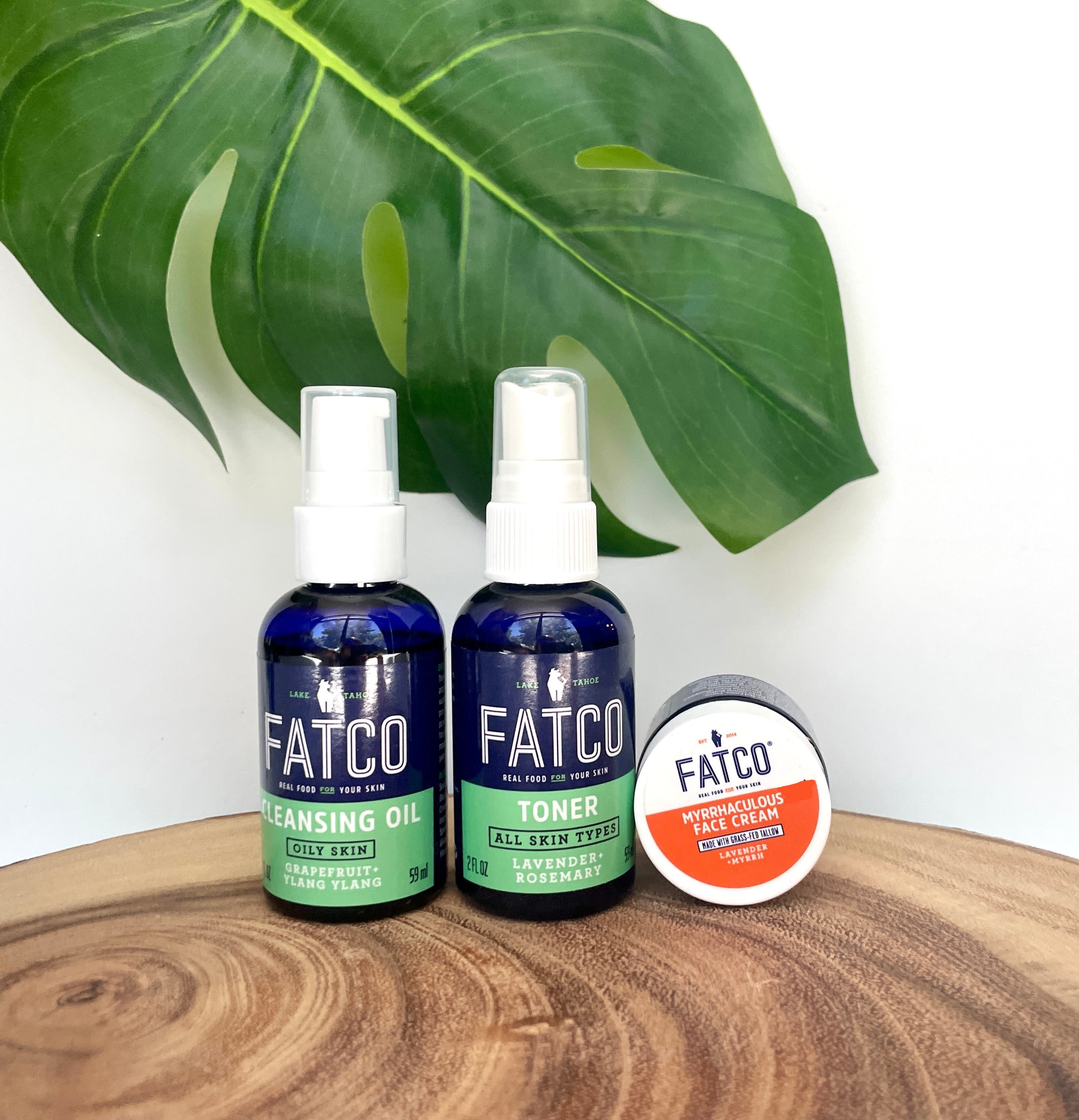
FATCO does not make a body lotion, which is worth saying in an article about buying one. What it makes is Body Butta, a whipped waterless butter, and the labeling habit behind it is unusual. The public catalogue pulled on 4 August 2026 gives 159 listings, 64 of them carrying an ingredient panel, and none of those panels uses Fragrance, Parfum or Aroma. Every scent is named, though the convention shifts. Essential oils cover most of the range, a vanilla fruit oil scents the Coconut and Vanilla deodorant, and plant extracts scent Cucumber and Mint. One Fat Stick uses a broader term, "Natural flavors of Lemon and Honey". The Calming Body Butta is scented with lavender and clary sage essential oils and is stocked in all three sizes today, while the Invigorating version is out in every size. Baby Butta is the one with nothing added for smell.
FATCO Tallow Skincare
Grass-Fed. Suet-Sourced. Dry-Rendered.