Best Face Oil for Sensitive, Acne-Prone Skin: How to Choose

If your skin is reactive and it also breaks out, look for a short formula led by lighter, linoleic-rich carrier oils, with as little added scent as possible. Then test it on one patch of skin first. You are solving two problems at once, and most face oils are built for only one of them.
Key Takeaways
- Read the carrier oils at the top of the label, not the front claim. Labeling runs in descending order of predominance. The first few names are effectively the formula.
- Lighter, linoleic-rich oils are the safer starting point. Sebum from acne-prone skin has repeatedly been found low in linoleic acid. Grapeseed, rosehip seed and jojoba lean that way.
- "Non-comedogenic" is not a test result. The ratings behind the phrase came from single ingredients, usually undiluted, on the ears of albino rabbits.
- Fragrance is the deciding variable for the sensitive half. Essential oils count as fragrance, and they are the usual trigger in natural blends.
- A cleansing oil and a face oil carry different risks. One is on your face for two minutes; the other stays on overnight.
- Tallow has no formal comedogenic rating. It appears on none of the published charts, so nobody can honestly give you a number for it.
How to Pick a Face Oil If Your Pores Clog Easily
Read the ingredient list top down and judge the first few carrier oils, because that is most of what is in the bottle. Federal cosmetic labeling requires descending order of predominance, with one caveat: anything at one percent or less may be listed in any order. Essential oils and preservatives usually sit down there, so the tail tells you what is present, not how much.
Three questions do most of the deciding.
How heavy are the carriers at the top? If congestion is your main complaint, you want light, fast-absorbing oils leading the formula. If dryness is the bigger problem, reverse that.
How many scent ingredients are there? Count them. Four essential oils means four more chances to irritate reactive skin.
What else is on your face? If you use benzoyl peroxide, a retinoid or salicylic acid, the oil is competing with products that already stress your barrier.
No label can tell you how your skin will respond, which is why the patch test below is not optional.
What "Won't Clog Pores" Actually Means
Less than the packaging implies. No agency defines "non-comedogenic," no laboratory certifies it, and the numbers circulating on ingredient charts came from a test on rabbits.
The phrase starts with a 1976 paper in Cutis by James Fulton and colleagues. Its abstract says the need for a comedogenic-free cosmetic led them to the only model available: the rabbit. Kligman and Kwong refined the protocol in 1979, applying materials for two weeks just outside a rabbit's ear canal. Fulton's 1984 paper in the Journal of the American Academy of Dermatology produced the ingredient list most charts still copy. Its own abstract states the limitation. The data were gleaned from the rabbit ear assay, "which is not an ideal animal model but is the best we have."
Mills and Kligman then built a human version in 1982. Their finding was flat: the rabbit model is more sensitive than the human. Substances scoring weakly comedogenic in the rabbit are probably safe for people, they wrote, with the possible exception of acne-prone ones.
Two more limits matter. Every rating came from one ingredient on its own, usually at full strength, which is not how a finished blend behaves. And most ingredients people look up carry no published number at all. Tallow is one of them, so any chart assigning it a score invented that score. Our reference on which oils carry a published rating marks the difference row by row, and the longer history sits with the non-comedogenic claim on a cleanser.
Which Oils Suit Acne-Prone Skin, and Which Need More Care
Lighter, higher-linoleic oils are the safer opening move, and the reason is compositional rather than cosmetic. A review of lipid mediators in acne reports decreased amounts of linoleic acid in the skin surface lipids of affected patients. That shortfall has been linked to follicular hyperkeratosis, one of the steps in comedone formation. Piling on a fat heavy in oleic acid and short on linoleic does nothing to correct it.
| Oil | Character | Fits |
|---|---|---|
| Grapeseed, hemp seed | Linoleic-dominant, light, absorb fast | Oily and congestion-prone skin |
| Rosehip seed | Linoleic-dominant, dry-feeling finish | Congestion-prone, uneven tone |
| Jojoba | A liquid wax ester, not a triglyceride | Most skin types, including oily |
| Squalane | A saturated hydrocarbon, no linoleic or oleic acid at all | Very reactive skin, minimal routines |
| Argan, apricot kernel, macadamia | Richer, more oleic-forward | Dry skin, or dry patches on combination skin |
| Olive, avocado | Oleic-dominant and heavier | Dry skin; sparingly if you congest easily |
| Coconut | Lauric-dominant, near the top of the classic pore-clogging lists | Body, rather than a congestion-prone face |
Nothing there is a rule about your skin. It is a rule about where to start, and the right-hand column is what to argue with once you know how you react.
Sensitive Skin: Fragrance Is the Variable That Decides It
For the reactive half of the problem, the ingredient most likely to give you trouble is the scent, not the oil. Essential oils are fragrance. So is "natural fragrance." In natural blends they are the usual trigger, and they are not made gentler by being plant-derived.
Fewer ingredients means fewer things that can set your skin off, so the shortest list you can find wins by default. Watch what sits alongside the oil, too. Dermatologists at the American Academy of Dermatology advise gentle, alcohol-free products and avoiding astringents, toners, and exfoliants, which dry the skin and can make acne look worse. If your skin stings at the moisturize step too, the same logic applies to a moisturizer for sensitive skin: barrier-compatible, short label, no perfume.
Oily, Dry, or Both: Matching the Oil to the Skin
"Acne-prone" is not one skin type. The oil that suits an oily T-zone is not the one that suits flaking cheeks.
Oily and acne-prone. Use the lightest carriers above, and use less than you think. A few drops pressed in at night is a different proposition from a full dropper. If you are shiny by noon, the formula is too rich or the amount too generous.
Dry and acne-prone. Common in anyone on a retinoid or benzoyl peroxide, and richer carriers belong here. Argan, apricot kernel and avocado replace lipids dry skin is genuinely short of. Keep a linoleic-rich oil in the mix so the balance does not tip entirely toward heavy oleic ones. Pair it with a lightweight face lotion for acne-prone skin rather than relying on oil alone.
Combination. Treat the zones separately. No rule says one product goes everywhere.
Oil Cleansing Is a Different Job From Leaving Oil On
A cleansing oil is on your face for two minutes and then removed; a face oil stays on all night. That is why the same ingredient can be fine in one and a problem in the other, and why the best cleansing oil for acne-prone skin is a separate question.
Cleansing oils work on the like-dissolves-like principle. Oil lifts sebum, sunscreen and makeup without the stripping that leaves skin tight after washing and shiny by noon. The caution is real, though. A Cleveland Clinic dermatologist notes that on acne-prone skin an oil-based cleanser can cause breakouts, especially used on its own.
Removal is where most oil-cleansing failures happen. Emulsified formulas rinse off with water. Pure-oil blends need a warm damp cloth pressed over the face and then wiped, not scrubbed, since the AAD warns that scrubbing with washcloths irritates skin. Residue is what shows up as congestion three days later, and matching a cleansing oil to your skin type avoids most of it.
How to Introduce a Face Oil Without Setting Off a Breakout
One new product at a time, patch tested first, given a fortnight before you judge it.
Put a small amount on your jawline for several days and watch that area rather than your whole face. Add nothing else new in that window, because two new products at once make a reaction impossible to attribute. FATCO's own oil-cleansing guidance allows about two weeks for skin to adjust, once per day, a reasonable clock for a face oil too.
The AAD notes that acne takes time to clear, and that switching treatments too often irritates skin and causes breakouts of its own. If breakouts persist after a genuine trial, see a board-certified dermatologist rather than buying a sixth oil.
Got Questions?
Face Oil FAQ
Q How do I pick a face oil if my pores clog easily?
Start with the carrier oils at the top of the label and choose a lighter, linoleic-rich one such as grapeseed, rosehip seed or jojoba. Keep the scent ingredients to a minimum, patch test on your jawline for two weeks, and add nothing else new in that window.
Q What is the best face oil for acne-prone skin?
There is no single best one, but the safest profile is a short formula led by light, linoleic-rich carriers with little or no added scent. Skip anything whose first ingredient is a heavy oleic-dominant oil if congestion is your main complaint, and introduce it one product at a time.
Q What is the best cleansing oil for acne-prone skin?
A light one that comes off completely. Grapeseed and jojoba-led blends suit shine-prone skin, and the removal step matters as much as the formula: press a warm damp cloth over your face rather than scrubbing. Cleveland Clinic cautions that an oil cleanser used alone can trigger breakouts.
Q Are there face oils that won't clog pores?
No oil can promise that, because no agency defines or certifies the claim. The published ratings came from single ingredients tested undiluted on rabbit ears, and finished blends behave differently. Judge the formula by its carrier oils and your own two-week patch test instead.
Q What oils work for dry, acne-prone skin?
Richer carriers are fine here, so long as they are not the whole formula. Argan, apricot kernel and avocado replace the lipids dry skin is short of. A linoleic-rich oil such as rosehip seed alongside them keeps the balance from tipping too far toward heavy oleic oils.
Q What works for oily, acne-prone, sensitive skin?
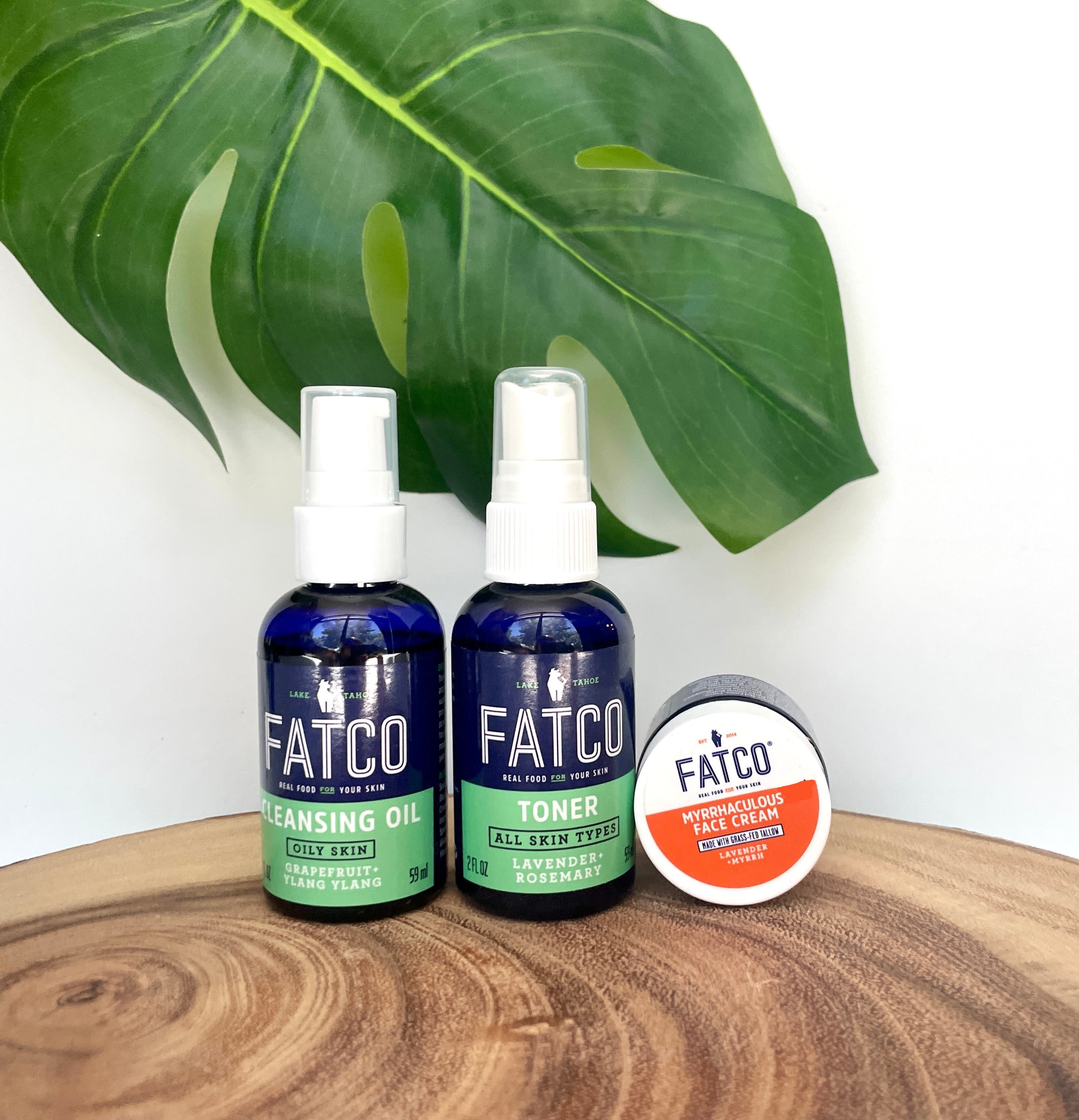
The lightest formula with the shortest ingredient list you can find, used sparingly at night. Oily and reactive skin usually reacts to the scent rather than the oil, so count the essential oils on the label first. FATCO's plant-oil Cleansing Oil for Oily Skin is one starting point.
The FATCO Alternative
FATCO's face oils are plant-oil serums rather than tallow, which surprises people who know the brand for its creams. The Myrrhaculous Face Oil layers seventeen organic botanical oils, jojoba, grapeseed, rosehip seed and tamanu among them, and goes over a cream rather than instead of one. Be straight about the scent question, though. It carries lavender and myrrh essential oil, so patch test the jawline if fragrance is your trigger. The Unmyrrhaculous Face Oil is the same blend with the myrrh removed. On the cleansing side, the Cleansing Oil for Oily Skin runs castor, grapeseed, olive and jojoba at the top of the label. Dry and normal/combo versions cover the other ends of the range. Tallow arrives later, in the face creams, where it shares several fatty acids with the skin's surface lipids.