Beef Tallow for Skin: What It Does, and Who Should Skip It

Beef tallow for skin does two things: it fills the gaps between surface skin cells, and it slows the rate at which water leaves. That is the whole verified mechanism. Most of what gets claimed beyond it is either overstated or untested, and the honest version is still a good enough reason to try a jar.
Key Takeaways
- Tallow and human sebum share high proportions of palmitic and oleic acid, and the overlap stops there. Sebum also carries squalene, wax esters and sapienic acid, none of which tallow contains.
- The strongest published claim is compositional, not clinical. A 2024 scoping review found tallow biocompatible with skin while reporting significant research gaps and almost no work in human subjects.
- The vitamin story does not hold. USDA reference data puts beef tallow at zero vitamin A and zero vitamin K, leaving vitamin E and a trace of D.
- It suits dry, mature and reactive skin, and it is a poor first pick for oily skin. The sheen is real, the scent depends on the filtering, and it is not vegan.
What Beef Tallow Actually Is
Tallow is rendered beef fat. Hard fat from cattle, usually the suet around the kidneys and loins, is melted at low heat, strained clean of water and protein, and cooled into a firm white block. Nothing is added. Skincare tallow is filtered further than kitchen tallow, and what separates one jar of tallow from another is the source fat, the animal's diet, and how thoroughly it was filtered.
What Tallow and Human Skin Actually Share
This is where most writing on the subject goes wrong, so here is the precise version.
USDA FoodData Central's entry for beef tallow, fdcId 171400, measures 36.0 g oleic acid, 24.9 g palmitic acid and 18.9 g stearic acid per 100 g. As shares of total fatty acids that works out to roughly 38, 26 and 20 percent. A 2025 cross-sectional analysis in the Journal of Cosmetic Dermatology states that tallow and human sebum both carry high proportions of palmitic acid and oleic acid. That overlap, the paper says, lets tallow integrate into the skin's lipid matrix and support barrier function.
The overlap is partial, and the gaps are the interesting part. Human sebum's characteristic monounsaturated fatty acid is sapienic acid, which a review in Dermato-Endocrinology describes as unique to human sebum and about a quarter of its total fatty acids. The same review reports squalene and wax esters at roughly 12 and 26 percent of sebum, and says both are found nowhere else in the body. Tallow contains none of those three. Stearic acid, tallow's third-largest fatty acid, is not a sebum component at all.
So tallow is compatible with the fats your skin makes rather than a copy of them. That is a smaller claim than the one printed on most tallow packaging, and it is the one that survives being checked.
The vitamin story does not survive. USDA reference data puts beef tallow at zero vitamin A and zero vitamin K, with vitamin E at 2.7 mg and vitamin D at 28 IU per 100 g. Tallow is a fat, not a supplement. Eating it raises a separate argument about saturated fat, and whether beef tallow is healthy to eat settles nothing about putting it on your face.
What the Evidence Supports, and Where It Stops
The best available review is a 2024 scoping review in Cureus, and it is worth reading for what it declines to claim. Its authors screened 147 papers and included 19, spanning comparative, basic-science and animal work, with no randomized trials on human skin. They concluded that tallow looks biocompatible with skin on compositional grounds. They also wrote that significant research gaps remain, that most published evidence lacks human subjects, and that no direct research exists on the mechanism by which tallow crosses the skin barrier.
Two findings inside that same review get left out of most summaries. Plain tallow fat left an oily surface, which the authors said may deter oily or acne-prone skin. And its own conclusion states that pumpkin seed oil and linoleic acid offered superior hydrating and moisturizing benefits to tallow.
The 2025 analysis cuts both ways too. It notes that palmitic and stearic acid may support stratum corneum repair, then adds that oleic acid and other free fatty acids can raise water loss through the skin over time.
What Using It Is Actually Like
It arrives solid. A tallow cream is firm at room temperature, wants a few seconds of warming between your fingertips, and goes on as an oil rather than a cream.
For the first ten to fifteen minutes your face will look shiny. Most skin dulls that down. A matte finish this is not, and that single fact decides whether people keep using it. Give any switch two weeks before judging it. That is the same window FATCO quotes for oil cleansing, and it helps to know how a tallow face cream behaves day to day before you commit a jar.
Scent is the other surprise. Well-filtered tallow smells of very little. Poorly filtered tallow smells like a roasting pan.
Who It Suits, and Who Should Skip It
| Skin type | Verdict | Why |
|---|---|---|
| Dry | Strong fit | Nothing evaporates off, so every gram stays working |
| Mature | Strong fit | Oil production falls with age, and this replaces lipids directly |
| Sensitive or reactive | Usually a fit | Short ingredient lists give fewer things to react to |
| Combination | Selective | Tallow on dry cheeks, nothing across an oily T-zone |
| Oily or congested | Poor first pick | The 2024 review named the oily surface as a deterrent |
| Active inflammatory acne | Skip for now | A rich occlusive is the wrong experiment mid-flare |
| Vegan | Not an option | Tallow is an animal byproduct, and cruelty-free is not vegan |
People with eczema-prone skin often land here too, though tallow is an emollient rather than a treatment for the condition, and an occlusive belongs nowhere near broken or weeping skin.
The Honest Downsides
Five of them, none of which a tallow brand enjoys writing down.
It is heavy, and heaviness is a preference. Some people love the cushioned feel. Others find any fat-based product uncomfortable regardless of what it is made from.
It can go rancid. No water means no preservative system is needed, but the fat itself oxidizes eventually. Store it cool and dark, and trust your nose.
Nobody has rated it for pores. Tallow has no published comedogenic rating in either direction, because it never appeared in the original rabbit-assay screens or the modern review tables. Anyone quoting you a number is quoting a consumer database. The 2025 analysis says outright that the non-comedogenic label attached to tallow online warrants further study.
It is an animal product, and it can sensitize. That same analysis notes bovine products may induce sensitizing allergic reactions in people with atopic dermatitis or sensitive skin. Patch-test on your jawline or inner forearm for several days.
Grass-fed is not a regulated term. USDA's Agricultural Marketing Service withdrew its livestock marketing claim standards on 12 January 2016, at 81 FR 1386. Treat any grass-fed line, FATCO's included, as the brand's sourcing claim rather than a certified one.
The Case Dermatologists Make
Cleveland Clinic published a piece in February 2026 arguing there is no evidence of a benefit beyond ordinary moisturizing. Dermatology resident Angela Wei lists four risks there: clogged pores from the thick consistency, irritation in rosacea, allergic reactions, and more sensitivity to sunburn. She adds that many tallow products carry fragrance to cover the smell, which is its own irritant. The same piece notes that tallow is unregulated and unpreserved, so quality and shelf life vary between products.
Most of that lands, and this article has already granted the evidence point, the regulation point and the rancidity point. The fragrance point is fair and specific: plenty of tallow products carry essential oils, FATCO's face creams among them.
Where the argument overreaches is the pore claim, which is asserted without any rating behind it. And no benefit beyond a moisturizer is a smaller criticism than it sounds. Being a good moisturizer is what most people want from a moisturizer.
Got Questions?
Frequently Asked Questions
Q What does beef tallow do for skin?
Two things, both ordinary. It fills the gaps between surface skin cells, and it forms a layer that slows water loss. Tallow is not delivering vitamins or actives, and USDA data puts its vitamin A and vitamin K at zero. Judge it as a moisturizer.
Q Why don't dermatologists like beef tallow?
Mostly because the evidence is thin. Cleveland Clinic's position is that no research shows a benefit beyond ordinary moisturizing, and it flags irritation, allergic reaction and unregulated quality. Tallow is also unpreserved, so it can go rancid. None of that makes it harmful, only unproven.
Q Is beef tallow good for oily skin?
Usually not as a first choice. The 2024 Cureus review reported that plain tallow fat left an oily surface, which its authors said may deter oily or acne-prone users. If you blot by noon, a lighter formula serves you better. Patch-test before committing either way.
Q Is beef tallow a natural sunscreen?
No. Tallow carries no sun protection factor, and Cleveland Clinic notes it is not known to have sun protective qualities and, being a thick oil, may increase sensitivity to sunburn. Use a tested, labeled broad-spectrum sunscreen and put your tallow underneath it.
Q Is tallow better than retinol?
They are not competing. Retinol is a vitamin A derivative that changes cell turnover, while tallow is a moisturizer with no measurable vitamin A in USDA data. Cleveland Clinic makes the same point directly. Use tallow for dryness and a real retinoid for what retinoids do.
Q Is tallow butter good for skin?
Tallow butter usually means whipped tallow, the same fat aerated or blended with plant butters into a softer texture. It behaves the same way on skin, and only the spreadability changes. FATCO's Calming Body Butta is that format, built for body skin where a richer layer is easier to wear.
The FATCO Alternative
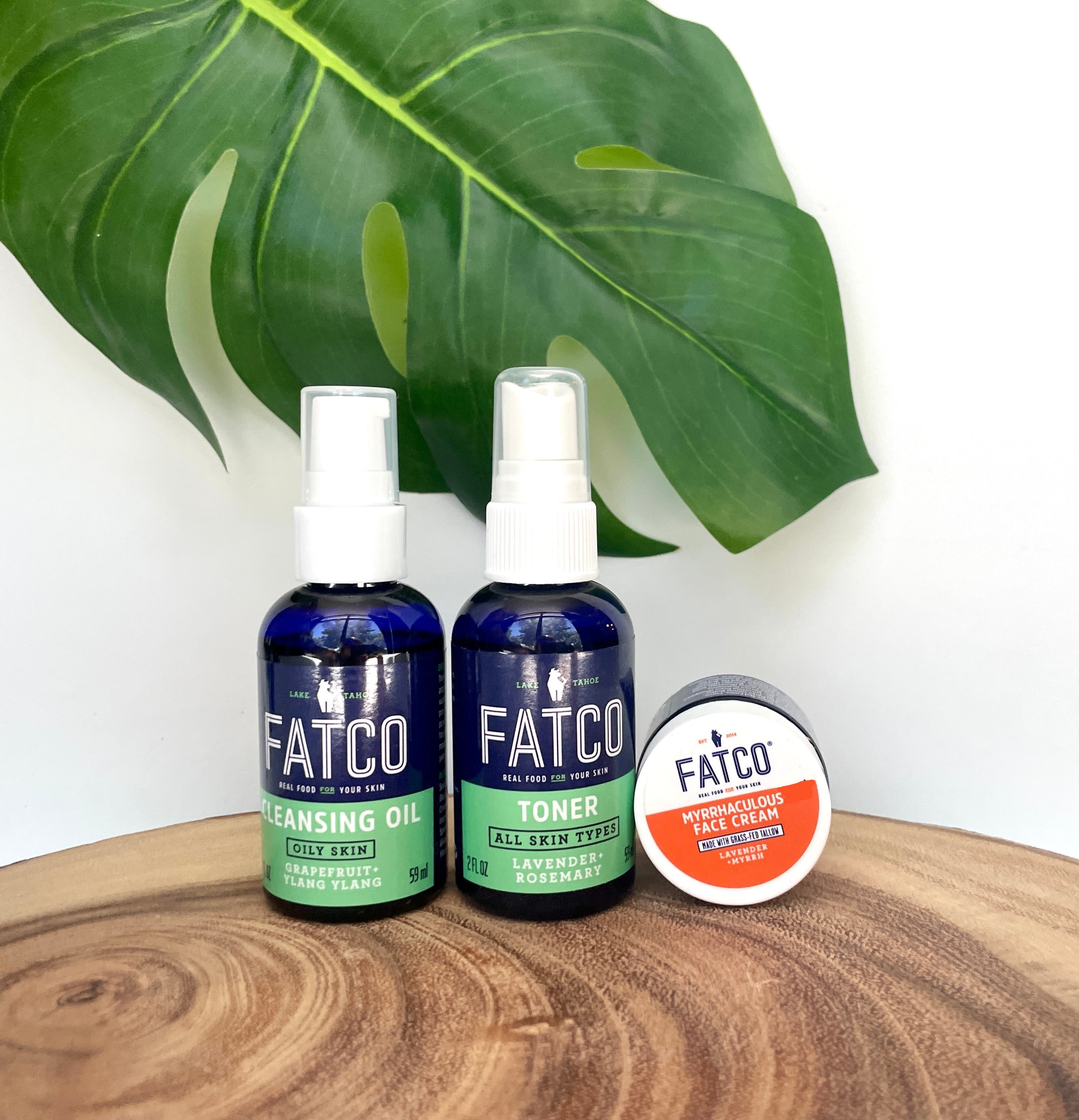
FATCO makes the narrow version of this pitch, because the narrow version is the one that holds. Myrrhaculous Face Cream opens with tallow from grass-fed cows, then coconut oil, shea butter and jojoba. After those come pumpkin seed, olive and avocado oils, beeswax, and a stack of rosehip, evening primrose, borage, moringa and argan. No water, so no preservative system, and a pea-sized amount morning and evening. It carries lavender and myrrh essential oils, so it is not the pick if fragrance is what you are avoiding. If your skin is dry, mature or reactive and your current lotion has stopped working by lunch, it is worth two weeks of your time.
FATCO Tallow Skincare
Grass-Fed. Suet-Sourced. Dry-Rendered.