Sensitive Skin Care: A Simpler Routine That Calms Instead of Provokes

If your skin reacts to nearly every product you try, the problem likely isn't your skin. It's the products. Sensitive skin care works best when you stop layering and start stripping back.
Key Takeaways
- Sensitive skin reacts because the barrier is impaired, not because the skin is inherently fragile.
- Fewer ingredients mean fewer opportunities for a reaction. A 3-step routine covers everything most sensitive skin needs.
- Fragrance, alcohol denat, and harsh surfactants are the most common triggers hiding in products labeled "gentle."
- Tallow-based formulas suit some reactive skin because tallow shares fatty acids with the skin's surface lipids, works as an occlusive, and keeps the ingredient count low. Note the caveats: FATCO's face creams and most of its soap bars are scented with essential oils, and an essential oil is still fragrance.
- If symptoms persist despite a simplified routine, see a dermatologist. Conditions like rosacea or eczema benefit from a clinical diagnosis.
Why Sensitive Skin Reacts
Sensitive skin describes a pattern of reactivity rather than a single diagnosis. The skin flushes, stings, itches, or breaks out in response to products, temperature shifts, or stress. Cleveland Clinic calls it very common. Self-reported rates differ widely because the definition does: a UK survey put it at 51.4% of women and 38.2% of men, a wider European study at 38.4% of the population, and a Brazilian study at 45.7% of women and 22.3% of men.
The common thread is a compromised skin barrier. The outermost layer of the epidermis, the stratum corneum, acts as a physical seal. It's made up of skin cells held together by a mortar of lipids: ceramides, fatty acids, and cholesterol. When that lipid layer is depleted or disrupted, two things happen. Irritants and allergens get in more easily, and moisture escapes faster. The skin becomes both reactive and dry at the same time.
Ceramide depletion is a significant part of the story where the skin is atopic. Reviews of ceramide abnormalities in atopic dermatitis report that total stratum corneum ceramide levels are significantly reduced compared with healthy controls, and that the reduction tracks with higher water loss through the skin. That is a specific finding about atopic dermatitis rather than about every reactive complexion, but it is the clearest picture we have of what a depleted lipid mortar does.
The nervous system may play a role too. A 2022 review in Frontiers in Pain Research argues that sensitive skin behaves like a small-fiber neuropathy, pointing to a measured decrease in intra-epidermal nerve fiber density in affected people, abnormal results on quantitative sensory testing, and overlap with irritable bowel syndrome and sensitive eyes. Note the direction: the finding is altered and reduced nerve fibers, not extra ones. The skin isn't being dramatic. The signalling itself looks different.
The practical takeaway: if your barrier is depleted, an ingredient doesn't have to be particularly harsh to provoke a response when the barrier is compromised. Even mild compounds can provoke a response when the seal is broken.
The Less-Is-More Philosophy
The instinct when skin reacts is to add something. A calming serum. A barrier repair cream. A targeted treatment. This almost always makes things worse.
Every new product adds new potential triggers. An 8-ingredient moisturizer and a 7-ingredient serum give you 15 different compounds your sensitized skin must process. If a reaction occurs, you have no idea which one caused it.
The more useful instinct is subtraction. What can you take out? The most effective sensitive skin care routines are boring by design. They repeat the same two or three steps every day, using the same products, so the skin gets consistent input and recovers its baseline rather than constantly adapting to something new.
This is sometimes called the "skin fasting" or "skin reset" approach. You temporarily run a minimal routine until the barrier settles, then reintroduce anything you need one product at a time with a gap of at least two weeks between introductions.
The 3-Step Minimal Routine
Step 1: Gentle Cleanse
Cleansing is necessary but it is also the step most likely to disrupt the barrier if done wrong. Foaming cleansers and those with sulfates strip the skin's natural oils along with the dirt. For sensitive skin, a cream or oil-based cleanser does the job with less disruption.
What to look for: a short ingredient list, no fragrance (including "natural fragrance"), and no added acids. The skin should feel soft and not tight after washing. Tightness after cleansing is a sign the barrier has been disturbed.
Tallow soap, made through traditional saponification, uses no synthetic surfactants at all and produces a mild, creamy lather from a very short ingredient list. That short list is its real advantage over a product with 20 ingredients and added "skin benefits."
Be clear-eyed about the trade-off, though. Saponification requires a strong alkali, so every true soap bar is alkaline, and a 2022 review of soaps and syndets in Molecules concludes that syndets are usually the better choice for barrier integrity for exactly that reason. If pH is your priority while a barrier is actively compromised, an acidic liquid cleanser beats any bar, ours included.
One more label check: only one of FATCO's bars is free of added scent. The Baby Fat Bar lists grass-fed beef tallow, sodium hydroxide, colloidal oats, calendula, olive oil, distilled water, sucrose and sodium lactate, with no essential oils. The Lavender, Lemongrass and Coffee bars are all scented, so screen the label rather than the brand.
If you wear minimal makeup or no makeup, you may not need to cleanse in the morning at all. A splash of water or a gentle rinse is enough.
Step 2: Moisturize
Moisturizing after cleansing restores what washing removed. For sensitive skin, the goal is occlusion (sealing in moisture and blocking irritants) plus barrier support.
The best moisturizers for sensitive skin have a few things in common: they don't contain fragrance or fragrance-adjacent ingredients like "parfum," they're free of alcohol denat, and they use simple fat-based emollients rather than long lists of active compounds.
This is where tallow fits. USDA reference data for beef tallow (SR Legacy, fdcId 171400) gives 36 g of oleic acid, 24.9 g of palmitic acid and 18.9 g of stearic acid per 100 g, and all three of those also appear among the skin's surface lipids. That overlap is the compatibility argument, and it is worth stating its limit: the formulations shown to rebuild a depleted barrier combine ceramides, cholesterol and free fatty acids in ratio. Tallow supplies fatty acids, not that full mixture, so the defensible claim is a compatible occlusive with a short ingredient list rather than a barrier-repair formulation.
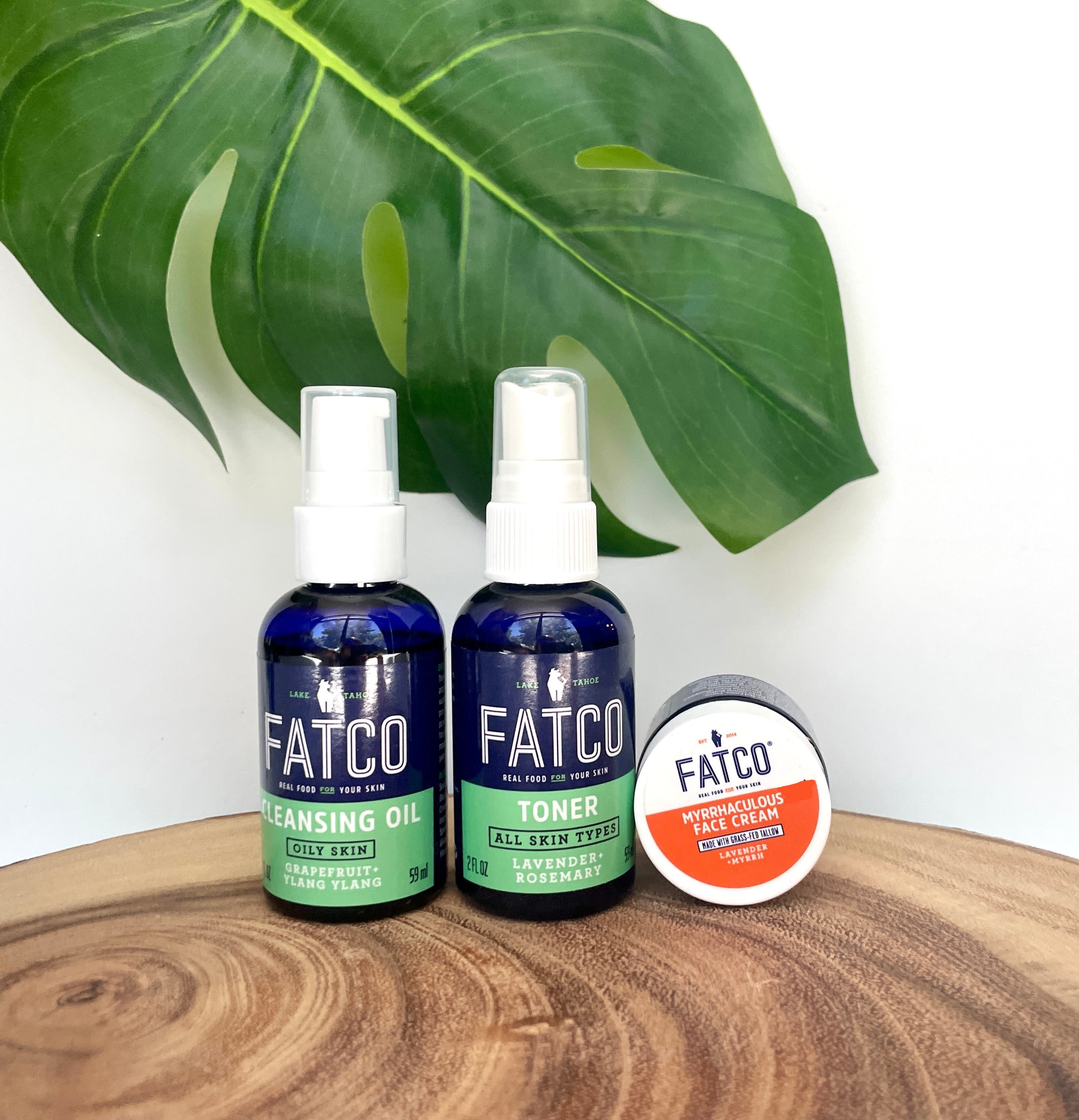
That is why tallow-based products like FATCO's Myrrhaculous Face Cream and Unmyrrhaculous Face Cream show up in sensitive skin routines: a short list, no synthetic fragrance, no synthetic preservatives or emulsifiers. Both are scented with lavender essential oil, and Myrrhaculous adds myrrh, so neither is fragrance-free in the strict sense a reactive complexion may need.
Applying moisturizer to slightly damp skin, right after washing, helps trap water in the skin before it evaporates.
Step 3: Protect
Sun exposure is one of the most reliable ways to aggravate sensitive skin, and UV is a documented driver of cutaneous inflammation and photodamage. Daily SPF is not optional if you're trying to calm reactivity.
The challenge is that many sunscreens are themselves triggers, and some of the chemical filters are on the photoallergen list. The American Academy of Dermatology makes the practical call for you: dermatologists recommend physical sunscreens for people with sensitive skin, meaning products whose active ingredient is titanium dioxide, zinc oxide, or both. The AAD notes the same ingredients may cause less irritation on the sensitive skin of infants and toddlers.
Beyond the filter, look for a short ingredient list, no added fragrance, and no alcohol denat.
At night, you can skip sunscreen and simply double your moisturizer application if your skin feels tight or reactive after the day.
Ingredient Red Flags for Sensitive Skin
The ingredient list tells you more than the front-of-pack claims. These are the most common offenders:
Fragrance (including "natural fragrance"): A 2025 review of contact allergy to cosmetics reports that fragrances and essential oils remain the main contact allergens in cosmetics, with more than 150 fragrance materials known to be allergenic. The same review notes that most of the essential oils used in products marketed as natural are themselves common fragrance sensitizers, so "natural fragrance" carries the same risk, not less. Linalool and limonene, the terpenes in lavender and citrus oils, are barely allergenic on their own but their air-oxidation products are much more so. If your skin is reactive, fragrance-free formulas are not a nicety. They're a baseline.
Alcohol denat: Found in many toners, serums, and "lightweight" moisturizers, denatured alcohol evaporates quickly and disrupts the skin's surface lipids. Short-term it can feel refreshing. Longer term it depletes the barrier. Look for it on labels as "alcohol denat," "ethanol," or near the top of the ingredient list.
Harsh surfactants: Sodium lauryl sulfate (SLS) and sodium laureth sulfate (SLES) are found in many foaming cleansers and body washes. They clean effectively but at the cost of stripping the barrier's natural oils. The Molecules cleanser review singles out sodium cocoyl isethionate as a mild surfactant whose cleansers disturb the stratum corneum lipid region less than the alternatives it was compared against.
Overlapping actives: Retinol, glycolic acid, lactic acid, vitamin C, and niacinamide are all legitimate skincare actives. On reactive skin, combining them adds acid burden and can overwhelm the barrier's repair capacity. If you use any active ingredients, use one at a time, not nightly, and not while the barrier is actively compromised.
Common Triggers and Gentler Swaps
| Common trigger | What to swap it for |
|---|---|
| Fragrance (synthetic) | Fragrance-free formulas only |
| Alcohol denat in toners | Skip toner entirely or use plain water mist |
| Foaming cleanser with SLS | Cream or oil cleanser, or a syndet bar if pH is the priority |
| Chemical sunscreen (oxybenzone, avobenzone) | Mineral sunscreen with zinc oxide or titanium dioxide |
| Multi-active serum stack | One active maximum, 2-3 nights a week |
| Exfoliating scrub | Soft washcloth or no exfoliation during a barrier reset |
| "Natural fragrance" essential oil blend | Fragrance-free formulas, not unscented ones. The AAD's wording is to "choose fragrance-free (rather than unscented) products", because unscented can mean the scent was masked rather than left out |
Patch-Test Everything, Then Introduce One at a Time
Even products marketed for sensitive skin can trigger a reaction in a specific individual. Before adding any new product to your routine, apply a small amount to the inside of the wrist or behind the ear and wait 24 to 48 hours. No reaction suggests a reasonable chance your face will tolerate it too. A reaction is the product telling you something clearly.
After a barrier reset, introduce new products one at a time with at least two weeks between each addition. This sounds slow. It is slow. It is also the only way to know what's working.
If you experience persistent redness, burning, or recurring rashes that don't resolve with a simplified routine, see a dermatologist. Rosacea is one distinct condition that benefits from clinical diagnosis and more targeted treatment. Eczema and contact dermatitis are others. A patch test performed by a dermatologist can identify specific allergens in a way no elimination protocol at home can replicate.
What's Actually Happening When You Simplify
Skin renews itself slowly, and slower still with age. The classic measurement, Grove and Kligman in the Journal of Gerontology in 1983, tracked a fluorescent dye off the skin surface and found stratum corneum transit time of about 20 days in young adults, lengthened by more than 10 days in older ones, with the decline steepening after age 50. Either way, you are working in weeks, not days. When you remove triggers and let the barrier repair undisturbed, the skin's inflammatory signalling quiets and products that previously caused reactions may become tolerable again.
The goal of a sensitive skin care routine isn't to find the perfect product. It's to stop interfering long enough for the skin to do what it's designed to do.
That's why FATCO's approach to skincare is built around fewer ingredients, not more. If you're managing a disrupted barrier and want to understand whether products are helping or hurting, the guide on skincare routines and skin barrier damage is a useful starting point. The same logic explains why tallow soap suits sensitive skin, worth knowing before you commit to a cleanser. And if you're comparing moisturizer options while rebuilding your barrier, the review of moisturizers for combination skin covers several formulas that also suit reactive skin types.
Got Questions?
Sensitive Skin FAQ
Q What does sensitive skin care actually mean?
Sensitive skin care means routines and products built to minimize irritation, stinging, or reactivity. The key features are low ingredient counts, no fragrance, no harsh surfactants, and formulas that support rather than disrupt the skin barrier. It's less a product category than a way of building the routine.
Q What ingredients should I avoid if I have sensitive skin?
The most common triggers are fragrance (listed as "fragrance," "parfum," or "natural fragrance"), alcohol denat, harsh surfactants like sodium lauryl sulfate, and overlapping actives like multiple acids or retinol with vitamin C. Patch-test new products and eliminate one variable at a time to identify your specific triggers.
Q Can natural or "clean" products still irritate sensitive skin?
Yes. Natural ingredients aren't automatically gentle; essential oils are among the most common contact allergens in personal care products. "Clean personal care" labeling describes what's excluded, not how a formula behaves on reactive skin. Fragrance-free and minimal-ingredient formulas are more reliable criteria than "natural" or "organic" claims.
Q Is tallow soap good for sensitive skin?
It depends on what your skin reacts to. Tallow soap cleanses through saponified fat rather than synthetic surfactants and keeps the ingredient list very short. But all true soap is alkaline, and cleanser reviews favour syndets on pH grounds, so if a raised skin pH is your problem an acidic liquid cleanser is the better pick. Of FATCO's bars, only the Baby Fat Bar has no added scent.
Q What makes tallow-based skincare a good option for sensitive skin?
Tallow shares its three main fatty acids, oleic, palmitic and stearic, with the skin's surface lipids, and it works as an occlusive that slows water loss. Products formulated with tallow also tend toward short ingredient lists and no synthetic fragrance. It is not a barrier-repair formulation, though, and most finished tallow creams including FATCO's add essential oils.
Q Do I need to see a dermatologist if my skin is sensitive?
Not urgently, if a simplified routine resolves your reactivity within six to eight weeks. See a dermatologist if your skin keeps reacting, develops persistent redness, or shows signs of eczema, rosacea, or contact dermatitis. They can patch-test, diagnose underlying conditions, and prescribe options a simplified routine can't address.
The FATCO Alternative
The principles behind a minimal sensitive skin care routine align with what FATCO has been doing since the beginning: real ingredients, short lists, no synthetic fragrance, and fats that share their main fatty acids with the skin's own surface lipids. The Myrrhaculous Face Cream and Unmyrrhaculous Face Cream are the most straightforward options for the moisturizing step. For cleansing, the Baby Fat Bar is the one with no added scent, though it is true soap and therefore alkaline, so reach for a Cleansing Oil instead if pH is your sticking point. We don't make a sunscreen, so the SPF step is someone else's job, and persistent reactivity is a dermatologist's.