Ceramide Moisturizers vs Tallow: Two Paths to Barrier Repair

A ceramide moisturizer and a jar of tallow are both sold as barrier repair, and they are not doing the same thing. Ceramides are one of the lipid families your outer skin builds its own structure from. Tallow is a rendered fat that sits on the surface and slows water loss. Which one you need depends on whether your barrier is depleted or simply exposed.
Key Takeaways
- The barrier's mortar is three lipid families, not one. The stratum corneum is held together by ceramides, cholesterol and free fatty acids arranged in stacked sheets called lamellae. Ceramides are the largest share of that mixture by mass.
- A ceramide moisturizer puts back something the skin is measurably short of. In atopic dermatitis, ceramide levels are reduced and the chains are shorter than in unaffected skin.
- The measured benefit is real and modest. A 2023 meta-analysis found ceramide moisturizers beat other moisturizers on eczema severity by about one point, with no significant difference in water loss.
- Tallow works by covering, not by resupply. Its fatty acids arrive bound up in triglycerides, no ceramide fraction is reported in its composition, and USDA reference data puts its cholesterol at 109 mg per 100 g.
- If your barrier is genuinely ceramide-depleted, tallow is not the shortcut. It is a good occlusive with a very short ingredient list, and that is a different job from replacing a missing lipid.
What the Skin Barrier Is Actually Made Of
The outermost layer of your skin is often described as bricks and mortar. The bricks are flattened dead cells. The mortar is a lipid mixture, and its composition is specific. A 2023 systematic review and meta-analysis in the Indian Journal of Dermatology describes it as extracellular lipids, "mainly ceramides, cholesterol, and free fatty acids that form the lipid lamellae".
Those lamellae are the reason the mixture matters more than any single ingredient. The three lipid classes stack into ordered sheets, and the ordering is what keeps water in and irritants out. The same review calls ceramide "a major lipid class by mass (~50%)" of that mortar. That is why ceramides get named on the front of the bottle and cholesterol rarely does.
Two things follow. A product that adds ceramides is topping up the largest single component. A product that adds none is doing something else, which may still be useful.
What a Ceramide Moisturizer Does
It supplies the lipid that compromised skin tends to run short of. In atopic dermatitis, the review reports reduced ceramide levels and shorter ceramide chain lengths, and links that shortfall to increased barrier permeability. That is a real, measured deficit rather than a marketing premise, and it is the strongest argument the category has.
Now the size of the effect, which the same paper is unusually honest about. Pooling two randomized trials, ceramide moisturizers reduced eczema severity scores more than the comparison moisturizers did, with a mean difference of 0.98 points. Pooling three trials on water loss through the skin, there was no significant difference at all. The authors' summary is that ceramide moisturizers are more effective at improving severity but "are not better at improving TEWL when compared to other moisturisers".
So a ceramide moisturizer is worth reaching for when the barrier is inflamed and reactive. It is not a different category of product, and the two severity trials it pooled were small and ran four weeks. A dedicated eczema cream usually pairs ceramides with colloidal oatmeal for that reason, rather than relying on the lipid alone.
What Tallow Does
Tallow is rendered beef fat, and its fatty acids arrive esterified in triglycerides rather than as the free fatty acids the lamellae are built from. USDA reference data gives 36.0 g of oleic acid, 24.9 g of palmitic acid and 18.9 g of stearic acid per 100 g. That works out to roughly 38, 26 and 20 percent of total fatty acids. Cholesterol comes in at 109 mg per 100 g, about a tenth of one percent by weight. Ceramides are not among the lipids reported for it.
The compatibility argument rests on the fatty acids. A 2025 analysis in the Journal of Cosmetic Dermatology puts it precisely: both tallow and human sebum have high proportions of palmitic and oleic acid. The overlap is partial, not a match. Skin's leading monounsaturate is sapienic acid rather than oleic, sebum also carries squalene and wax esters that tallow has none of, and stearic acid is not a sebum fatty acid.
What tallow does well is sit there. It is an occlusive and an emollient, so it slows evaporation and softens rough texture. That is the same distinction that separates moisturizers that sit on the surface from the ones that sink in. For skin that is dry because the air is dry or the cleanser was harsh, that is often enough.
The same 2025 analysis also cuts against tallow, and it is worth saying so. Oleic acid is a recognized skin penetration enhancer, and ultrastructural work shows it disrupts stratum corneum lipid packaging and may increase permeability. Studies in human and reconstructed-skin models found that oleic acid and other free fatty acids can raise water loss over time. Oleic acid is tallow's largest fatty acid. That is a caveat, not a verdict, and the same paper notes that palmitic and stearic acid may support barrier repair.
Ceramide Moisturizer vs Tallow at a Glance
| Ceramide moisturizer | Tallow | |
|---|---|---|
| What it supplies | Ceramides, usually with humectants and occlusives | Triglycerides, mostly oleic, palmitic and stearic |
| How it works | Replaces a lipid the barrier is short of | Slows water loss from the surface |
| Published evidence | Randomized trials and a 2023 meta-analysis in atopic dermatitis | No human trial of tallow itself; the evidence is about its fatty acids |
| Ingredient list | Multi-ingredient emulsion with preservatives | Can be as short as one fat, or a fat plus plant oils |
| Best suited to | Diagnosed eczema, reactive skin, a barrier that is depleted | Dry, tight, weather-worn skin with no diagnosis |
| Main limitation | Modest measured margin over ordinary moisturizers | Supplies no ceramides; oleic acid has a disruption literature |
Which One Your Skin Actually Calls For
Start with the honest question: is your barrier depleted, or is it exposed?
Depleted looks like skin that reacts to products it used to tolerate, stings on application, stays red, and flakes again a few hours after moisturizing. If a dermatologist has diagnosed eczema, that is the depleted picture with a name on it, and the ceramide route is the one with trial evidence behind it. Reaching for a fat because it is simpler will not put back a lipid that is missing.
Exposed looks like skin that feels tight after washing, roughens in winter, and settles quickly once you stop stripping it. Nothing is missing there. A plain occlusive fat handles it, which is how a tallow moisturizer behaves on skin: it slows the evaporation and lets the skin rebuild on its own schedule.
The two are not mutually exclusive. Ceramide creams are usually built with occlusives in them already, so layering a heavy fat on top mostly adds thickness. If products of every kind provoke a reaction, the bottleneck is choosing a moisturizer for sensitive skin with the shortest tolerable ingredient list, whichever lipid it is built around.
One more practical note. Tallow has never been given a formal comedogenic rating in the primary studies, so any number attached to it online was inferred rather than measured. If you are acne-prone, patch test on a small area before committing either product to your whole face.
Got Questions?
Frequently Asked Questions
Q Does beef tallow have ceramides?
No. Tallow is rendered fat, made almost entirely of triglycerides built from oleic, palmitic and stearic acid. Ceramides are a separate lipid class that skin makes itself, and they are not among the components reported for tallow. Any ceramide in a product was added separately.
Q Do ceramide moisturizers actually work?
Yes, modestly and measurably. A 2023 systematic review and meta-analysis found ceramide moisturizers improved eczema severity scores more than other moisturizers, by a mean difference of about one point. On water loss through the skin they were no better. Real benefit, smaller than the marketing suggests.
Q Is a ceramide moisturizer better than a normal moisturizer?
For a depleted barrier, somewhat. The pooled trial advantage over ordinary moisturizers was about one severity point in atopic dermatitis, with no measured difference in water loss. For ordinary winter dryness with no diagnosis, a plain occlusive does the same job for less money.
Q How long do ceramides take to repair the skin barrier?
No source gives a fixed timeline. The two severity trials in the 2023 meta-analysis measured at two and four weeks, and that is where the modest improvement showed up. Skin renews continuously, so treat a few weeks as the window for judging, not a repair deadline.
Q Are ceramides good for eczema?
The evidence supports them. People with atopic dermatitis have reduced ceramide levels and shorter ceramide chains, and ceramide moisturizers outperformed comparison moisturizers on severity scores. They are a supporting measure, though, not a replacement for the treatment plan a dermatologist puts you on.
Q Can you use tallow instead of a ceramide moisturizer?
Only if your problem is dryness rather than depletion. Tallow slows water loss and softens skin, and it contains no ceramides to replace what a compromised barrier is short of. For plain dry, tight skin it works well. For diagnosed eczema, it is not a substitute.
The FATCO Alternative
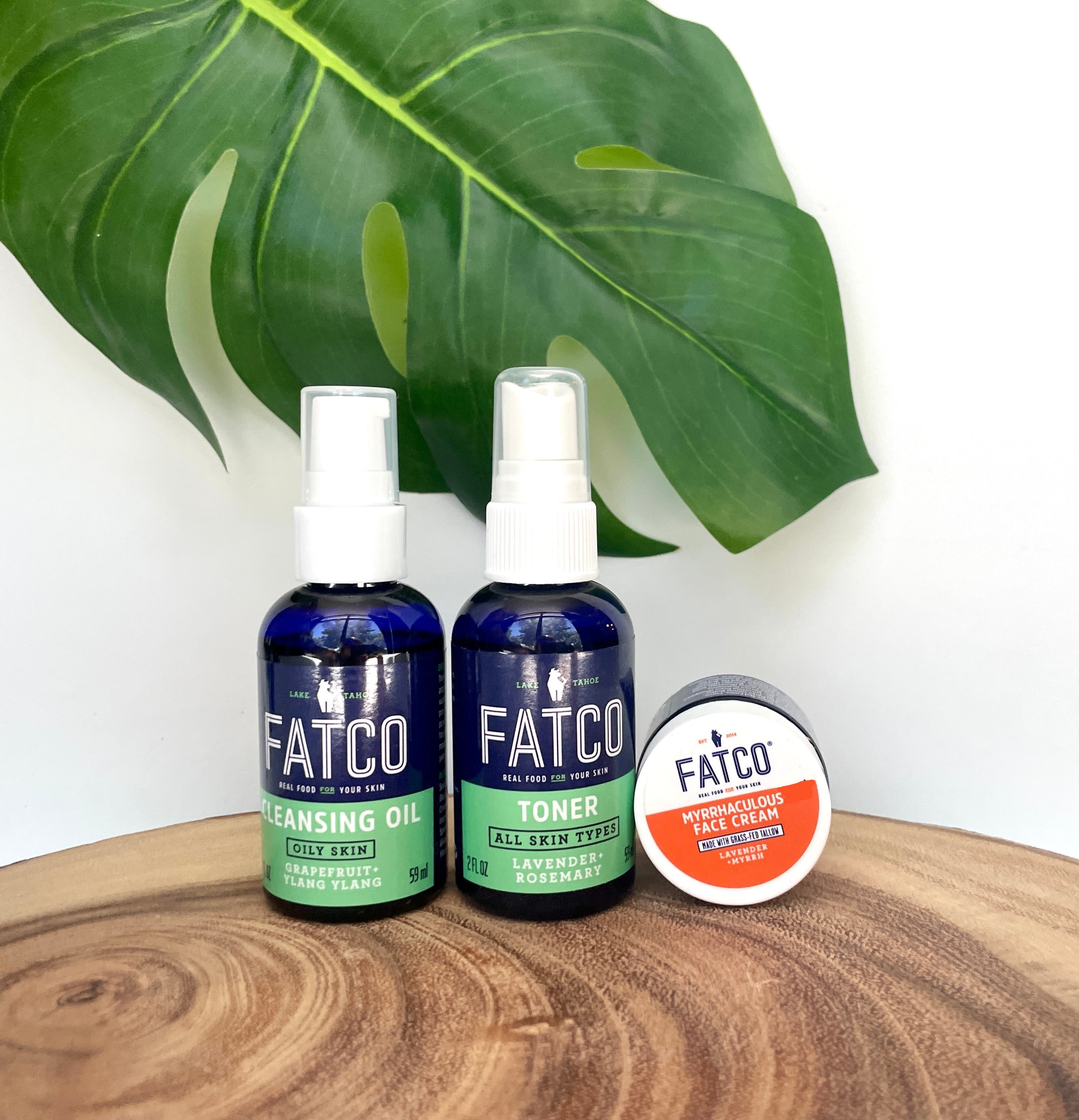
FATCO does not make a ceramide cream, and this is not the article where we pretend tallow is one. What we make is the simplest possible occlusive: grass-fed tallow with a short stack of plant oils, no synthetic fragrance, no parabens or sulfates. If your skin is dry, tight and weather-worn, that is exactly the right tool. The shortest label we make is Baby Butta, whose whole panel is tallow, coconut oil, shea butter, olive oil, avocado oil, jojoba oil and beeswax, with no added scent. If a dermatologist has told you your barrier is depleted, buy the ceramide cream and use ours underneath it or not at all. One caveat worth knowing before you shop: both Myrrhaculous and Unmyrrhaculous Face Cream contain lavender essential oil, and Myrrhaculous adds myrrh, so neither is fragrance-free.