Leaf Lard: The Highest-Grade Pork Fat and How It Compares to Tallow
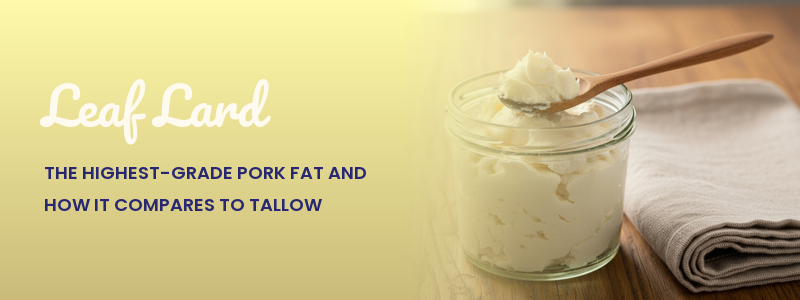
Leaf lard is the top grade of pork fat, and it is one of the few fat terms with a federal definition behind it: 9 CFR 319.702 reserves the name "Leaf Lard" for lard prepared from fresh leaf (abdominal) fat, the sheet-like deposits around the pig's kidneys and loin rather than the back fat most people picture when they hear the word "lard." Understanding what makes it distinct from ordinary lard, and how it sits alongside beef tallow, is genuinely useful for anyone curious about traditional animal fats.
Key Takeaways
- Leaf lard is a specific grade, not just any pork fat. The federal standard of identity defines "Leaf Lard" as lard prepared from fresh leaf (abdominal) fat, the visceral fat around the kidneys and loin, rather than the back fat used for ordinary lard.
- Its fatty acid profile is oleic-forward. USDA FoodData Central puts lard at 41.2 g oleic acid, 23.8 g palmitic acid, 13.5 g stearic acid and 10.2 g linoleic acid per 100 g. Those are several of the same fatty acids found in the skin's surface lipids, though the proportions are not a match.
- Beef tallow and leaf lard overlap in several ways, but diverge in key ratios. Per the same USDA reference, tallow carries more saturated fat (49.8 g against lard's 39.2 g per 100 g) and more stearic acid (18.9 g against 13.5 g), and it is firmer at room temperature. Lard is softer and lighter.
- Tallow is the animal fat the skincare evidence actually covers. The one peer-reviewed scoping review on animal fat and skin looks at tallow only and mentions lard nowhere, so a direct head-to-head on barrier performance does not exist in the literature.
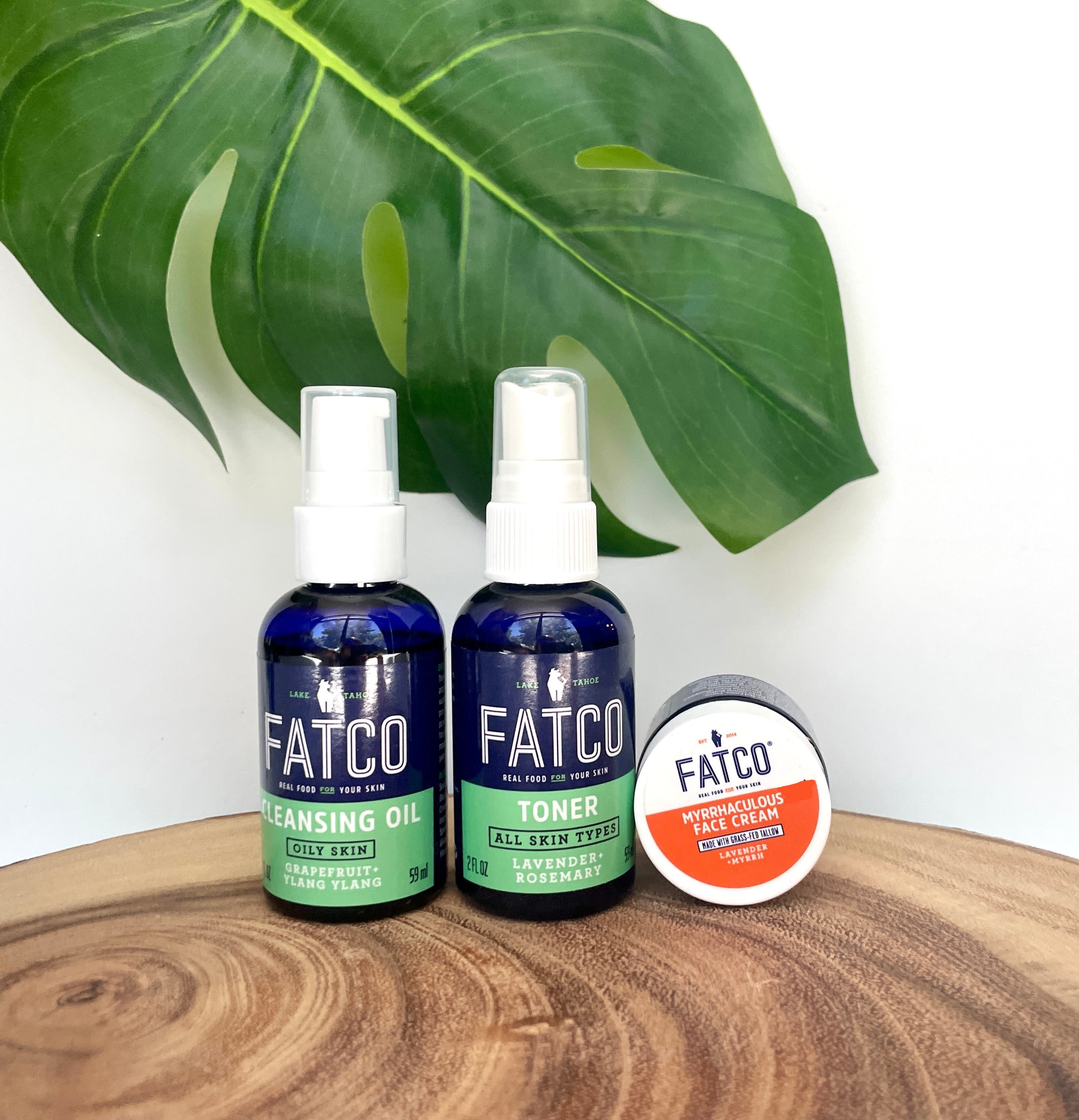
- FATCO uses grass-fed beef tallow, not pork fat. The sourcing is deliberate: a supply chain built around suet from grass-fed cattle, and no pork-related dietary or religious restrictions.
What Makes Lard "Leaf"
"Leaf" is the trade and regulatory term for the fat itself. The federal standard of identity for lard, at 9 CFR 319.702, defines "Leaf Lard" in one sentence: lard prepared from fresh leaf (abdominal) fat. That is the sheet-like visceral fat around the kidneys and loin, as distinct from the subcutaneous back fat along the spine that ordinary lard is usually rendered from.
Leaf lard is not the same product as what you typically find in a block at the grocery store, but the difference is not smell or color. The same regulation requires anything labeled "Lard" or "Leaf Lard" to be white when solid and free from foreign odors and flavors, so a shelf-stable block will meet that bar too. What separates them is what else is in the tub: Armour, the most widely distributed retail lard in the United States, lists its ingredients as lard and fully hydrogenated lard with BHA, propyl gallate and citric acid added to protect flavor. Leaf lard sold as leaf lard is single-ingredient rendered fat, and bakers seek it out for pie crust and pastry.
Rendered slowly at low temperature, leaf lard sets up as a stable, creamy white fat with very little residual odor. Do not expect much in the way of vitamins from it either way. USDA reference data reports lard at zero vitamin A and zero vitamin K, with vitamin D at 102 IU and vitamin E at 0.6 mg per 100 g. Beef tallow in the same database runs the other way on both measured vitamins, 28 IU of D and 2.7 mg of E, so neither fat is simply "richer" than the other.
The Fatty Acid Profile of Leaf Lard
Lard's composition, per USDA FoodData Central (fdcId 171401), breaks down as follows. All figures are grams per 100 g of fat, which is the basis USDA publishes.
| Fatty Acid | Grams per 100 g | Where it sits |
|---|---|---|
| Oleic acid (C18:1) | 41.2 | The single largest component, and a monounsaturate |
| Palmitic acid (C16:0) | 23.8 | Saturated |
| Stearic acid (C18:0) | 13.5 | Saturated, and lower than tallow's 18.9 |
| Linoleic acid (C18:2) | 10.2 | Polyunsaturated, and roughly triple tallow's 3.1 |
| Myristic acid (C14:0) | 1.3 | Saturated |
Total saturated fat sits at 39.2 g, monounsaturated at 45.1 g and polyunsaturated at 11.2 g per 100 g. That monounsaturated-dominant composition is what makes lard softer at room temperature than beef tallow, which USDA puts at 49.8 g saturated and 41.8 g monounsaturated.
A word on what that overlap does and does not mean. The skin barrier's own lipids are ceramides, cholesterol and fatty acids, as Cleveland Clinic describes in its explainer on a damaged skin barrier. The overlap between an animal fat and those lipids is real at the level of which fatty acids are present, and it stops there. A 2018 review in the Journal of Lipids reports that the most abundant monounsaturate on the human skin surface is sapienic acid, which neither lard nor tallow supplies, and that sebum also carries squalene and wax monoesters, which neither fat contains at all. Oleic acid does show up repeatedly in the transdermal literature as a penetration enhancer, but the mechanism described there is disruption of the stratum corneum's ordered lipid packing rather than a comfortable fit with it.
Leaf Lard in the Kitchen
Leaf lard's culinary reputation rests almost entirely on pie crust, where bakers use it for flakiness. It is also stable enough for pan-frying and sautéing: Fatworks, one of the larger US specialty renderers, states a smoke point of 370°F for its own pasture-raised pork lard, which is a brand figure for that jar rather than a fixed property of all lard.
Lard has a long history in soap making and in the pharmacy, where rendered animal fat served as an ointment base before petroleum-derived alternatives arrived. We have not been able to open a primary source that pins that history to leaf lard specifically rather than to lard generally, so treat it as background rather than a sourced claim. The better-documented case for pork fat on skin is compositional, not clinical.
Leaf Lard vs. Beef Tallow: An Honest Comparison
Both are ancestral, food-grade animal fats with long histories in cooking and traditional skincare. The differences between them are real but narrower than most people assume.
All four fats below are USDA FoodData Central reference entries, reported as grams per 100 g of fat so the columns are directly comparable. The database publishes a single beef tallow entry (fdcId 171400); it does not split the record by feeding system, and a 2010 review in Nutrition Journal found that total saturated fat does not actually differ between grass-finished and grain-finished beef, so no separate grass-fed row would be honest here.
| Fat | Source | Texture at Room Temp | Saturated (g) | Stearic (g) | Oleic (g) | USDA entry |
|---|---|---|---|---|---|---|
| Beef tallow | Cattle | Semi-solid, creamy | 49.8 | 18.9 | 36.0 | fdcId 171400 |
| Leaf lard, and lard generally | Pigs | Soft, spreadable | 39.2 | 13.5 | 41.2 | fdcId 171401 |
| Coconut oil | Coconut | Solid below 76°F | 82.5 | 2.5 | 6.3 | fdcId 171412 |
| Olive oil | Olives | Liquid | 13.8 | 2.0 | 71.3 | fdcId 171413 |
Where beef tallow differs: it carries roughly 40 percent more stearic acid than lard and a firmer set. A 2024 scoping review in the journal _Cureus_ examined tallow's composition against the skin barrier and concluded that on composition, tallow "looks to be biocompatible." The same review flags significant research gaps eleven times, and it never mentions lard or pork at any point, so it is evidence about tallow and about composition, not a head-to-head result between the two fats.
Where leaf lard differs: its oleic-forward profile makes it softer and lighter to work with. For people who find beef tallow too heavy for facial use, leaf lard from pasture-raised pigs is a reasonable alternative to try. Neither fat has a formal comedogenic rating, and no published test ranks either against plant oils, so treat "less pore-clogging" claims about either one, ours included, as untested.
On sourcing transparency: be careful with the word "grass-fed." USDA's Agricultural Marketing Service withdrew its Grass (Forage) Fed Marketing Claim Standard on 12 January 2016 (81 FR 1386), and told existing users to adopt a private or third-party standard instead. There is no federal definition behind the term today, only whatever standard the producer names and whatever label FSIS approved. Leaf lard, by contrast, does have a federal standard of identity at 9 CFR 319.702, though that governs what the fat is rather than how the pig was raised. Both claims are worth asking a producer to substantiate. On availability, leaf lard is easier to find than its reputation suggests: Fatworks lists pasture-raised leaf lard in a 14 oz jar at $17.75 as of 31 July 2026, against $18.25 for its grass-fed beef tallow in the same size.
How to Source and Render Leaf Lard
If you want to try leaf lard, the place to look is a local butcher, a farmers market with a whole-hog vendor, or a heritage pork farm that sells direct. Ask specifically for leaf fat, sometimes called "kidney fat" or "perirenal fat." Many grocery store meat counters can order it even if they don't stock it routinely.
Once you have the raw fat, the variable that matters most is heat, not method. Cut the fat into small pieces and cook it slowly over very low heat for several hours, then strain through a fine-mesh strainer or cheesecloth into a clean glass jar.
Whether to add water is a genuine disagreement, and it is worth knowing both sides. Montana State University Extension describes wet rendering, using steam or added water, as typically producing a lighter and more stable fat, because color impurities come out during boiling. FATCO's own published position on the tallow side runs the other way: its post on why not all beef tallow is created equal argues that wet rendering "can strip some of the fat-soluble vitamins and aromatic compounds from the fat," that residual water shortens shelf life, and that dry rendering at controlled temperature is what preserves those nutrients. FATCO uses dry rendering and triple filtering for that reason. If you are rendering at home for skincare rather than for the fryer, that is the case for keeping water out of the pot.
Do not read color as a defect. Fatworks says on its own product page that unbleached pasture-raised pork lard "ranges from white to off-white to even a slight yellow depending on the batch," and FATCO makes the parallel argument for tallow, that a yellow or ivory cast in a grass-fed fat is carotenoid pigment doing its job rather than a flaw. A strong sour smell is a real warning sign. A faint color is not.
Who Leaf Lard Is For
Leaf lard suits several use cases well:
- Pie crust and pastry makers who want the traditional flaky texture without the synthetic shortening route
- Cooks who prefer a heat-stable, neutral-flavored fat for pan-searing and frying
- People experimenting with ancestral skincare who want a lighter-textured animal fat
- Those who avoid beef products but still want an animal-fat-based moisturizer
A few caveats: pork is prohibited under both kashrut and halal dietary law, and many observant people extend that to topical products even though both frameworks are written about eating. If that applies to you, grass-fed beef tallow is the nearest functional equivalent, and whether a given beef product carries certification is a question for the certifying body rather than something to assume.
Sourcing does change pork fat, because pigs are monogastric and what they eat shows up fairly directly in their fat. The direction is not fixed, though. A 2021 study in Animals of free-range Iberian pigs fattened on acorns found their fat was higher in linoleic acid than that of pigs on a mixed commercial ration, because acorns are themselves linoleic-rich. Assume the diet matters and ask what it was; do not assume pasture automatically lowers the omega-6 load.
Got Questions?
Leaf Lard FAQ
Q What is leaf lard and how is it different from regular lard?
The federal standard of identity, 9 CFR 319.702, defines "Leaf Lard" as lard prepared from fresh leaf (abdominal) fat, the visceral fat around the kidneys and loin. Regular lard comes mostly from back fat. Both must be white when solid under the same regulation, so the practical difference is texture and what else is in the tub.
Q What is the fatty acid profile of leaf lard?
Per USDA reference data, lard runs 39.2 g saturated fat, 45.1 g monounsaturated and 11.2 g polyunsaturated per 100 g. Oleic acid leads at 41.2 g, followed by palmitic acid at 23.8 g, stearic at 13.5 g and linoleic at 10.2 g. Several of those fatty acids are also present in the skin's surface lipids, though not in the same proportions.
Q Is leaf lard the same as beef tallow?
No. Leaf lard is rendered pork leaf fat; beef tallow is rendered fat from cattle. USDA puts tallow higher in stearic acid (18.9 g against lard's 13.5 g per 100 g) and higher in total saturated fat, which is why it sets firmer. Lard is softer and higher in oleic acid.
Q Can leaf lard clog pores or cause breakouts?
Neither lard nor tallow has been assigned a formal comedogenic rating, and no published test ranks either against plant oils, so anyone quoting you a number is guessing. Skin responses vary, so patch-test on a small area before wider use. Sourcing changes the fat, but not in one predictable direction.
Q Where can I buy leaf lard?
Local heritage-breed pork farmers, full-service butchers, and whole-hog vendors at farmers markets are all worth calling. Ask for "leaf fat" directly. Specialty renderers also ship it: Fatworks listed pasture-raised leaf lard at $17.75 for a 14 oz jar on 31 July 2026. If you would rather use beef, grass-fed beef tallow online covers that route.
Q Why did lard fall out of mainstream use?
Marketing and price, mostly. The American Oil Chemists' Society records that Crisco reached grocery shelves in June 1911 and was advertised as a healthier alternative to animal fats and more economical than butter, backed by a free 615-recipe cookbook. What it was not sold on was cleanliness or modernity, a framing often attributed to the campaign after the fact. Traditional animal fats lost shelf space on cost and advertising rather than on any test of how they perform.
The FATCO Alternative
FATCO's skincare starts with beef tallow rather than pork fat, sourced from suet on grass-fed cattle and, in the brand's own words, dry rendered and triple filtered. Tallow is also the animal fat the small published literature actually studies, which is a reason to start there rather than with lard. If you're curious about what a food-grade animal fat does on skin, this is where to start.