Homemade Deodorant: A Recipe That Works, and What It Won't Fix
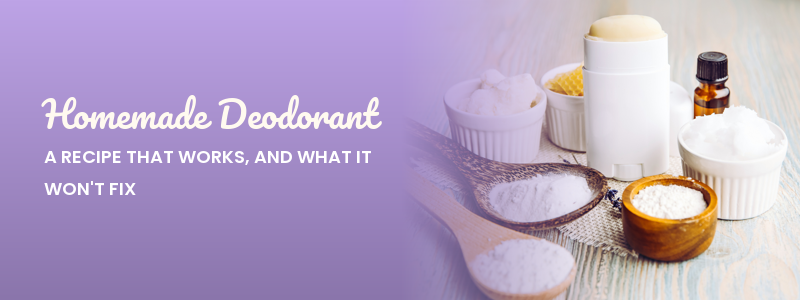
You can make a deodorant that genuinely controls odor in about ten minutes, with four ingredients and no equipment. What you cannot do at home is make it stop you sweating, survive a hot car, or come out the same twice. Those three limits are worth knowing before you start, because most DIY recipes online skip them.
Key Takeaways
- Odor is bacterial, not sweat. Sweat is close to odorless until skin bacteria break it down, which is why a deodorant can work without blocking anything.
- The whole recipe is a fat, a starch, and an odor active. Everything else is optional. Coconut oil, arrowroot and baking soda cover all three.
- The baking soda ratio decides whether it burns. Skin sits at about pH 4.7 and baking soda solutions sit above pH 8, so the more you add, the further you move from where skin is comfortable.
- No homemade deodorant is an antiperspirant. Blocking sweat requires an aluminum salt regulated as an over-the-counter drug, which is not a thing you make in a kitchen.
- FATCO's Stank Stop contains baking soda too. The difference is not its absence, it is the tallow base and the zinc oxide sitting alongside it in a fixed ratio.
What a Deodorant Actually Has to Do
Fresh sweat is close to odorless. The smell arrives afterwards, when the bacteria living in the underarm break down the compounds in that sweat into volatile molecules. A 2013 review in FEMS Microbiology Ecology describes the underarm as a permanent home for a large microbial population feeding on eccrine, apocrine and sebaceous secretions. It names short and medium-chain volatile fatty acids, 16-androstene steroids and thioalcohols as the molecular classes behind the smell. The review comes from Unilever's research arm, which is worth knowing given that Unilever sells deodorant.
That is the whole target. A deodorant does not have to stop the sweat, it has to interfere with the bacteria or absorb what they produce. Three ingredient types do that, and every homemade recipe combines them. An absorbent starch, an alkaline or mineral odor active, and a fat to carry both and keep them on skin.
If you want the fuller picture of what the other category does, antiperspirants and deodorants solve different problems and only one of them is regulated as a drug.
The Base Recipe
This makes roughly a 2 oz (60 ml) jar, which lasts most people six to eight weeks.
- 3 tablespoons coconut oil, solid, at room temperature
- 2 tablespoons arrowroot powder (cornstarch works, tapioca starch works)
- 1 tablespoon baking soda, or half that, or none, depending on your skin
- 1 tablespoon beeswax or rendered tallow, optional, for a firmer set
Scent, if you want it, is 10 to 15 drops of essential oil stirred in at the end. Treat it as the most likely irritant in the jar rather than as decoration.
Step by Step
- Soften the fat. Warm the coconut oil until it is soft but not liquid. If you are adding beeswax or tallow, melt those first over low heat and let the mix cool until it thickens at the edges.
- Whisk the dry ingredients together separately. Arrowroot and baking soda clump if you add them straight to fat. Mixing them dry first is the difference between a smooth cream and a gritty one.
- Fold the dry blend into the fat a third at a time. Beat it, do not stir it. You are looking for the texture of thick frosting.
- Stir in the essential oil last, after the mix has cooled to room temperature. Heat drives off the volatile fraction, which is the part you paid for.
- Spoon into a clean, dry jar. Let it set at room temperature rather than in the fridge, which sets it too hard to scoop.
Apply a pea-sized amount with clean fingers, warmed between fingertips first. It goes on as a thin film, not a layer.
The Baking Soda Ratio Is the Whole Decision
Baking soda is the reason homemade deodorant works, and the reason a good number of people abandon it. It is a base. Sodium bicarbonate solutions sit between pH 8.0 and 8.6 at one percent, and a deodorant paste is far more concentrated than one percent.
Skin sits a long way below that. A 2006 multicentre study of 330 people in the International Journal of Cosmetic Science measured skin pH before and after 24 hours without showering or products. The average dropped to 4.93, and the authors put the natural skin surface pH at about 4.7. That gap is not a scandal, it is just chemistry, and it is why an underarm that tolerates a light dusting can react badly to a heavy paste.
The practical version is a ladder rather than a yes or no:
| Baking soda in the recipe | Odor control | Who it suits |
|---|---|---|
| 1 tablespoon (the standard) | Strongest | Skin that has already handled baking soda deodorants |
| 1.5 teaspoons | Noticeably good | Most people starting out |
| None, arrowroot doubled | Absorbs, does not neutralize | Reactive skin, freshly shaved underarms |
| None, plus 1 teaspoon magnesium hydroxide | Good, gentler chemistry | Anyone who has reacted before |
Start on the second row. Move up only if odor breaks through by evening, and move down at the first sign of stinging or pink skin. If you already know baking soda is a problem for you, the full picture on why it irritates some underarms is worth reading before you mix anything.
Storage, Shelf Life and Troubleshooting
There is no water in this recipe, so there is nothing for microbes to grow in and no preservative is needed. That protection lasts exactly as long as the jar stays dry. Dip in with clean, dry fingers, keep the lid on, and do not add water to loosen it.
It went liquid. Coconut oil is solid in a cool room and liquid in a warm one, and there is no fixing that with technique. Add the optional beeswax or tallow, which raise the melting point of the whole blend, or keep the jar out of the bathroom in summer.
It is gritty. The dry ingredients went in unmixed, or the baking soda was lumpy. Sieve next time.
It marks shirts. Fat marks fabric. Use less, let it absorb for a minute before dressing, and expect to treat the armpits of pale shirts.
It stopped working after a week. More likely your skin changed than the jar did. Heat, cycle, diet and stress all move the baseline, which is the same reason odor at the source shifts week to week.
What Homemade Deodorant Will Not Fix
It will not stop you sweating. Antiperspirants work by forming plugs in the sweat ducts with aluminum salts, and in the United States that makes them over-the-counter drugs with mandated actives and testing. Nothing in a kitchen does that job.
It will not hold a fixed strength. A tablespoon is a volume, and how much baking soda ends up in one depends on how packed the spoon was. Commercial formulas are weighed. Yours is not, which is why two batches from the same recipe can behave differently.
It will not fix heavy sweating. If sweat soaks through clothing on ordinary days, that is a different problem with different answers, and a homemade jar is the wrong tool for it.
Where FATCO Fits
FATCO's Stank Stop cream contains baking soda. So does the stick. We are not going to pretend otherwise in order to sell you something. Any brand calling baking soda the villain while quietly using it is worth a second look at the panel.
What differs is what surrounds it. The cream is built on tallow from grass-fed cows, with shea butter, arrowroot and non-nano zinc oxide. The alkaline fraction sits in a fixed ratio rather than whatever your tablespoon happened to hold. The stick adds magnesium hydroxide as a second odor active. If your homemade version worked but stung, that combination is the same recipe with the sharp edges taken off. There is more in our guide to deodorant for reactive underarm skin.
Got Questions?
Homemade Deodorant FAQ
Q How do you make deodorant with three ingredients?
Coconut oil, arrowroot powder and baking soda, in roughly a three to two to one ratio by volume. Soften the oil, whisk the powders together, beat them into the fat, and jar it. The fat carries, the starch absorbs, the baking soda handles odor.
Q What is the best homemade deodorant?
The one your skin tolerates daily. A coconut oil and arrowroot base with a modest amount of baking soda suits most people. Reactive skin does better with magnesium hydroxide instead. Strength is easy to add later and hard to undo once your underarms are irritated.
Q What can I use instead of deodorant?
Arrowroot or cornstarch alone absorbs moisture and dulls odor without any alkaline ingredient. A magnesium hydroxide paste works for many people. Washing the underarm properly and changing shirts more often does more than either, and neither blocks sweat.
Q Is baking soda safe in a homemade deodorant?
For most people yes, at a modest ratio, on unbroken skin. The risk is concentration, not the ingredient. Home recipes are measured by volume rather than weight, so it is easy to overshoot. Skip it entirely on freshly shaved or already irritated underarms.
Q What did people use before deodorant?
Washing, mainly, plus perfumed oils and powders to mask what was left. Alum stone has a long history in several regions and still sells as crystal deodorant. Purpose-made underarm deodorant is a recent arrival with a stranger history than you would expect.
Q What should I use if homemade deodorant irritates my skin?
Halve the baking soda first, and if it still stings, drop it and double the arrowroot. If a no-baking-soda version also reacts, the trigger is likely the essential oil rather than the mineral. An unscented commercial formula removes both variables at once.
The FATCO Alternative
If the DIY route appeals but the results are inconsistent, FATCO's Stank Stop is the same idea made properly. A grass-fed tallow base instead of coconut oil alone. Arrowroot and shea butter for absorption and slip, zinc oxide alongside the baking soda, and a ratio that holds between batches. It comes as a cream in a jar if you like applying with your fingers, and as a twist-up stick if you do not. There is an unscented version of the cream for anyone who has worked out that the essential oil was the problem.