Oil Cleansing for Oily Skin: How It Works and Who It's For

Oil cleansing works on oily skin because of a basic chemistry rule: like dissolves like. The sebum on your face and in your pores is oil, and another oil dissolves it directly, with no detergent in between. That is why massaging a cleansing oil into dry skin lifts sebum, sunscreen, and makeup without the tight, stripped feeling a foaming wash can leave behind. It is not a cure for oily skin and it does not suit everyone, but it is a real method with a real mechanism.
Key Takeaways
- Oil dissolves oil. Sebum is almost entirely nonpolar lipid, and a nonpolar plant oil dissolves it without the detergents that strip your barrier along the way.
- No cleanser shuts off sebum production. Oil output is driven mostly by genetics and hormones. A cleanser only controls what gets left behind.
- Harsh washing can backfire. The American Academy of Dermatology warns that a face wash that is too harsh can irritate skin and trigger increased oil production.
- Skin type changes the formula, not the method. FATCO makes three cleansing oils, one each for oily, dry, and normal/combo skin, all used with the same steps.
- It is not universal. Acne-prone and congested skin often does better with a gentle foaming or salicylic acid wash, and any new oil deserves a patch test.
What Oil Cleansing Is, and Where It Came From
Oil cleansing means washing your face with oil instead of soap or detergent. You massage plant oils into dry skin and give them a minute or two to break down the sebum, sunscreen, and makeup on the surface and inside pores. Then you press a warm damp cloth over your face and wipe everything away. There is no lather and no squeaky finish. Online the practice is shortened to OCM, for oil cleansing method. It sits alongside foaming, cream, and oil formats as one of several legitimate ways to get a face clean.
The method is old even though the acronym is new. Greeks, Etruscans, and Romans cleaned their skin by drizzling on olive oil and scraping it off with a curved bronze strigil, usually at the community baths after exercise. The modern revival came through blogs and Pinterest boards in the late 2000s, then went mainstream when Korean double cleansing turned oil-based first cleansers into a drugstore category. That lineage is worth naming honestly. OCM is a folk method the cosmetics industry later adopted, not a protocol out of dermatology research. The chemistry holds up. Some of the claims that grew up around it online, particularly about detoxing or purging, do not.
How Oil Cleansing Actually Works
Sebum is not water soluble, which is the entire problem. Peer-reviewed analyses of skin surface lipids indexed in PubMed Central find that sebum is built mostly from triglycerides, wax esters, and squalene. A free fatty acid fraction about as large as the wax esters makes up most of the rest. Those dominant components are nonpolar. Water is polar, so it slides off them instead of carrying them away. That is why a rinse with plain water leaves your face as greasy as it started.
Conventional face washes solve this with surfactants. A surfactant molecule has a water-loving end and an oil-loving end, so it grips the sebum and lets the rinse water take it. That works fine for plenty of people. The catch is that surfactants are indiscriminate. They remove the sebum you wanted gone plus some of the barrier lipids you needed. A 2018 comparison of four soap types found that only traditional alkaline soap still showed raised water loss and redness 72 hours after a single patch test. The creamy, glycerin, and syndet formulas were back to baseline by then.
Oil cleansing takes the other route. Rather than emulsifying sebum so water can carry it off, it dissolves it. A nonpolar plant oil and nonpolar sebum experience the same intermolecular forces, so they mix freely. That is the practical meaning of like dissolves like. The oil loosens the hardened sebum in pores, and the warm cloth lifts the whole mixture off. Nothing in that sequence has to disturb your barrier lipids.
Who Oil Cleansing Is For, by Skin Type
The steps do not change from one skin type to the next. What changes is which oils belong in the bottle.
| Skin type | How oil cleansing tends to behave | What the blend should lean on |
|---|---|---|
| Oily | Often the strongest fit when the issue is shine rather than congestion. Clears surface oil without the stripping that leaves skin tight and shiny by noon | Lighter oils: grapeseed, jojoba |
| Dry | Cleans without removing the lipids dry skin is already short on, so skin feels soft rather than taut | Richer oils: avocado, macadamia, apricot kernel, sesame |
| Combination | Handles an oily T-zone and drier cheeks with one product instead of two | A middle weight that neither overloads nor strips either zone |
| Sensitive | Workable, though essential oils are the usual trigger, not the carriers | The shortest ingredient list you can find, patch-tested on the jawline |
| Acne-prone | The least predictable, and the group that should approach cautiously | Lighter oils only, and a real patch test |
Oily skin gets the most out of this because it has the most to lose from the alternative. The instinct with a shiny face is to reach for the foamiest thing on the shelf. The American Academy of Dermatology is direct about where that leads: a face wash that is too harsh can irritate skin and trigger increased oil production. Oil cleansing sidesteps that trade, since there is no detergent to over-correct with.
The tension in that guidance is worth naming. The same AAD page advises against oil-based cleansers for oily skin and points readers to a mild foaming wash instead. Oil cleansing is the minority position in dermatology, not the default recommendation.
The honest limit is acne. A Cleveland Clinic dermatologist cautions that on acne-prone skin, an oil-based cleanser used alone can cause breakouts, and that most people do not need a two-step cleanse at all. Heavily congested skin often does better with a gentle foaming or salicylic acid face wash. If breakouts rather than shine are your main issue, the leave-on treatment matters more than the cleanser, and some face washes make breakouts worse regardless of format.
How to Oil Cleanse Correctly
- Start with a completely dry face. No splash of water first. Water blocks the oil from reaching the sebum.
- Warm a quarter-sized amount in your palms and massage it over your whole face for one to two minutes, including the nose and jawline where congestion collects.
- Soak a washcloth in very warm water and wring it out. Press it flat against your face for 30 to 60 seconds. The heat softens what the oil has loosened.
- Wipe gently, do not scrub. The cloth is there to carry the oil off, not to exfoliate. Rinse the cloth and wipe again if skin still feels coated.
- Follow with your usual next step. No second cleanser needed. Toner and moisturizer go on as normal.
Set realistic expectations. The change in how skin feels arrives immediately, since the post-wash tightness is gone from the first use. Shine, texture, and congestion take longer. Give any new cleanser two to four weeks, and use a fresh washcloth each time. A short adjustment stretch is common. But there is no evidence that skin detoxes or purges, so congestion that keeps building past that window is a signal to stop.
Common Oil Cleansing Mistakes
- Applying it to a wet face. The most common error, and it undercuts the whole mechanism.
- Rinsing instead of wiping. Water alone will not carry the oil off. The warm cloth does that.
- Scrubbing with the washcloth. Dermatologists advise against abrasive scrubbing with any cleanser, since irritation makes every skin problem worse.
- Using the wrong weight of oil. A rich blend built for dry skin feels heavy on an oily T-zone, and the reverse leaves dry skin wanting.
- Skipping moisturizer afterward. Oily and dehydrated are not opposites, and the worry that a moisturizer clogs your pores is usually misplaced.
- Switching every two weeks. Cycling faster than skin can respond means you never learn what worked.
What to Look For in a Cleansing Oil
The best cleansing oil for oily skin is not the one with the longest ingredient list. It is the one whose oils match your skin's weight. Four things separate a good bottle from a mediocre one.
Carrier oils suited to your skin type. Lighter oils like grapeseed and jojoba spread thin and absorb quickly, which suits oily skin. Jojoba earns its reputation because it is not technically an oil but a liquid wax ester, structurally close to the wax esters in your sebum. Heavier oils like avocado and macadamia are right for dry skin, wrong for a shiny T-zone.
A cleansing anchor. Castor oil is the standard. It runs up to 90 percent ricinoleic acid, a hydroxylated fatty acid that makes castor far more viscous than other plant oils. That viscosity is what gives a cleansing blend its body and slip.
Restraint on fragrance. Essential oils are the most common irritant in a natural cleansing oil. A few are fine. A long perfume list on something you leave on for two minutes is not.
Honest claims about pore-clogging. Individual oils get assigned comedogenic ratings on a 0 to 5 scale all over the internet. Those numbers trace back to a rabbit ear assay, and they score ingredients in isolation rather than finished formulas. Dermatology researchers reviewing that model have flagged its absence of correlation with what happens on human skin, and the limits on what its results can honestly support. It pays to know how the comedogenic scale works before a number decides for you. FATCO's cleansing oils are not formally rated for comedogenicity, and the oils they use are generally considered low-risk.
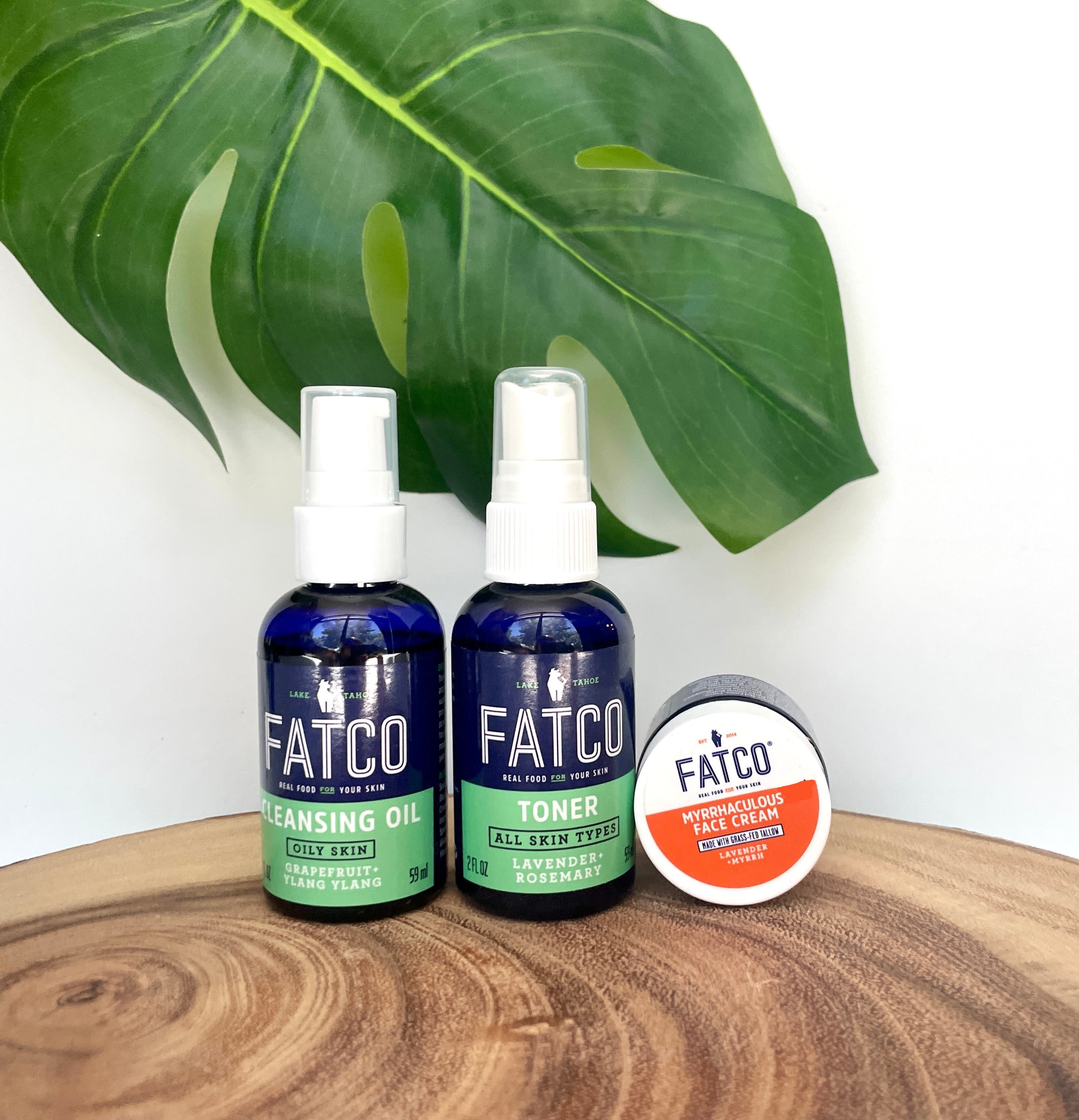
FATCO makes three, each $14 for 2 oz, each anchored on organic castor oil. The Cleansing Oil for Oily Skin is the one built differently. After the castor it runs grapeseed, olive, and jojoba, with tamanu and argan behind them, finished with grapefruit and ylang ylang. The Cleansing Oil for Dry Skin and the Cleansing Oil for Normal/Combo Skin run on the same base: apricot kernel, sesame, avocado, and macadamia, with lavender, rosemary, and lemongrass. The real fork is between that richer base and the lighter oily-skin blend. FATCO's founder has long advised starting with the normal/combo formula unless your skin runs distinctly dry or oily. Her logic: simply leaving detergent behind rebalances a lot of skin on its own.
Got Questions?
Oil Cleansing FAQ
Q What is the best cleansing oil for oily skin?
The best one is built from light, fast-absorbing oils rather than heavy ones. Look for grapeseed or jojoba high in the ingredient list, castor oil as the cleansing anchor, and minimal fragrance. FATCO's Cleansing Oil for Oily Skin fits that pattern at $14.
Q Can you really wash your face with oil if your skin is oily?
Yes, and the logic is chemical rather than counterintuitive. Sebum is nonpolar, so another nonpolar oil dissolves it directly, with no detergent needed to bridge oil and water. The result is a face that is genuinely clean without the tight, stripped feeling that often precedes an afternoon shine.
Q What does OCM mean in skincare?
OCM stands for the oil cleansing method: massaging oil into dry skin, then removing it with a warm damp washcloth instead of rinsing with soap. It is the practice ancient Greeks and Romans used with olive oil, revived through blogs in the late 2000s.
Q Is cleansing oil good for dry skin?
It suits dry skin particularly well. Dry skin is short on barrier lipids to begin with, and detergent cleansers remove more of them. A cleansing oil built on richer carriers like avocado, macadamia, and apricot kernel cleans without taking those lipids with it.
Q How long does oil cleansing take to show results?
The change in how skin feels is immediate, since the post-wash tightness disappears from the first use. Visible changes in shine and congestion take two to four weeks. If congestion is still worsening past that point, the blend is too heavy for your skin.
Q Which cleansing oil should you choose if you are not sure of your skin type?
Start with a middle-weight normal/combo formula. It is forgiving in both directions, handling an oily T-zone and drier cheeks without overcorrecting either. Most people find that simply moving off detergent cleansers rebalances how their skin behaves, which makes the specialist formulas easier to choose later.
The FATCO Alternative
FATCO's founder came to oil cleansing after years of fighting oily skin with alcohol-heavy astringents that only made it angrier. The Cleansing Oil was among the first products she formulated when the brand launched in 2014. All three versions are plant oils, most of them organic, with no sulfates and no synthetic detergents, nothing that strips a barrier doing its job. Cleansing is only half of it, though. What you put back on matters just as much, which is where FATCO's grass-fed tallow face creams pick up. Tallow shares its two dominant fatty acids, palmitic and oleic, with human sebum.