Spots and Redness on Your Face: Mapping Causes to Solutions

A spot and an area of redness are two different findings, and separating them is the first useful thing you can do. A spot is a discrete bump or mark you can point at. Redness is a color change spread across skin. This article helps you describe what you are looking at accurately enough to act on it. It does not diagnose anything.
Key Takeaways
- Name the bump before you treat it. A blackhead, a papule, a pustule and a milium look similar at arm's length and behave differently up close.
- Location is real information. Bumps around the mouth, scale beside the nose, and flushing across the center of the face each point somewhere specific.
- Flat marks are usually not scars. The American Academy of Dermatology describes the flat mark left after a blemish as something that clears on its own.
- Two of these need a doctor rather than a shelf. Deep painful lumps and the rash that follows steroid cream are where over-the-counter effort works against you.
- FATCO makes no acne or rosacea treatment. No exfoliating acid, no benzoyl peroxide, no prescription active. Tallow-based care is a moisturizer, and that is the honest limit of it.
Spots and Redness Are Not the Same Finding
A spot is a lesion. Something occupies a small area: a plugged pore, an inflamed follicle, a cyst under the surface, or pigment left after inflammation settled. You can usually feel it, or at least draw a border around it.
Redness is diffuse. Vessels near the surface have widened, or inflammation is spread through the tissue rather than concentrated in one follicle. There is often nothing to feel.
That distinction matters because the responses barely overlap. Unclogging pores does nothing for widened blood vessels.
Naming the Spot
The American Academy of Dermatology publishes a picture guide to the different types of acne blemishes, and its medical names narrow things fast.
Whiteheads and blackheads. Both start, in the AAD's words, when "pores become clogged with excess oil, bacteria, and dead skin cells". If the pore closes up you get a tiny white or flesh colored bump, medically a closed comedo. If it stays open you get a blackhead, an open comedo. The AAD is direct that the black dots are not dirt, so scrubbing only worsens things.
Papules and pustules. When the plug pushes deeper and inflames, you get small red bumps that feel hard. Those are papules, and the AAD notes that a lot of them can make an area "feel like sandpaper". A pustule is the same thing containing yellowish fluid, with a white or yellow center.
Nodules and cysts. These sit deep, feel tender or painful, and often scar as they heal. The difference is pus: a cyst has it, a nodule does not, which is why nodules feel harder. This is the one category where the AAD skips self-care and says you will need a dermatologist's help.
Milia. These are the firm white bumps that will not pop, and they are not acne. Cleveland Clinic describes milia as "small, white cysts on your skin" made of trapped dead skin cells, and says plainly that people confuse them with whiteheads. They cluster on eyelids, forehead and cheeks. Secondary milia can also appear "as a reaction to a heavy skin cream or ointment".
Flat marks left behind. After a blemish clears, many people are left with a completely flat spot that can be pink, red, purple, black or brown. The AAD says this is frequently mistaken for a permanent scar and is not one. Its medical name is postinflammatory hyperpigmentation, and it eventually clears alone, though some marks last a year or longer. A true scar changes the surface, as a depression or a raised area.
Naming the Redness
Flushing that comes and goes. Cleveland Clinic notes that many people with rosacea have a history of frequent blushing, and calls facial redness that comes and goes the earliest sign of the condition.
Color that stays. Persistent redness resembling a blush or a sunburn that does not fade is the next stage. The AAD notes that depending on skin tone it may read as red, violet or brown.
Visible blood vessels. Cleveland Clinic describes small blood vessels that look like thin red lines becoming visible under the skin. That is its own finding, separate from color. The AAD adds that they show mostly on lighter skin tones and are difficult to see on darker ones, so their absence proves nothing.
Scaly redness in the oily creases. Seborrheic dermatitis produces a scaly rash on oily areas. Beyond the scalp, the AAD lists the ears, eyebrows, beard and the skin around the nostrils. Lighter skin tones tend to get a red raised rash, darker tones a pink or slightly purple patch.
Redness where something touched. The AAD says an allergic contact rash often starts as itchy skin followed by a rash, appearing hours or days after the exposure.
What the Location Tells You
| Where it sits | What tends to appear there | What that points toward |
|---|---|---|
| Nose and cheeks, sometimes spreading to forehead and chin | Flushing, lasting color, thin red vessels, bumps and pus-filled pimples but no blackheads | Rosacea pattern |
| Around the mouth, sometimes nose or eyes | Small acne-like bumps with dry, flaky skin around them | Perioral dermatitis |
| Eyebrows, sides of the nose, ears, hairline | Scaly, greasy-looking rash | Seborrheic dermatitis |
| No single site, unlike the rows above | Blackheads and whiteheads alongside inflamed bumps | Acne, which produces comedones |
| Eyelids, under the eyes, cheeks, forehead | Firm white bumps that will not open | Milia |
| Wherever a product, metal or fabric sat | Itch, then rash, where the substance touched | Contact reaction |
The most useful row is the blackhead one. Cleveland Clinic puts it in a sentence: rosacea bumps "might resemble acne, but rosacea doesn't cause blackheads". Blackheads mixed in means acne. Inflamed bumps with flushing and no comedones put rosacea on the list.
The One That Gets Mistaken for Acne
If your bumps sit around your mouth, read this before buying anything. The AAD describes perioral dermatitis as a rash that "often looks like small, red, acne-like breakouts" on lighter skin and skin-colored breakouts on skin of color. Dry, flaky skin usually comes with it, and it can also appear around the eyes or nose.
What drives it is why it matters. The AAD says many people develop this rash after applying a corticosteroid medicine to the skin for too long. Clearing it requires stopping all corticosteroids, including over-the-counter hydrocortisone cream. The AAD also warns the rash can worsen when you stop, which is exactly when people reach for the cream again. Get it looked at rather than guessing.
Which Ones Clear, Which Need a Change, and Which Need a Doctor
Clears on its own. Milia. Cleveland Clinic says adults can have them for a few weeks to a couple of months before they go. Squeezing or scraping them can scar or infect the skin. If they are still there after a few months, see someone. Flat post-inflammatory marks also fade alone, slowly.
Answers to a routine change. Redness driven by a damaged barrier or a contact reaction. Calming that kind of facial redness takes a shorter product list and a gentler approach rather than a new active. Mild comedonal acne sits here too, and the AAD's timing is explicit: give treatment six to eight weeks, and if blemishes remain, consider a dermatologist.
Needs a doctor. Nodules and cysts, which the AAD routes straight to a dermatologist because early treatment means fewer permanent scars. Perioral dermatitis, for the steroid reason above. Rosacea, because as the AAD puts it, "you'll find few treatment options online and in stores". Seborrheic dermatitis too, since untreated scale thickens. If eye symptoms come with facial rosacea, say so at the appointment. The AAD estimates half of people with rosacea get a flare affecting the eyes.
Where the two overlap, a calm rosacea routine runs alongside medical care, not instead of it. Azelaic acid is one of the few actives with approved uses on both sides of the acne and rosacea line.
Where Tallow-Based Care Fits, and Where It Does Not
Narrowly. FATCO makes no exfoliating acid, no benzoyl peroxide, no antibiotic and no prescription anything. Nothing in the catalogue treats acne, rosacea, seborrheic dermatitis or perioral dermatitis. If you have named something on this page that needs treatment, the treatment is the priority.
What tallow does is sit on the surface and slow water loss. It shares fatty acids with the skin's surface lipids, and a short ingredient list gives a reactive face fewer things to react to. That argues for the moisturizer slot next to whatever is treating the problem, and for nothing beyond it. Whether it suits acne-prone skin is person by person, and tallow carries no published comedogenic rating in either direction.
Two cautions. Heavy creams and ointments are on Cleveland Clinic's list of triggers for secondary milia, so new firm white bumps after switching to a richer product is a plausible connection. And every FATCO face cream contains lavender essential oil, which is fragrance.
Got Questions?
Frequently Asked Questions
Q Why am I getting red spots on my face all of a sudden?
Sudden red spots most often mean inflamed follicles, a contact reaction, or a first rosacea flare. Check for blackheads: their presence points to acne, their absence with flushing points toward rosacea. Itch and rash appearing where something touched your skin suggests a contact reaction instead.
Q Can rosacea look like a pimple?
Yes. Rosacea produces small red bumps and pus-filled pimples that the American Academy of Dermatology calls papules and pustules, the same terms it uses for acne. The distinguishing feature is what is missing. Cleveland Clinic states that rosacea does not cause blackheads, so comedones point to acne rather than rosacea.
Q What looks like a whitehead but will not pop?
Almost always milia. Cleveland Clinic describes them as small white cysts of trapped dead skin cells, and says outright that they are not a type of acne. They clear on their own over weeks to a couple of months. Squeezing them risks scarring or infection.
Q How long do the red marks left after pimples usually last?
Weeks to months, and sometimes longer. The AAD describes these as completely flat spots that can be pink, red, purple, black or brown, often mistaken for permanent scars. Unlike scars they clear without treatment, though darker marks take longer and some persist beyond a year.
Q What gets mistaken for rosacea?
Acne is the common one in both directions, which is why the AAD publishes a side-by-side comparison. Seborrheic dermatitis also overlaps, producing redness beside the nose and on the eyebrows, and the AAD notes people can have both at once. Perioral dermatitis rounds out the group.
Q Why is my moisturizer giving me bumps?
Two different things produce that. Heavy creams and ointments can trigger secondary milia, the firm white bumps Cleveland Clinic links to exactly that cause. Ingredients you react to can produce an itchy rash instead, which is a contact reaction. Stop the product, watch which pattern fades, and reintroduce one thing at a time.
The FATCO Alternative
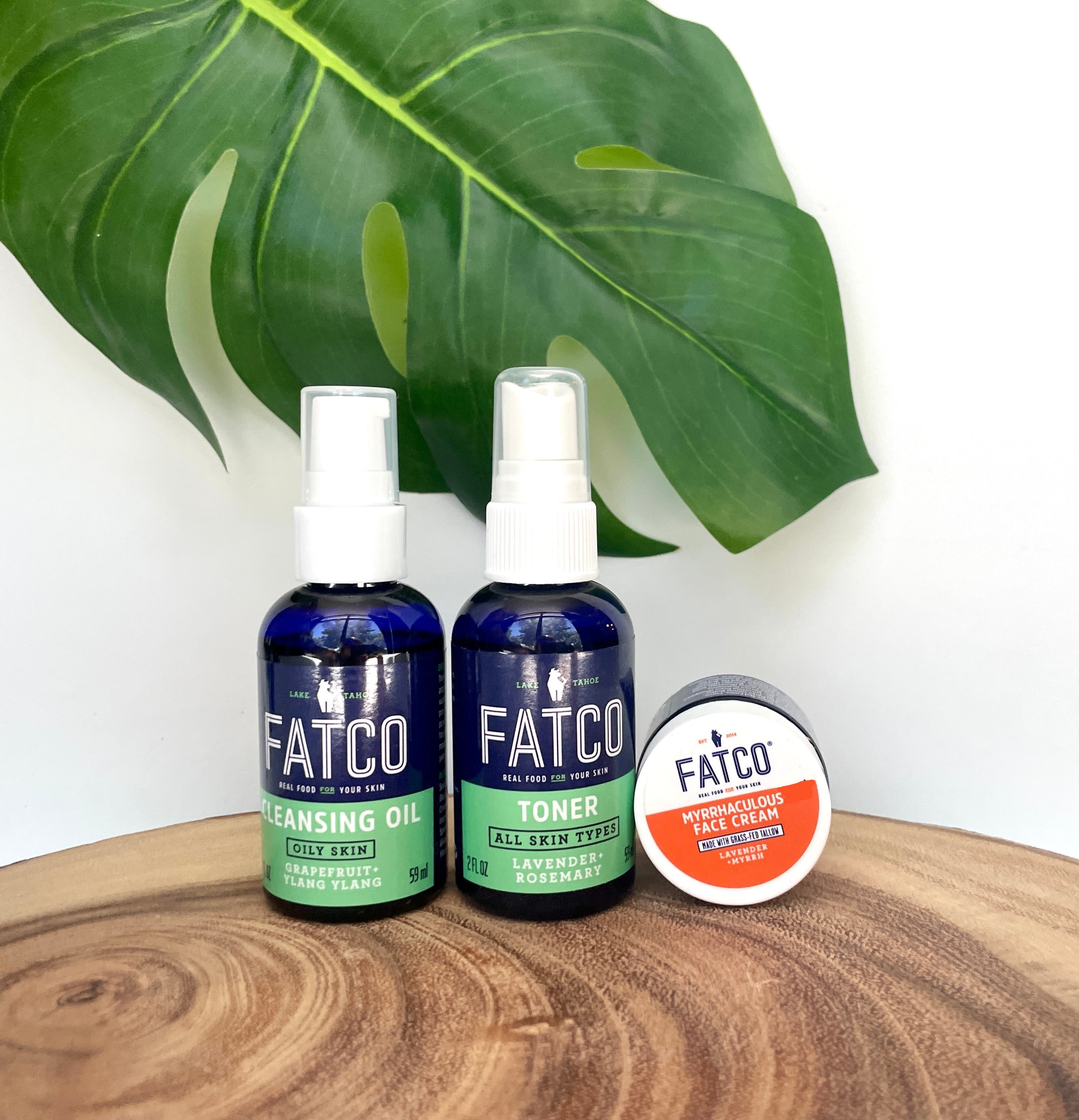
If you have worked out what you are looking at and the answer is a treatment, get the treatment. If the answer is a face reacting to too many products, FATCO's face care line is short on ingredients by design. Grass-fed tallow, plant oils, no synthetic fragrance, no alcohol, no synthetic preservatives. Our creams carry essential oils, so check the panel if you are avoiding scent. Patch-test before committing your whole face.