Baby-Safe Lip Balm: What to Look For
A baby safe lip balm is defined far more by what is missing from the label than by what is on it. Before the first birthday that means no honey at all. It also means no camphor, menthol or essential oils, plus some care with sunscreen balms before six months. A tube of plain petroleum jelly clears every one of those bars, and so does a short unscented balm whose every ingredient you can name.
Key Takeaways
- No honey before age one. The CDC says not to give infants honey or products made with it, and a lip balm sits at the mouth.
- Skip the medicated sticks. Camphor, menthol and phenol are on the AAD's list of lip ingredients to avoid, and swallowed camphor is a known poisoning risk for children.
- Unscented is the starting point. Essential oils and flavorings are there for smell and taste, and a poison center and dermatologists both flag them.
- Petroleum jelly is a real answer. Petroleum jelly and beeswax are the bases to look for in a lip balm.
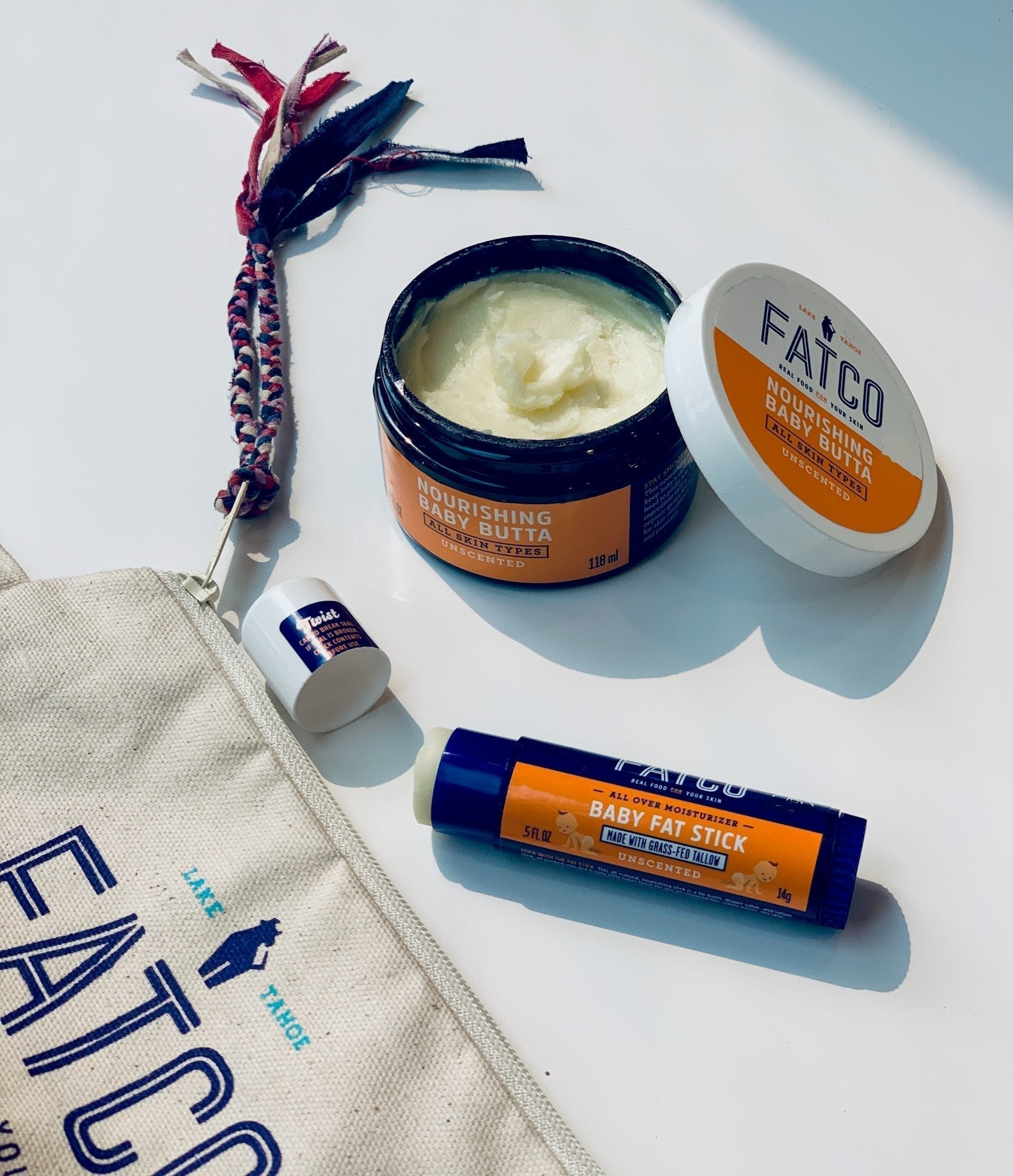
- FATCO's Baby Fat Stick is its unscented stick. The panel opens with sweet almond oil, lists grass-fed tallow third, and carries no honey or essential oil.
What Makes a Lip Balm Baby-Safe
What makes a lip balm baby-safe is mostly about where it goes. On an adult, a balm is a cosmetic that stays put. On a baby, anything spread on the lips sits within easy reach of the tongue, and small hands wipe it off and carry it straight back to the mouth.
That changes how the label should be read. The National Capital Poison Center makes the general point that children have thin skin and immature livers, which might leave them more susceptible than adults to toxic effects. A few ingredients that are harmless on a grown-up's lips stop being harmless at that size.
So choosing a lip balm for babies is mostly a short list of things to rule out, followed by one choice about the base. Dry, peeling lips in a newborn's first weeks raise their own questions, separate from which tube to buy.
The Baby-Safe Lip Balm Checklist
Work down this list with the label in your hand. A balm that fails any line is worth swapping for a plainer one.
1. No Honey Before the First Birthday
The American Academy of Pediatrics names honey as a source of botulism spores and says to avoid it in babies under 12 months. The CDC goes further on what counts. Its guidance covers honey and products made with it, and it cites a group of Texas babies who developed infant botulism after using honey pacifiers.
A pacifier is not food, and neither is a lip balm. Both put honey at a baby's mouth, which is why this rule belongs on a lip balm checklist at all.
Read to the end of the panel, because honey can sit near the bottom. Three of FATCO's own scented sticks list it tenth or eleventh: Lemon + Honey, Orange + Vanilla and Vanilla + Coffee. They belong in an adult's pocket during that first year. The AAP adds that honey is safe from 1 year of age onward, so this line has an end date.
2. No Camphor, Menthol or Phenol
These three are what make a medicated stick tingle. The American Academy of Dermatology lists all three, along with eucalyptus and salicylic acid, among the lip ingredients to stop using while lips are chapped. That advice is general rather than baby-specific, and the tingle is the irritation, not the stick working.
Camphor carries a second problem for small children. The National Capital Poison Center warns that even a small amount of camphor is dangerous if swallowed, and that seizures can begin within a few minutes. It also records poisonings from camphor skin products used on children more often than their labels allowed.
Check two places. A medicated stick lists its actives in a Drug Facts box, and everything else has a plain ingredient list underneath.
3. No Essential Oils or Added Flavor
Essential oils are natural, and that is not the same as gentle. The poison center's summary is that misuse of essential oils can cause serious poisoning. Flavoring has its own line on the AAD's avoid list, which warns that cinnamon, citrus, mint and peppermint can be especially irritating to dry, chapped lips. Fragrance gets a separate line.
FATCO's scented sticks show how flavor builds up on a label. Lavender + Peppermint lists peppermint and lavender essential oils. Lemon + Honey lists grapefruit oil and natural lemon and honey flavors.
The three honey sticks also list stevia, a sweetener. None of that is a flaw in a balm for adults, but each one is an extra line to check for a baby.
The fragrance-free standard that guides choosing a baby lotion carries over here, with one extra reason: a sweet balm is one that gets tasted.
4. Care With SPF Before Six Months
An SPF lip balm is a sunscreen, so sunscreen guidance applies to it. The AAP's first instruction is to keep babies younger than 6 months out of direct sunlight. For those babies, it says sunscreen can go on small areas of the body, such as the face, when protective clothing and shade are not available.
Once a balm with SPF does make sense, the AAD's lip list helps sort the filters. It names titanium oxide and zinc oxide among the sun-protective ingredients that help chapped lips, and octinoxate and oxybenzone among those to avoid.
5. A Base You Can Name
The NHS advice for sore or dry lips is a lip balm containing petroleum jelly or beeswax, and the AAD's list of ingredients that help chapped lips includes white petroleum jelly, petrolatum, shea butter and castor seed oil. Plain petroleum jelly from the pharmacy is a respectable answer, and nobody should feel they are cutting corners by choosing it.
Balms built on fats are the other route. A tallow lip balm is made with beef fat, which is richest in oleic and palmitic acid, and the skin's surface lipids carry both. That overlap is partial. Its vitamin content is modest as well: in USDA's figures for beef tallow, vitamins A and K1 both come out at zero, and D and E appear only in small amounts.
Whatever the base, every oil on the panel is a separate allergen question. Read each oil by name rather than trusting the front of the tube. Some people react to fragrances, dyes or cosmetic ingredients, so try another balm if one is not working.
6. One Tube Per Baby
Don't share lip balms, because sharing can spread germs. A baby's tube stays the baby's tube.
How to Choose a Baby-Safe Lip Balm
The table sorts common options by the checklist above. To read a lip balm label line by line, start at the base and work down to the flavors.
| Option | Base | Honey | Scent or flavor | Checklist note |
|---|---|---|---|---|
| FATCO Baby Fat Stick, Unscented | Sweet almond oil, beeswax, tallow | No | None listed | Sweet almond, coconut, shea, kukui (as on every Fat Stick) |
| FATCO Lemon + Honey, Orange + Vanilla, Vanilla + Coffee | Beeswax, sweet almond oil, tallow | Yes | Flavor oils, stevia | Honey on the panel: not under 12 months |
| FATCO Lavender + Peppermint | Beeswax, tallow | No | Peppermint and lavender essential oils | Peppermint is on the AAD's flavor list |
| Plain petroleum jelly | Petrolatum | No | None | Named by both the NHS and AAD |
| SPF lip balm | Varies | Check | Check | Under 6 months: shade first, then small areas only (AAP) |
| Medicated lip stick | Varies | Check | Check | Camphor, menthol or phenol: skip |
When It Is Not a Lip Balm Question
Dry lips can be a sign the body needs fluid rather than a balm. A dry mouth, lips and tongue are among the symptoms of dehydration. In a baby the signs also include a sunken soft spot on the head, sunken eyes, few or no tears when crying, fewer wet diapers than usual, and drowsiness or irritability.
The NHS asks for an urgent appointment with a doctor when a child seems drowsy, has fewer wet diapers, or breathes quickly or has a fast heart rate. The same applies to a baby who cries with few or no tears, or whose soft spot sinks inwards. It calls these signs of serious dehydration that need urgent treatment.
It treats a further set of signs as an emergency. Those are dehydration with blue, gray, pale or blotchy skin, lips or tongue, or skin that feels cold. Fast or difficult breathing counts too, as does a baby who is sleepier than normal or hard to wake. For any of these, call emergency services.
Separately, it advises seeing a doctor when lips are hot, painful and swollen, because that can be a sign of infection.
Got Questions?
Frequently Asked Questions
Q Can you put lip balm on a baby?
The label decides it. The AAP and CDC rule out honey for infants. The AAD tells people with chapped lips to avoid camphor, menthol and phenol, and a poison center warns that swallowed camphor is dangerous for children. For dry lips, look for a balm containing petroleum jelly or beeswax.
Q What is a good lip balm for infants?
For an infant, the best pick is the plainest one. Under 12 months that means no honey, camphor, menthol or essential oils. Plain petroleum jelly qualifies, as does a short unscented balm. Before six months the AAP puts shade first and sunscreen, SPF balms included, on small areas only when shade is not available.
Q What is a good lip balm for a 2-year-old?
By two the honey rule is over, since the AAP says honey is safe from age one. The rest still applies. Skip medicated sticks with camphor or menthol, and know that citrus, mint and peppermint flavors can irritate chapped lips. Give each child their own tube.
Q Are all-natural balms safe for kids?
The word natural settles nothing on its own. Essential oils are natural, and a poison center warns that misusing them can cause serious poisoning. Look instead for a balm with no camphor, menthol, essential oils or added flavor, a base you recognize, and every oil checked against any allergy in the family.
Q Can the Baby Fat Stick be used as a lip balm?
Yes. FATCO sells it as a lip balm, diaper salve and lotion stick in one tube. It is the only Fat Stick listing no scent, flavor or honey. Like every Fat Stick, it lists almond, coconut, shea and kukui: check them against any allergy.
The FATCO Alternative
FATCO's answer is the Baby Fat Stick, Unscented, the one stick in the Fat Stick line with no scent or flavor on its label. Its panel lists nine ingredients: sweet almond oil, beeswax, tallow from grass-fed cows, cocoa seed butter, shea butter, coconut oil, rosehip fruit oil, kukui seed oil and olive fruit oil. None of them is honey, an essential oil, camphor or a sunscreen filter. It comes in a 0.5 oz tube.