Best Face Creams for Aging Skin: Real Ingredients That Help

Choosing the best face cream for aging skin is harder than it looks. The anti-aging category is the most crowded shelf in skincare, and the marketing language ("reverses 10 years," "clinically proven firming") obscures what the ingredients actually do. Some actives have solid clinical backing. Others are mostly texture and fragrance. This article covers seven well-regarded options with honest ingredient notes, and ends with a look at FATCO's tallow-based alternative for anyone interested in a different approach to skin nutrition. Most picks are true creams; a couple are serum-textured treatments that belong in the same conversation because they target the same concerns and fit naturally alongside or instead of a traditional moisturizing cream.
Key Takeaways
- Barrier support and hydration are the foundation. Ceramides, fatty acids, and humectants may help reduce the visible appearance of fine lines by keeping skin plump and moisture-loss low. No topical cream eliminates wrinkles.
- Retinol has the strongest over-the-counter evidence for aging skin, but requires a slow start, consistent SPF use, and months of patience. Prescription retinoids are stronger still.
- Peptides and niacinamide are gentler companions. Peptides may support collagen signaling; niacinamide supports the barrier and is well tolerated alongside retinol. Evidence for peptides varies by type.
- The seven picks here run about $22 to $55. Higher price doesn't mean stronger actives. Formulation and personal tolerance matter more.
- For dry, reactive, or active-fatigued skin, grass-fed tallow provides barrier-supporting fatty acids without the irritation cycle retinol can create.
What Actually Works in Anti-Aging Skincare
The National Institute on Aging describes the outer layer of skin getting thinner, paler, and less elastic with age, driven by a loss of elastic fibers and collagen, and notes that older adults may produce less oil from the glands in their skin. The actives with the strongest evidence for supporting visible skin appearance are retinoids, niacinamide, ceramides, and peptides:
- Retinoids (retinol, retinal, retinyl palmitate): speed up cell turnover and may support collagen synthesis. Retinol is the best-evidenced over-the-counter form for aging skin. Side effects include dryness and irritation, especially early on.
- Niacinamide (vitamin B3): supports the skin barrier, may reduce redness, and helps with uneven tone. It sits well alongside retinol, and one study found a niacinamide moisturizer used with tretinoin reduced the retinoid's side effects.
- Ceramides: naturally occurring lipids in the skin barrier. Topical ceramides help restore barrier integrity and reduce moisture loss.
- Peptides: short amino acid chains that signal collagen production. Evidence varies by type; palmitoyl pentapeptide-4 (still on the Olay Regenerist label) is one of the more studied options.
Emollients and humectants reduce transepidermal water loss, making lines look less pronounced day-to-day. That's part of why keeping your skin barrier intact matters so much as skin ages.
7 Best Face Creams for Aging Skin: Honest Picks
Prices are approximate and were re-checked against live brand and retailer pages in July 2026. Check the retailer for the latest.
1. Olay Regenerist Micro-Sculpting Cream
Price: around $22-37 for 1.7 oz (about $24 at Target, $36.65 direct from Olay).
Olay's flagship anti-aging moisturizer is one of the most studied over-the-counter options. The current label leads with niacinamide, panthenol, and three peptides (palmitoyl dipeptide-7, palmitoyl pentapeptide-4, and tripeptide-3), which Olay markets as its Triple Collagen Peptide complex. Note that the reformulated version no longer lists hyaluronic acid, and it does contain fragrance, which matters if you are reactive. Niacinamide is the standout ingredient: clinical work uses it in the 2% to 5% range and reports no irritation up to 5%.
Olay Regenerist doesn't contain retinol (that's in the Retinol 24 line). For daytime use without the retinol sensitivity, the Micro-Sculpting Cream is a commonly recommended option at this price range.
Frequently recommended for: daytime use, skin that can't tolerate retinol, or as a complement to a separate retinol product used at night.
2. RoC Retinol Correxion Deep Wrinkle Night Cream
Price: around $22 for 1 oz (30ml) direct from RoC.
RoC's current label carries retinol alongside magnesium aspartate, zinc gluconate, and copper gluconate. RoC's own marketing attributes the performance to its patented retinol technology rather than to those minerals, and the claim that they activate the retinol is not something the brand states, so treat it as folklore. The retinol concentration isn't disclosed on the label, which is common in the category. RoC does cite long-running research on its retinol, but that research is brand-funded, not independent.
Night-only use is appropriate here since retinol increases photosensitivity. Start with every other night to reduce irritation risk. The formula includes glycolic acid, which can increase sun sensitivity, so daytime sunscreen is essential. It also contains fragrance and is not a fragrance-free option.
Frequently recommended for: retinol beginners who want a well-established brand without paying dermatology-clinic prices.
3. La Roche-Posay Redermic R
Price: around $55 for 1 oz (30ml).
La Roche-Posay Redermic R uses pure retinol alongside retinyl linoleate, adenosine, LHA (capryloyl salicylic acid, a salicylic acid derivative), glycerin, and sodium hyaluronate. The LHA performs mild surface exfoliation, which supports cell turnover alongside the retinol. La Roche-Posay positions Redermic R as a gentler-entry retinol, and the formulation reflects that: it's designed for people who want the retinol benefits with a lower irritation ceiling than prescription-strength alternatives.
One caveat worth knowing before you buy: the label lists parfum, and there is no fragrance-free version of Redermic R. The formula absorbs quickly and works as a daily treatment rather than a heavy cream layer. A 2023 review in Biomolecules summarizes the evidence base for topical retinol, reporting promise in enhancing skin texture, diminishing fine lines, and increasing the thickness of the epidermal and dermal layers.
Frequently recommended for: people new to retinol who want a French pharmacy option; sensitive skin types that have had difficulty with stronger retinol concentrations.
4. Neutrogena Rapid Wrinkle Repair Regenerating Cream
Price: around $29 for 1.7 oz.
Neutrogena's Rapid Wrinkle Repair formula uses retinol and hyaluronic acid together. Neutrogena says it delivers "uniquely stabilized retinol" deep within the skin's surface. The full ingredient list includes sodium hyaluronate alongside humectants and emollients that support hydration. It's one of the more accessible options in the retinol category, available at most drugstores.
The formula does contain fragrance (Target lists the scent as floral), which is worth noting for anyone with reactive skin. The cream weight is moderate, appropriate for day or night depending on your preference, though retinol formulas are generally better suited to nighttime use.
Frequently recommended for: value-conscious buyers who want retinol plus hydration in one step.
5. Vichy LiftActiv B3 Tone Correcting Night Cream
Price: around $45 for 1.69 oz (50ml).
This is the one on the list that is not primarily a wrinkle product. Vichy pairs 0.15% pure retinol with 4% niacinamide and markets it first for uneven tone and dark spots, with wrinkles and radiance as secondary claims. If discoloration is part of what you are trying to address, that combination is the reason to look at it; if it isn't, one of the straight retinol options above is a closer match.
Two corrections to claims that circulate about this cream: the label does not contain hyaluronic acid, and it does not contain Vichy's mineralizing thermal water either. The first ingredient is plain water, followed by glycerin, and panthenol and glycerin do the humectant work.
Frequently recommended for: aging skin where uneven tone and dark spots are as much of a concern as fine lines.
6. CeraVe Skin Renewing Retinol Serum
Price: $24.99 for 1 oz (30ml) direct from CeraVe.
This is technically a serum, but it earns a mention here because it pairs encapsulated retinol with three ceramides, niacinamide, and hyaluronic acid, and is free of added fragrance. Be precise about what the brand claims: CeraVe's slow-release language is about its MVE technology encapsulating the ceramides, not the retinol, and it describes the encapsulated retinol only as helping promote the skin's natural exfoliation process. The ceramides and niacinamide reinforce the barrier at the same time the retinol works on turnover, which is a thoughtful combination.
For aging skin that trends sensitive or reactive, this pairing of retinol support with barrier repair is often better tolerated than straight retinol in a standard base.
Frequently recommended for: sensitive or barrier-compromised aging skin; retinol beginners who had difficulty with previous formulas.
7. Neutrogena Rapid Wrinkle Repair Fragrance-Free
Price: around $29 for 1.7 oz.
For anyone who wants the Neutrogena Rapid Wrinkle Repair formula without fragrance (which the original contains), Neutrogena makes a fragrance-free version with the same retinol and hyaluronic acid base, sold at the same price. Neutrogena describes it as formulated without fragrance, parabens, mineral oil and dyes. That makes it a more sensible choice for sensitive, reactive, or rosacea-prone skin.
Choosing the Right Cream for Your Skin
If fine lines are the primary concern and you tolerate retinol, start with RoC Retinol Correxion or La Roche-Posay Redermic R at night plus a barrier moisturizer in the morning. For sensitive or reactive skin, CeraVe Skin Renewing Retinol Serum pairs the active with barrier repair. Olay Regenerist is the retinol-free daytime option. If active-heavy formulas have delivered more irritation than benefit, a fat-based moisturizer is worth exploring.
A moisturizer suited to your skin type under or instead of an anti-aging cream can make a real difference in how comfortable your skin feels.
| Skin concern | Recommended direction |
|---|---|
| Dry, barrier-depleted skin | FATCO tallow face cream |
| Fine lines, tolerates retinol | RoC Retinol Correxion or La Roche-Posay Redermic R |
| Sensitive or reactive skin | CeraVe Skin Renewing Retinol Serum |
| Daytime use, retinol-free | Olay Regenerist Micro-Sculpting Cream |
| Uneven tone and dark spots alongside lines | Vichy LiftActiv B3 Tone Correcting Night Cream |
| Fragrance sensitivity | Neutrogena Rapid Wrinkle Repair Fragrance-Free |
Ancestral Skin Nutrition: How Tallow Fits an Anti-Aging Routine
The seven options above all take the same basic approach: use synthetic actives (retinol, peptides, niacinamide) to stimulate or support skin function. That's the dominant model in dermatology skincare, and for many people it works well.
FATCO takes a different route, grounded in ancestral skin nutrition. Grass-fed beef tallow is roughly 37% oleic, 27% palmitic and 17% stearic acid, and palmitic and stearic each make up about 10% of the free fatty acids in the skin's own barrier, so there is genuine overlap. The case for tallow on aging skin isn't that it replaces retinol's mechanism, but that it provides an emollient built on fatty acids the barrier already uses, along with the vitamin E that comes with the fat (USDA reference data lists 2.7 mg per 100 g).
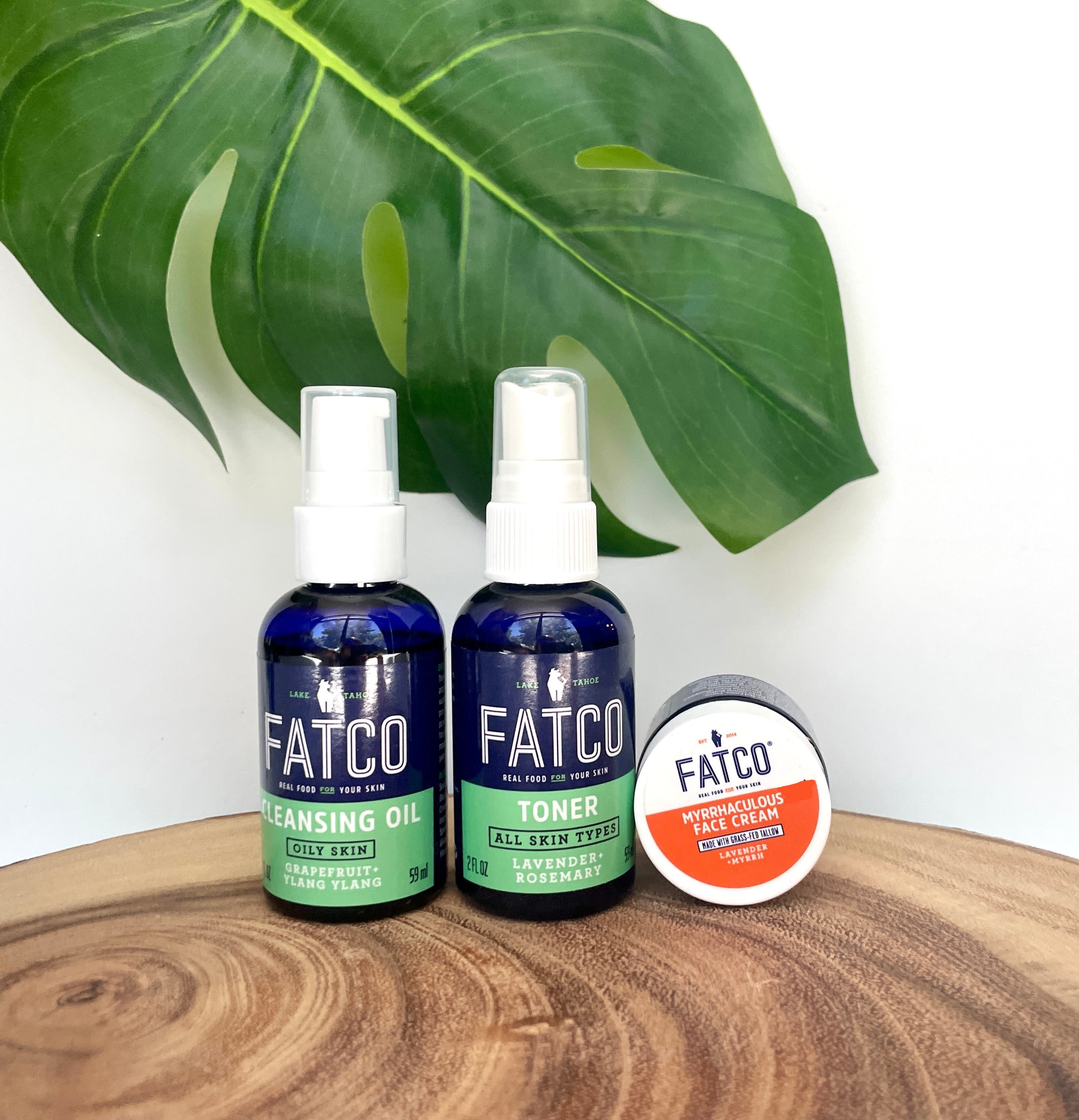
Myrrhaculous Face Cream combines grass-fed tallow with coconut oil, shea butter, jojoba, pumpkin seed, olive, avocado, rosehip seed, evening primrose, borage, moringa and argan oils, beeswax, and lavender and myrrh essential oils. FATCO describes the rosehip seed oil as rich in vitamin A precursors. Unmyrrhaculous Face Cream is the same base minus the myrrh; FATCO removed it because myrrh essential oil is traditionally avoided during pregnancy, and positions that version as pregnancy-safe. It still contains lavender essential oil, so it is myrrh-free rather than essential-oil-free. Both are $52 for 2 oz.
To be straight about the evidence: there is no long-term clinical trial on tallow for aging skin specifically. FATCO's creams are best framed as emollient and barrier-support products that may complement or replace conventional moisturizers, not as retinol alternatives that produce the same structural changes. For aging skin that is dry, reactive, or worn down by active-heavy routines, a tallow-based formula is a simpler foundation to work from.
Got Questions?
Anti-Aging Face Cream FAQ
Q What age should I start using anti-aging face cream?
No guideline sets an age. The common practical advice is to start preventive basics in your twenties, meaning SPF and a barrier-supporting moisturizer, and to introduce retinol when visible fine lines appear. Gentle basics early do no harm; strong actives before the skin needs them add irritation risk without proportional benefit.
Q Is retinol or peptides better for wrinkles?
Retinol has the stronger evidence base for visible fine-line improvement over time. Peptides work differently, signaling cells toward more collagen production, but results vary by peptide type and concentration. Most people see more noticeable change from retinol; peptides suit retinol-intolerant skin, or work as a gentle morning add-on.
Q Can a face cream really reduce wrinkles?
Yes, in a limited but real sense: creams soften how pronounced fine lines look, not undo structural aging. Retinol speeds cell turnover, while ceramides and fatty acids cut the moisture loss that makes lines more visible, both working gradually with consistent use. Prescription retinoids, injectables, and resurfacing treatments go further than any cream can.
Q How long does it take for anti-aging creams to show results?
Think in months, not weeks. Retinol trials commonly run on 12-week windows, and RoC's own claim for its night cream is framed at 12 weeks. Niacinamide and ceramide-based formulas can show barrier improvements faster, sometimes within a few weeks. Realistic timelines reduce the temptation to over-layer or switch products too quickly.
Q Should I use anti-aging cream in the morning or night?
Use retinol at night. It increases photosensitivity and breaks down under UV exposure, so daytime application wastes it and raises irritation risk. Niacinamide and ceramide-based moisturizers are flexible and work either time of day. A practical routine looks like retinol at night, then a barrier-supporting moisturizer plus SPF in the morning.
Q What if I want anti-aging support without retinol's side effects?
Two directions work well here. Barrier-first formulas built on ceramides, niacinamide, and peptides give meaningful support without retinol's irritation cycle. Or step further into a tallow-based cream like FATCO's Myrrhaculous or Unmyrrhaculous, which supplies grass-fed fatty acids that overlap with the skin's own barrier lipids. There is no clinical trial of tallow for aging skin, so judge it as an emollient rather than as an active.
The FATCO Alternative
Retinol has the strongest evidence for visible fine line support, but it's not the only lever, and it's not the right fit for every skin. FATCO's tallow-based face creams take the ancestral route: emollient support and fat-soluble nutrients from grass-fed sourcing, built on the same fatty acids as skin's own surface lipids. If your skin is dry, reactive, or worn down by active-heavy routines, that simpler foundation is where to start.