Pig Lard for Skin: Great-Grandmother's Secret, Backed by Science
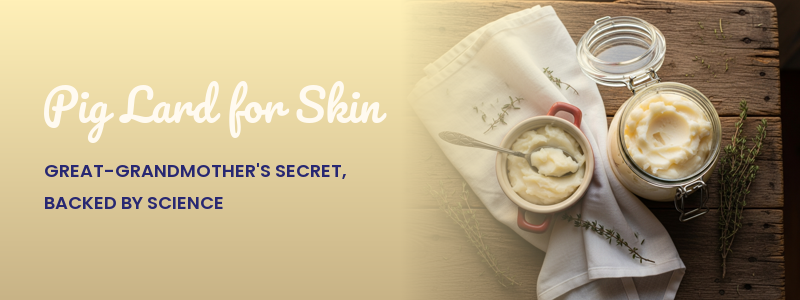
Pig lard was the moisturizer your great-grandmother trusted before petroleum jelly made animal fat feel old-fashioned. It kept skin soft through hard winters, conditioned hair before shampoo existed, and showed up in medicine cabinets from rural farmhouses to Victorian apothecaries. Its retreat was slower than the story usually goes: USDA availability data has lard peaking in 1940, decades after Crisco arrived, then falling steadily from the mid-1950s on. The composition that made it work, though, never changed.
Key Takeaways
- Rendered animal fats have a long history in traditional skincare. Across many cultures, fats like lard and tallow were used to condition and protect skin long before modern cosmetics existed, valued for being cheap, stable, and compatible with skin.
- Its fatty acid profile explains why it worked. USDA reference data puts lard at about 41 g of oleic acid per 100 g, and it shares several fatty acids with the skin's surface lipids, while palmitic and stearic acids give it body.
- Lard vs. tallow comes down to fatty acid emphasis. Lard is the more oleic-forward of the two, while beef tallow carries more stearic acid (18.9 g vs 13.5 g per 100 g in USDA data), which is what gives tallow its firmer set and longer-lasting feel on dry or compromised skin.
- How the animal was raised changes the fat. Feed shows up directly in a pig's fat, which is why lard varies more batch to batch than beef tallow does. The direction of that shift depends on what the animal actually ate, so treat sweeping "pastured is always richer" claims with care.
- FATCO makes beef tallow skincare, not lard. Grass-fed sourcing, higher stearic acid content, and a more standardized supply chain are why the face creams take the tallow path, carrying forward the same ancestral skincare logic that made lard a household staple.
Why Pig Lard Was the Skincare Standard for Centuries
For much of history, rendered animal fats were among the most accessible skincare materials people had. Lard and tallow were used in folk skincare and soapmaking across many cultures, valued for sealing in moisture and protecting skin against wind and cold. The specifics varied by region, but the underlying logic was the same: a fat the skin tolerates well, available in any kitchen.
The reason lard dominated for so long is practical: pigs were widely raised, fat was a by-product of butchering, and rendering it into a shelf-stable cream was simple. Every household had access to it. And it worked, not because of folklore, but because of chemistry.
Lard shares several fatty acids with the skin's surface lipids. Sebum is the skin's own oil, produced by sebaceous glands to lubricate and protect the skin surface, and the main lipids of the stratum corneum are cholesterol, free fatty acids and ceramides. Lard is not a copy of either, but oleic, palmitic and stearic acids appear on both sides of that comparison, which is the whole of the chemistry argument for putting a rendered animal fat on skin.
The Fatty Acid Profile of Pig Lard
USDA FoodData Central puts lard at 39.2 g saturated fat, 45.1 g monounsaturated fat and 11.2 g polyunsaturated fat per 100 g. The breakdown by individual fatty acid, on the same per-100-g basis, looks like this:
| Fatty Acid | Grams per 100 g of lard | Role in the fat |
|---|---|---|
| Oleic acid (C18:1) | 41.2 g | The dominant fatty acid; keeps lard soft and spreadable |
| Palmitic acid (C16:0) | 23.8 g | Saturated, contributes body and stability |
| Stearic acid (C18:0) | 13.5 g | Saturated, firms the fat up as it cools |
| Linoleic acid (C18:2) | 10.2 g | The main polyunsaturated fraction, the part most prone to oxidation |
That oleic-forward balance is what gives lard its soft, spreadable character at room temperature. Oleic acid is well documented in the transdermal literature as a penetration enhancer, working its way between the stratum corneum's lipid layers and loosening their packing, which is a plausible reason lard feels like it sinks in rather than sits, though nobody has tested lard itself for this on skin.
Lard's reputation for skin use also came bundled with claims about its nutrients, and those deserve care. The Weston A. Price Foundation's Wise Traditions podcast covered lard with regenerative farmer Charles Mayfield, who argued that pasture-raised pigs produce different fat from confinement pigs and tied the vitamin D in pork fat specifically to how much sun the animal got, not to feed. Note that Mayfield founded a lard-based skincare line, so the episode is an advocate's account rather than a neutral one.
Leaf Lard vs. Back Fat: The Quality Distinction That Matters
Not all pig lard is the same, and the difference comes down to where on the animal the fat was sourced.
Back fat comes from the subcutaneous layer under the pig's skin along the back and shoulders. It is the most common lard, widely used in cooking, and has a slightly yellow tint after rendering.
Leaf lard comes from the visceral fat around the kidneys and loin. It is purer, whiter, nearly odorless, and has a finer texture. For skincare applications, leaf lard is the preferred source because its neutral smell and cleaner color make it more versatile to work with.
If you are sourcing lard specifically for skin use, look for leaf lard from pasture-raised pigs. Pigs are monogastric, so dietary fat passes into body fat fairly directly, and that makes lard far more variable than beef tallow. It also means the "pastured is automatically richer" shorthand does not hold in one direction: a study of free-range Iberian pigs fattened on acorns found their fat higher in linoleic acid than fat from pigs on a mixed commercial ration, because acorns themselves are linoleic-rich. What you can say plainly is that the feed shows up in the fat, so ask what the animals ate. FATCO's Why Tallow? page makes the parallel case for why grass-fed sourcing matters in beef.
Why Pig Lard Fell Out of Use
Pig lard did not disappear because science improved on it. It disappeared because of industrial economics and marketing.
The American Oil Chemists' Society's history of the period records how it happened. Liquid-phase hydrogenation was patented by the German chemist Wilhelm Normann in 1903; a chemist from the British firm that held those rights moved to Cincinnati in 1907 and struck an arrangement with Procter and Gamble, whose first aim was hardening cottonseed oil as a soap raw material. Food patents followed, and Crisco reached grocery shelves in June 1911, advertised as a healthier alternative to animal fats and more economical than butter, backed by a free 615-recipe cookbook and a run of magazine advertising. Petroleum-derived skincare ingredients (mineral oil, petrolatum) offered cosmetic formulators the same thing from a different feedstock: cheap, stable, shelf-stable raw material.
The displacement was gradual, not sudden. USDA per-capita availability data for added fats and oils shows lard actually rising after Crisco launched, from 6.9 pounds a person in 1909 to a peak of 14.4 pounds in 1940. It held at 12.6 pounds in 1950, then slid to 7.4 by 1960, 4.5 by 1970 and 0.8 by 2000, while shortening and salad oils climbed. What replaced lard worked, in the sense that it moisturized, but most of the replacements were occlusive, sitting on the surface to slow water loss rather than contributing the same lipid classes the skin makes for itself.
Pig Lard vs. Beef Tallow: An Honest Comparison
Pig lard deserves respect. Its record spans millennia, its fatty acid profile is genuinely skin-compatible, and if you have access to high-quality leaf lard from pasture-raised pigs, it is a functional ancestral moisturizer.
That said, there are a few areas where beef tallow has a practical advantage.
Stearic Acid Content
Beef tallow carries more stearic acid than pig lard: 18.9 g per 100 g against lard's 13.5 g in USDA reference data. Stearic acid is one of the saturated fatty acids that gives a rendered fat its firm set. A 2024 scoping review in _Cureus_ concluded that, on composition alone, tallow looks to be biocompatible with skin, while repeatedly flagging significant research gaps and noting that the skin barrier's own main lipids are cholesterol, free fatty acids and ceramides. That review covers tallow only; it contains no mention of lard or pork.
For people with dry, compromised, or reactive skin, that higher stearic acid load is what most people notice, because it is why tallow sets firmer and stays put longer than lard's more oleic-forward profile. That texture difference is part of why tallow suits dry and sensitive skin well.
USDA FoodData Central, grams per 100 g:
| Fat | Saturated | Oleic acid | Stearic acid |
|---|---|---|---|
| Pig lard | 39.2 g | 41.2 g | 13.5 g |
| Beef tallow | 49.8 g | 36.0 g | 18.9 g |
Sourcing Standardization
Grass-fed beef supply chains are more developed and easier to verify than pasture-raised pork supply chains. Most commercial lard on grocery store shelves comes from conventionally raised pigs, and the shelf-stable retail brands are usually part-hydrogenated with added antioxidants rather than plain rendered fat. Finding genuinely pasture-raised leaf lard takes more effort.
Grass-fed beef tallow, by contrast, has a clearer supply chain vocabulary. "Grass-fed" has a defined meaning for cattle, and brands sourcing tallow from grass-fed herds can generally provide verifiable sourcing information.
Dietary and Religious Considerations
Some buyers avoid pork products for religious or dietary reasons. Pork is prohibited outright in both kosher and halal dietary law, so for those readers lard is off the table in any grade. Beef is permitted in principle, which keeps a beef-derived fat in the conversation. Whether a specific tallow carries a kosher or halal certification is a separate question and a genuinely contested one among certifying authorities, so check the certifying body rather than assuming.
What Lard Does Better
Pig lard does absorb faster than beef tallow, which has a slightly firmer texture at room temperature. If you find beef tallow too thick for facial use or prefer a faster-sinking feel, lard's higher oleic acid content makes it lighter in application. Some people with dry, non-reactive skin find lard perfectly effective for daily use.
Neither fat is a bad choice. Both are ancestral, food-grade moisturizers, and both bring lipid classes the skin already works with, which is more than can be said for a petroleum distillate. No head-to-head trial has ranked them against each other or against petrolatum, so treat that as a compositional argument rather than a proven result. The difference between the two fats is a matter of fatty acid emphasis and sourcing practicality, not a dramatic gap in performance. Whether tallow works for your specific skin type comes down to formula and skin profile; oily, dry, and sensitive each respond differently.
What to Look for If You Want to Try an Animal-Fat Moisturizer
Whether you're considering lard, tallow, or a blend, a few quality markers apply across both.
For pig lard:
- Source: pasture-raised pigs, ideally heritage breeds
- Type: leaf lard (not back fat)
- Rendering: slow and at low temperature, which is what protects the fat from scorching and oxidation
- Color: white to off-white, and a slight yellow is normal rather than a defect. Fatworks says the color of its unbleached pasture-raised lard "ranges from white to off-white to even a slight yellow depending on the batch"
- Smell: mild to neutral (leaf lard should not smell strongly of pork)
For beef tallow:
- Source: grass-fed and grass-finished cattle
- Rendering: slow and low-temperature, and on the beef side FATCO's own published position is that dry rendering preserves more of the fat-soluble nutrients while wet rendering can strip them
- Color: creamy off-white or pale yellow. FATCO treats a yellow tint as carotenoids from a pasture diet doing their job, and a snow-white, odorless tallow as a sign the fat was washed out rather than cleaned up
- Texture: semi-solid at room temperature, melts on skin contact
FATCO's beef tallow face creams are formulated from grass-fed tallow, which means you get the higher stearic acid profile for skin barrier support alongside the ancestral-fat approach your great-grandmother would recognize. For the science behind why beef tallow belongs in a skin care routine, that post covers the full case from fatty acid compatibility to fat-soluble vitamins.
Got Questions?
Pig Lard FAQ
Q Is pig lard good for your skin?
For most people, yes, as a plain moisturizer. Lard shares several fatty acids with the skin's surface lipids, and its oleic-forward balance makes it soft and easy to spread. The research here is thin, though: the published work on rendered animal fat and skin looks at tallow, not lard.
Q What is leaf lard, and why does it matter for skin?
Leaf lard is rendered from the visceral fat around a pig's kidneys and loin, unlike back fat from beneath the skin along the spine. It's purer, whiter, nearly odorless, and finer in texture, making it more practical to apply. Sun exposure, not feed, is what drives the vitamin D in pork fat, so pasture matters there.
Q Lard vs. tallow for skin: which is better?
Neither wins outright. Lard is the more oleic-forward of the two (41.2 g per 100 g) and feels lighter, while tallow's larger stearic acid share (18.9 g vs lard's 13.5 g) sets firmer and stays put longer. Dry or compromised skin usually prefers tallow; lard suits light daily moisturizing.
Q Why did people stop using lard on their skin?
Industrial economics, not science, and slowly. Procter and Gamble put hydrogenated cottonseed oil on shelves as Crisco in June 1911, advertised as a healthier alternative to animal fats. USDA data shows lard availability still peaking in 1940 and only collapsing after the 1950s, while cheap petroleum ingredients took the cosmetics side.
Q Can lard cause breakouts or clog pores?
Lard has not been formally rated for pore-clogging potential, so nobody can give you a number. Individual responses vary, so acne-prone skin should patch-test before full facial use. Grade matters more than any rating: leaf lard is cleaner and milder than back fat, and a pig's fat composition tracks whatever it was fed.
Q What is the modern alternative to pig lard for skin?
Grass-fed beef tallow is the closest equivalent, with a few practical edges: a more standardized supply chain, more stearic acid for a firmer set, and no pork-related dietary restrictions. FATCO makes tallow skincare rather than lard, and its face creams start with grass-fed tallow and skip petroleum derivatives entirely.
The FATCO Alternative
FATCO's face creams start with grass-fed beef tallow and stop there. No petroleum derivatives, no synthetic emulsifiers. Just the same ancestral fat your great-grandmother would have recognized, in a format that fits a modern skincare routine.